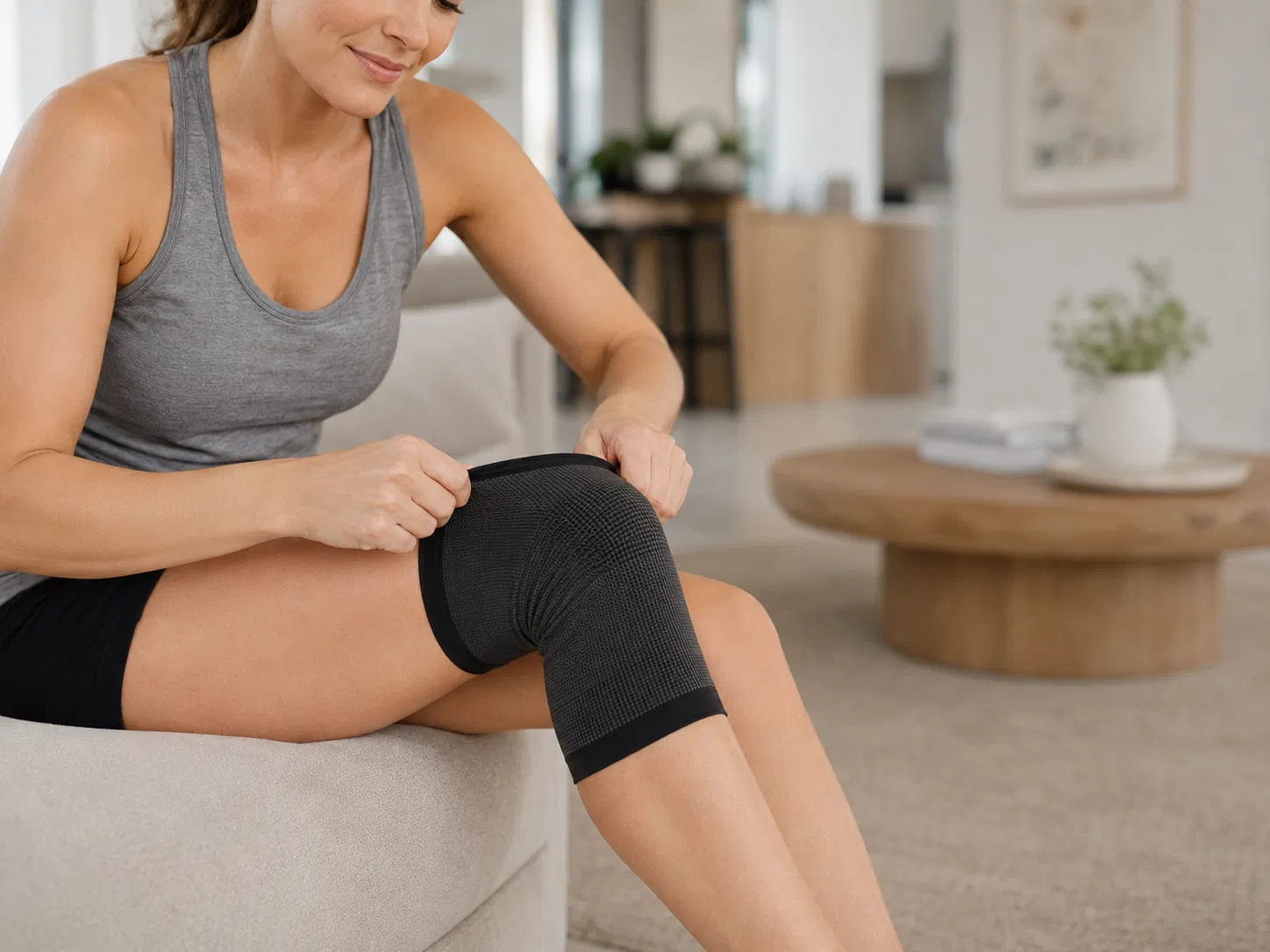
Build the timeline before calling it compensation
The first question is whether the knee hurt during the original accident or became painful later. If the ankle rolled while the foot was planted and the body continued turning, forces may have affected more than the ankle. If the knee was comfortable initially but became sore after several days of altered walking, the recovery pattern deserves attention. Neither timeline establishes a diagnosis by itself.
Try to recall the earliest symptoms without recreating the accident. Was there a fall onto the knee, a twist through the whole leg, or a distinct pop? Did the knee swell? Was pain present near the outside of the upper shin? Did you notice it only when you began walking in a boot? Tell the clinician about all painful areas, even if the ankle seems much worse.
The word sprain is sometimes used before the injury has been fully assessed. A painful swollen ankle can have a fracture or another significant injury, and a knee symptom can be missed when attention stays on the most obvious swelling. Do not use the initial label as proof that everything else is a minor knock-on effect.
| When the knee pain appeared | What deserves attention | What not to assume |
|---|---|---|
| At the same moment as the ankle injury | A shared twist, fall, direct impact, or injury extending up the leg | That the knee only hurts because of later limping |
| Later during restricted walking | Gait, protection, activity amount, and previously unnoticed injury | That changed walking proves the cause |
| After introducing a boot or crutches | Fit, instructions, technique, and allowed weight-bearing | That prescribed protection should be removed without advice |
| During return to sport | Readiness of the ankle, knee, and whole activity | That the calendar alone means the injury has recovered |
Why pain near the upper fibula matters after an ankle twist
The fibula is the slimmer bone on the outside of the lower leg. Its upper end is near the outside of the knee, while its lower end contributes to the ankle. The tibia and fibula are connected by structures along the leg and by the syndesmosis near the ankle. Certain rotational injuries can involve this connection rather than remaining confined to the usual outer ankle ligaments.
One important, less common pattern is a Maisonneuve injury, involving a fracture higher in the fibula together with disruption around the ankle. This is not what happens in most ankle sprains. It is a reason that pain or tenderness near the upper outer shin after an ankle injury should be reported promptly instead of being treated as a tight muscle or routine compensation.
The British Orthopaedic Association recommends additional whole-leg radiographs when examination suggests a proximal fibular fracture. Separate knee or foot imaging may also be indicated. An ankle X-ray does not automatically show the entire fibula, and a normal result at one site does not exclude every injury elsewhere. Do not repeatedly press or squeeze the leg to decide whether you need those images.
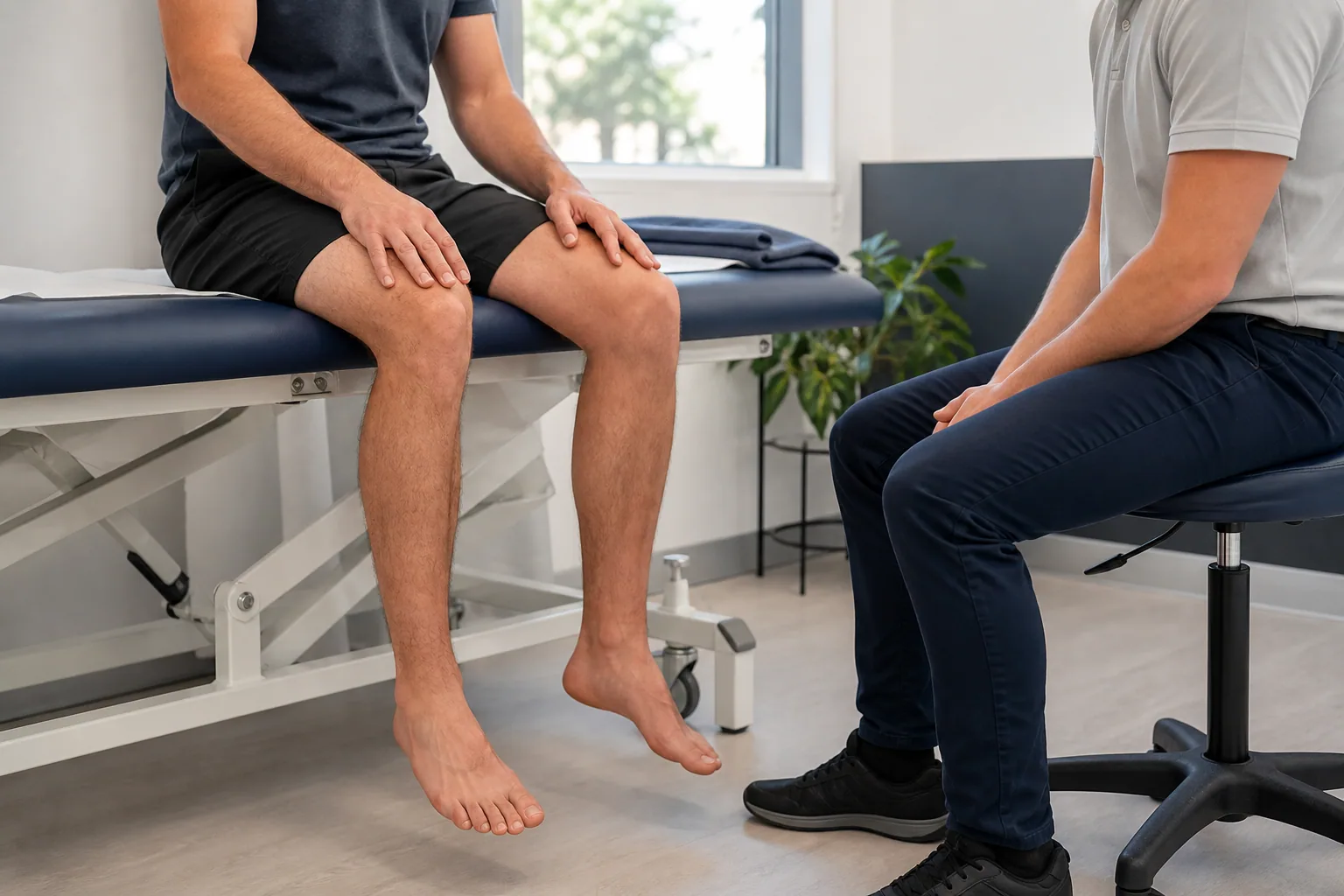
A high ankle sprain is not simply a worse ordinary sprain
The term high ankle sprain refers to injury of the syndesmotic structures connecting the lower-leg bones near the ankle. It is an anatomical description, not just a severity score. The examination and treatment plan can differ from those for an isolated lateral ankle sprain. Some injuries require different protection or specialist management depending on stability and associated damage.
AAOS notes that MRI may be considered when there are signs of a high ankle sprain or concerns about other injured structures. It is not required for every ankle sprain. The decision depends on the history and examination, including the ability to bear weight and the location of tenderness. A clinician should decide which tests are appropriate rather than a reader attempting a squeeze or rotation test.
If pain extends up the leg, the injury involved a substantial twist, or recovery is not following the expected pattern, contact the treating team. The purpose is not to insist on a particular diagnosis. It is to make sure the original assessment has accounted for the full symptom pattern and any change since the first visit.
The knee may have its own injury from the same event
A fall or twisting movement can also affect the knee directly. Knee swelling, a movement block, giving way, or difficulty bearing weight deserves an injury-focused assessment. The ankle being painful does not protect the knee from injury, and a person may only notice the second problem once the initial shock and ankle pain become less distracting.
Describe whether the knee is painful around the kneecap, along a joint line, behind the knee, or near the fibular head. Location helps direct the examination, but it does not identify a ligament, tendon, or meniscus on its own. Our knee injury symptom chart offers a way to organize the history without performing provocative tests.
A newly locked knee is especially important. If the knee remains stuck and cannot straighten as usual, seek urgent assessment rather than trying to release it with stretching or massage. Our locking versus catching guide explains why a persistent movement block is different from an occasional painless click.
Changed walking can contribute, but it is not a complete explanation
After a painful ankle injury, you may shorten the time spent on that foot, take shorter steps, turn the foot differently, or rely more on the other side. A boot or mobility aid can also change how you move. Those changes make it plausible that other joints may feel different during recovery. Plausible does not mean proven for a particular knee.
Research in people with chronic ankle instability has found differences in walking mechanics involving the ankle, knee, and hip. The investigators also acknowledged that those patterns could have developed after injury or existed beforehand. A study of chronic instability cannot be used to diagnose a new knee symptom a few days after an ankle sprain, or to claim that one compensation pattern explains everyone.
The practical question is whether walking is currently appropriate, whether you are using the prescribed support correctly, and whether the amount of activity matches your stage of recovery. Do not deliberately force a symmetrical gait if you have been told not to bear full weight. Protection and safe use of aids take priority over making the walk look normal.
Review boots and crutches with the treating team
If knee pain began after a boot was introduced, report that timing. The team can review fit, permitted walking, how you use the device, and whether an adjustment is needed. A boot is prescribed to protect a particular injury; it should not be abandoned simply because a general article suggests a different shoe would make the legs feel more even.
Similarly, crutches or other mobility aids need appropriate fitting and technique. If you are leaning heavily, hopping excessively, or developing pain elsewhere, ask for a practical review. Explain the stairs, commute, and home layout you have to manage. Advice that works on a short clinic corridor may need adaptation for your actual day.
Do not add a heel lift or substantially alter footwear height on your own to solve presumed imbalance. Such changes can affect stability and the protection plan. New numbness, a cold or discolored foot, pressure-related skin damage, or rapidly increasing pain needs prompt advice rather than a tighter strap or another improvised insert.
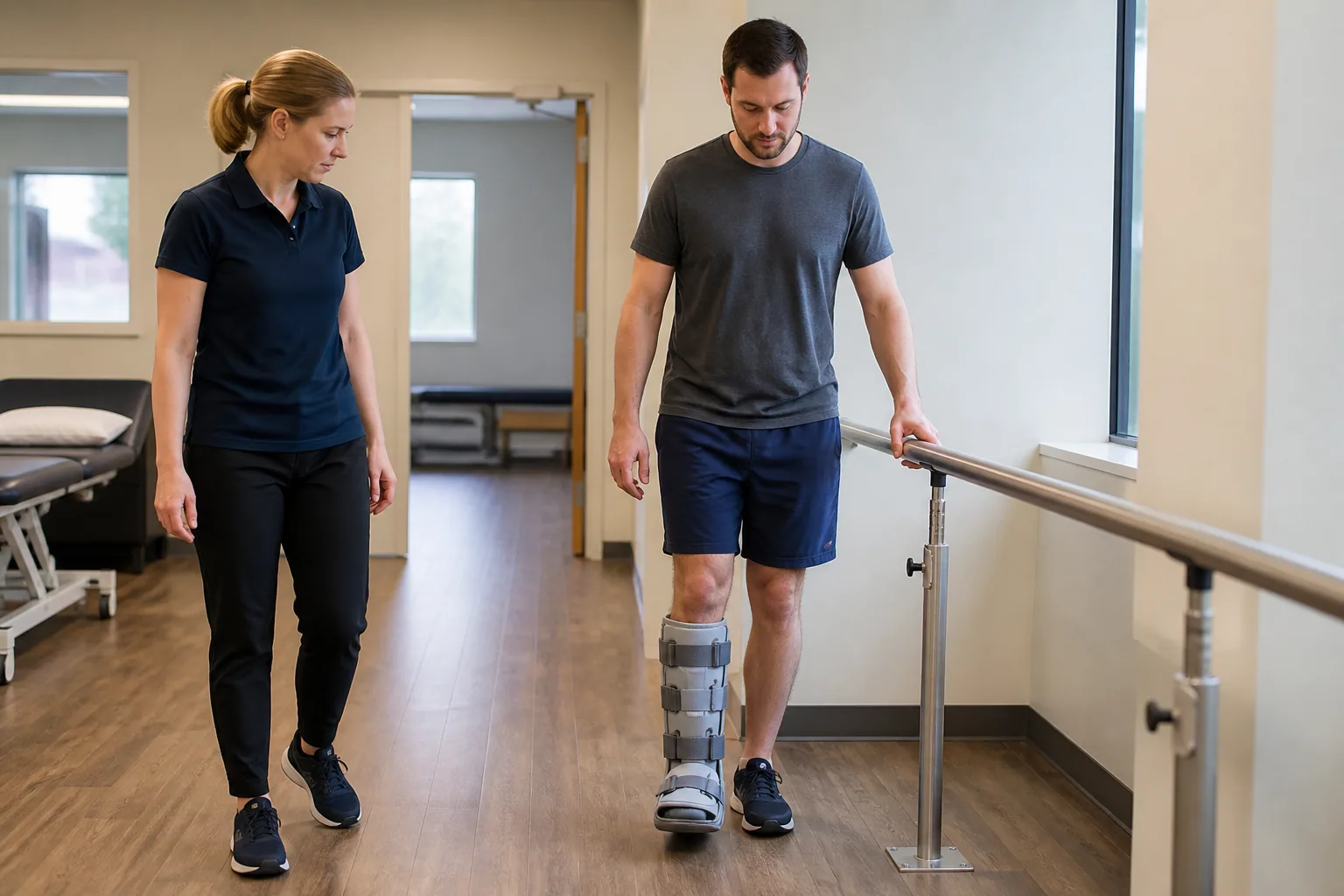
Which observations help without turning into self-testing?
Record ordinary function that you have already experienced within the care instructions: whether transfers are comfortable, how symptoms respond to the allowed walking, and whether swelling or movement has changed. Note where the knee hurts and whether the same or opposite side is affected. A short daily entry is enough to show a trend.
Do not hop, perform deep squats, twist on the injured foot, or aggressively stretch the calf just to see whether the knee tolerates it. Those tasks may be appropriate later in a supervised rehabilitation plan, but they are not screening tools for an uncertain injury. Pain relief from a maneuver does not prove that a fracture or ligament injury is absent.
| Useful observation | How to describe it | Avoid |
|---|---|---|
| Pain timeline | Started at the accident, after several days, or after a device change | Repeatedly reenacting the injury |
| Location | Knee region, upper outer shin, calf, ankle, or foot | Hard pressing or squeezing to identify a structure |
| Movement change | Usual knee straightening available or newly restricted | Forcing through a block |
| Allowed daily activity | Symptoms during the walking already permitted by the team | Hopping or running to prove readiness |
| Support use | Boot fit, crutch use, and practical difficulties | Changing protection or weight-bearing rules alone |
Rehabilitation comes after the injury questions are addressed
Once the relevant injuries have been assessed and a protection plan is clear, rehabilitation may address both ankle and knee function. Lateral ankle sprain guidelines consider factors such as range of motion, strength, balance, and functional movement. For ongoing instability, the assessment can extend to how the knee and hip participate in movement. This is more individualized than adding a generic set of knee exercises.
Early priorities may differ from later ones. A person with a stable improving sprain may be allowed a different amount of movement and loading from someone with a fracture, syndesmotic instability, or associated knee injury. Ask which instructions apply now and which are intended for a later stage. Do not skip protection because an exercise video promises to prevent compensation.
As recovery progresses, the clinician may work on comfortable ankle motion, calf and leg strength, balance, walking, and eventually the demands of work or sport. The exercises should fit both joints. If an ankle drill repeatedly provokes the knee, or a knee exercise strains the protected ankle, the plan needs adjustment rather than more determination.
Measure progress with function as well as pain
A useful recovery plan states what should improve and how it will be checked. That might include walking within the allowed limits, managing stairs safely, tolerating a working day, or later completing sport-specific tasks. Knee symptoms should be included rather than treated as irrelevant because the original referral was for an ankle.
Watch the overall response across sessions. One comfortable attempt is not enough to justify a large increase in activity, particularly if swelling or next-day function worsens. Equally, progress is not always perfectly smooth. Ask the treating clinician which changes are expected and which require review, so you do not have to guess whether to push on or stop everything.
For a later walking-related pattern after injury has been excluded or managed, our guide to knee pain after long walks helps examine distance and terrain. It should supplement an injury-specific plan, not replace restrictions imposed for a healing ankle or lower-leg injury.
Returning to sport needs more than a date
The PAASS consensus framework for lateral ankle sprain return-to-sport decisions considers pain, ankle impairments, the athlete's perception of readiness, sensorimotor control, and sport or functional performance. It is a structured clinical discussion, not a guarantee that passing one home test makes participation safe. Associated knee pain adds another reason to review readiness carefully.
Walking on level ground, jogging, jumping, and changing direction are different demands. A player who can manage a short walk may not be ready for a full training session with cutting and fatigue. The relevant progression depends on the injury and sport. Avoid using a match or long run as the first experiment simply because a certain number of weeks has passed.
Tell the clinician what the activity really involves, including terrain, footwear, session length, and the need to react unexpectedly. Ask whether both ankle and knee function have been considered. If the knee is still swelling, giving way, or restricting movement, do not treat ankle improvement as permission to ignore it.

| Stage to discuss | Question for the treating team | Reason for reassessment |
|---|---|---|
| Injury protection | Which structures are injured and how much weight is allowed? | New pain above the ankle or difficulty following instructions |
| Everyday walking | Is the aid or boot appropriate and used correctly? | Increasing limp, knee pain, swelling, or pressure symptoms |
| Rehabilitation | Does each task fit both ankle and knee restrictions? | A repeated flare or new instability |
| Work or sport | Which functional milestones should be met first? | Persistent symptoms despite the ankle feeling better |
Calf symptoms should not be dismissed as compensation
New one-sided calf swelling or pain, particularly during a period of reduced mobility, needs urgent medical advice because a blood clot is one possible cause. This cannot be reliably ruled out with a calf stretch, massage, or an online test. If leg symptoms are accompanied by chest pain or breathlessness, seek emergency care.
Many calf symptoms have other explanations, but the action is determined by the potential risk rather than a confident home diagnosis. Tell the clinician about immobilization, recent surgery, previous clots, and other relevant risk factors. Do not use a compression or massage product to treat unexplained calf swelling before it has been assessed.
When to get medical help
Seek urgent assessment for a locked knee, inability to bear weight, severe pain, major swelling or deformity, or a cold or numb foot. Report pain near the upper outer shin or fibular head after an ankle twist promptly. New calf swelling needs urgent advice; chest pain or breathlessness needs emergency care. Do not start a generic exercise or massage routine before significant injury is excluded.
Keep the whole injury in view
Knee pain after an ankle sprain deserves a timeline, not an automatic compensation label. Check whether the original event involved the knee or upper fibula, respect the protection plan, and review walking when later symptoms emerge. Once important injuries have been addressed, rehabilitation can build the capacity of the whole leg with clear goals and a safer return to activity.
Frequently Asked Questions
Can an ankle sprain cause knee pain?
An ankle injury and knee pain can be related through the same accident or through changes in walking and activity afterward. They can also be separate problems. The timing, pain location, swelling and ability to use the leg guide the assessment; compensation should not be assumed without checking for injury.
Why does the outside of my knee hurt after rolling my ankle?
The original twist may have affected the knee or upper fibula, among other possibilities. Pain near the fibular head or upper outer shin after an ankle injury should be reported promptly because certain ankle injuries extend through the syndesmosis and involve a higher fibular fracture. Do not treat the area as ordinary muscle compensation without assessment.
What is a Maisonneuve injury?
It is an injury pattern involving a fracture toward the upper fibula together with disruption around the ankle syndesmosis and often the inner ankle structures. It is not the explanation for most ankle sprains, but it is an important reason to assess the whole lower leg when symptoms or the mechanism suggest it.
Can limping make the opposite knee sore?
A change in how you walk or distribute activity may contribute to discomfort in either knee. That is a possibility, not a diagnosis. Persistent pain, swelling or loss of function should be assessed, and any prescribed weight-bearing restrictions must still be followed.
Should I remove my walking boot if it makes my knee hurt?
Do not stop prescribed protection or change weight-bearing instructions on your own. Contact the treating team to review fit, walking technique, permitted activity and whether another adjustment is appropriate. New numbness, circulation changes, severe pain or rapidly increasing swelling needs urgent advice.
Can I start knee exercises after an ankle sprain?
First make sure significant ankle, lower-leg and knee injuries have been assessed and that the exercises fit any restrictions. A generic squat, balance or stretching programme may be unsuitable for an unrecognized injury. Rehabilitation can later address ankle and knee function together when appropriate.
Does a normal ankle X-ray rule out a knee injury?
No. An ankle X-ray covers a limited area and does not assess every bone higher in the leg or all soft tissues. Tell the clinician about knee or upper-fibula symptoms so they can decide whether examination and additional imaging are needed.
When can I return to running after an ankle sprain with knee pain?
Return should depend on the assessed injuries, recovery of function, symptom response and confidence, not just elapsed time. Persistent knee pain means the plan may need review. Running, jumping and cutting should be added only when appropriate, rather than used to test an uncertain injury.
When is knee pain after an ankle sprain urgent?
Seek urgent assessment for inability to bear weight, a locked knee, major swelling, deformity, severe pain or a cold or numb foot. Report upper-fibula pain after a twist promptly. New one-sided calf swelling needs urgent advice, and calf symptoms with chest pain or breathlessness need emergency care.