Why Long Walks Trigger Knee Pain After 40
Walking is one of the most natural and beneficial forms of exercise, but for adults over 40, longer walks can trigger a familiar pattern: your knees feel fine at the start, comfortable through the middle, and then gradually begin to ache, stiffen, or throb during the final stretch or shortly after you stop. This delayed onset of knee pain after long walks is not random. It follows a predictable biomechanical pattern driven by cumulative joint loading.
Every step you take generates a force through your knee joint equal to approximately 1.5 times your body weight during flat walking and up to 3 to 4 times your body weight on stairs or inclines. Over the course of a 5-mile walk, that adds up to millions of pounds of cumulative force passing through the knee. For younger joints with thick cartilage and strong supporting muscles, this loading is well-tolerated. But as we age past 40, several changes make the knee increasingly sensitive to sustained walking loads.
The cartilage cushion between bones gradually thins, reducing shock absorption. The muscles that stabilize and protect the joint lose endurance faster. The synovial fluid that lubricates the joint surfaces becomes less effective under prolonged demands. And the connective tissues around the knee become less elastic, reducing the joint's ability to distribute forces evenly. Understanding these changes helps explain why knees hurt after walking long distances and what you can do about it. For a broader look at age-related knee changes, our guide on knee pain after 40 covers the full picture.
How Walking Biomechanics Change With Age
The way you walk changes subtly but significantly as you age, and these changes directly affect how much stress your knees absorb during longer walks.
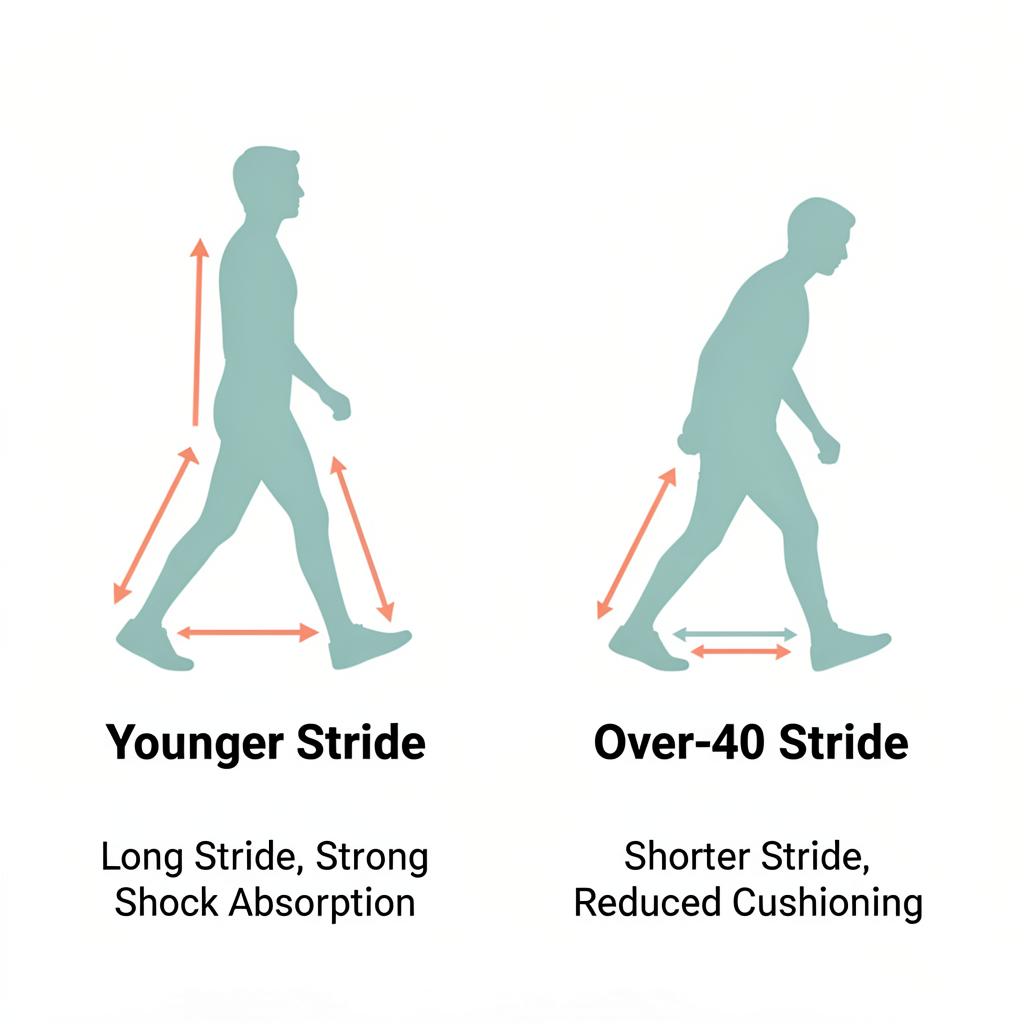
Stride Length Shortens
Research consistently shows that stride length decreases with age, beginning noticeably in the late 40s and early 50s. A shorter stride means more steps are needed to cover the same distance, which increases the total number of loading cycles on the knee joint. While each individual step may involve slightly less force, the cumulative effect of more steps can actually increase total joint loading over a long walk.
Shock Absorption Decreases
Younger walkers naturally absorb impact forces through a coordinated system of muscle engagement, cartilage compression, and fluid dynamics. With age, the muscles respond more slowly, the cartilage is thinner, and the body relies more heavily on passive structures (bones and ligaments) to handle impact. This shift from active to passive shock absorption means more stress reaches the joint surfaces directly.
Hip and Ankle Compensation
When the hip muscles weaken with age (particularly the gluteus medius), the knee absorbs forces that would normally be handled higher in the kinetic chain. Similarly, reduced ankle mobility forces the knee to compensate with altered movement patterns. These compensations are often invisible to the walker but create measurable increases in knee joint loading. For those also experiencing related hip and lower body connection issues, addressing the full chain matters.
Muscle Fatigue, Joint Pressure & Post-Activity Pain
One of the key reasons why knee pain after long walks tends to appear late in the walk or afterward (rather than at the beginning) is the relationship between muscle fatigue and joint protection.
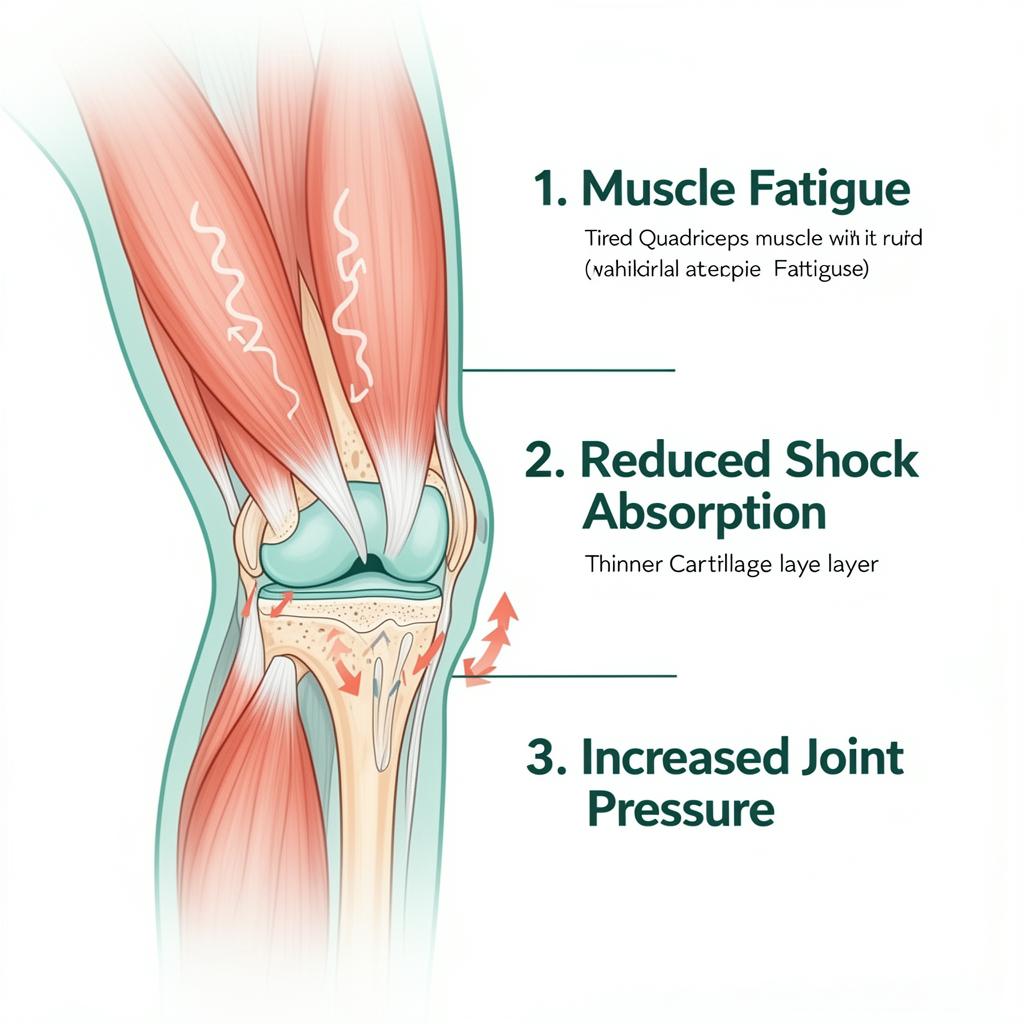
Your quadriceps, hamstrings, and calf muscles act as dynamic shock absorbers during walking. They contract with every step to cushion the impact and stabilize the knee joint. Early in a walk, when these muscles are fresh, they absorb a significant portion of the ground reaction forces, sparing the cartilage and joint surfaces from excessive stress.
As the walk continues, these muscles gradually fatigue. Their ability to contract quickly and powerfully decreases, and more of the impact force is transmitted directly to the cartilage, menisci, and bone surfaces within the knee. This is the point where knee pain after exercise begins to develop, even though the walking itself hasn't gotten harder. The muscles have simply run out of their protective capacity.
The Fatigue-Pain Connection
Phase 1, Fresh Muscles: Quadriceps and hamstrings absorb most walking impact, protecting joint surfaces.
Phase 2, Muscle Fatigue: After sustained walking, muscles lose contractile efficiency and absorb less shock.
Phase 3, Joint Overload: Unabsorbed forces reach cartilage and bone directly, triggering post-walk pain and stiffness.
Inner vs Outer Knee Pain After Long Walks
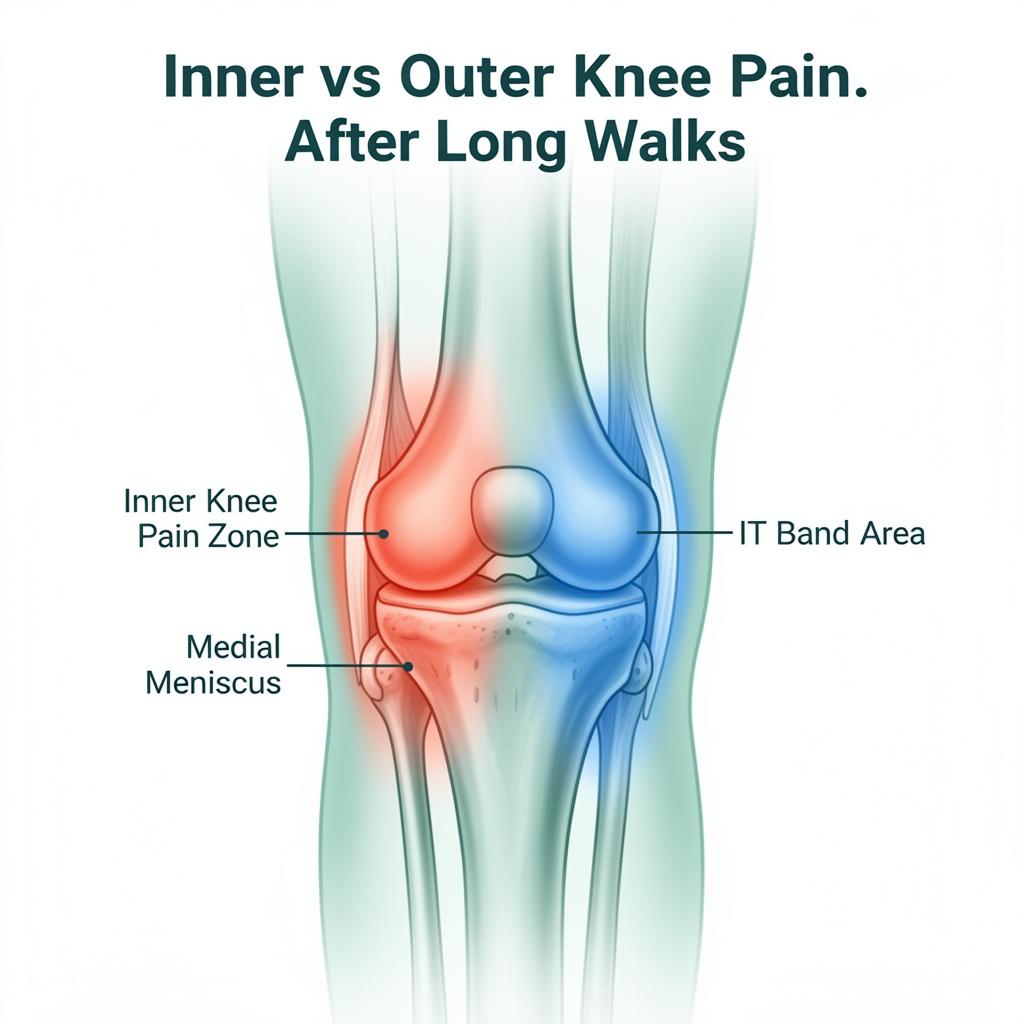
The location of your knee pain after walking provides important clues about which structures are being stressed. Inner and outer knee pain after long walks involve different anatomical structures and often respond to different strategies.
Inner (Medial) Knee Pain
The inner side of the knee bears a significant portion of your body weight during walking, especially if you have a tendency toward knock-knee alignment or foot pronation (inward rolling). Inner knee pain after long walks commonly involves the medial meniscus (the crescent-shaped cartilage cushion on the inner side), the medial collateral ligament, or the cartilage of the medial compartment. This type of discomfort often presents as a deep, dull ache that worsens with continued walking and may feel stiff after you stop. For more on inner knee patterns, see our guide on inner and outer knee pain.
Outer (Lateral) Knee Pain
Outer knee pain after long walks is frequently associated with the iliotibial (IT) band, a thick fibrous band that runs from the hip down the outside of the thigh and attaches just below the outer knee. During walking, the IT band slides over a bony prominence (the lateral femoral condyle) with each stride. Over thousands of repetitions during a long walk, this friction can create irritation and a burning or aching sensation on the outer knee. Our detailed guide on IT band syndrome explains this mechanism in depth.
Footwear, Pace & Ground Incline Effects
Three external factors significantly influence how much stress your knees absorb during walking: what you wear on your feet, how fast you walk, and what kind of surface you walk on.
Footwear Matters More Than You Think
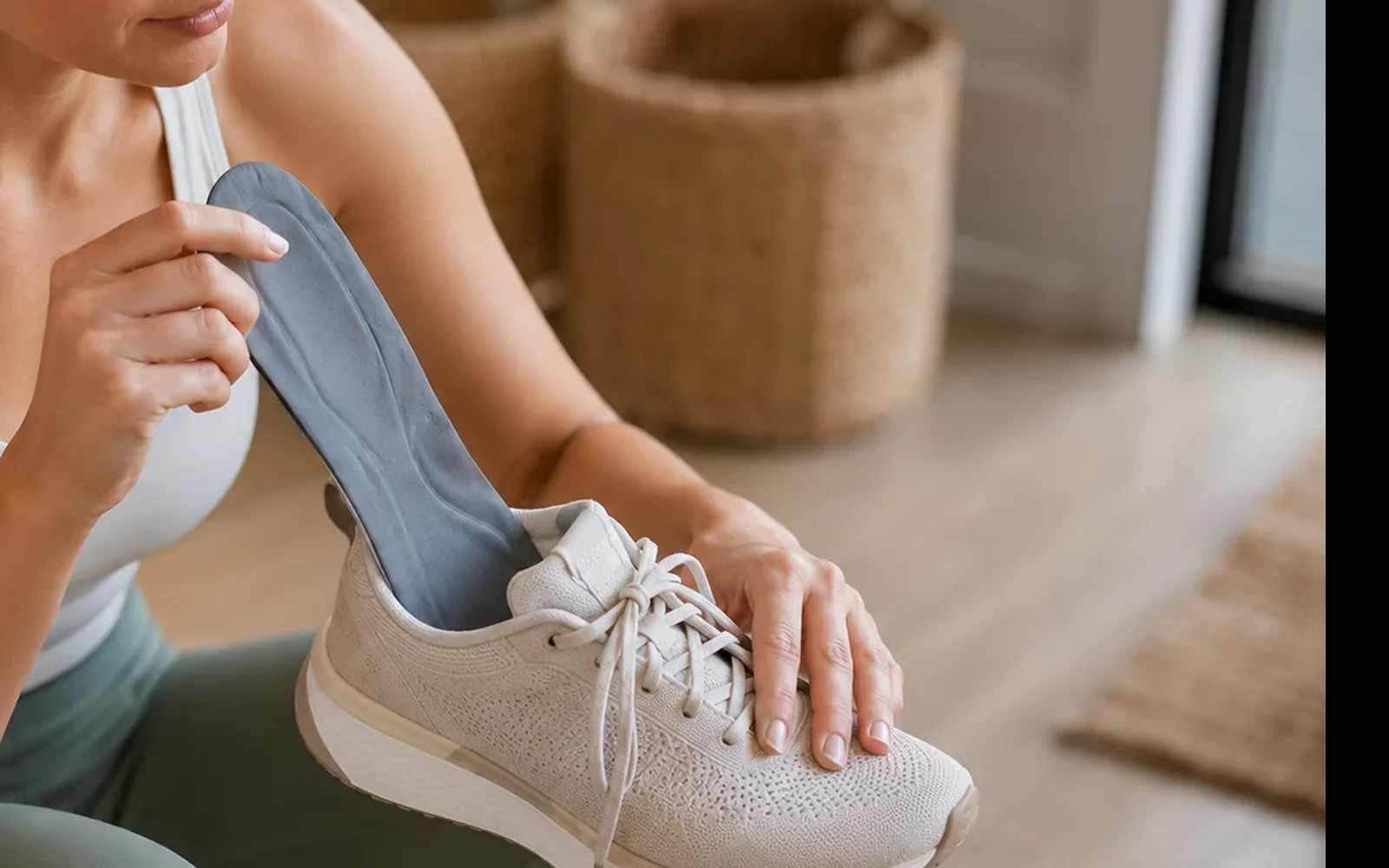
Worn-out shoes with compressed midsoles lose their shock-absorbing capacity, transferring more impact directly to the knees. Flat shoes without arch support can alter foot mechanics, changing how forces travel up the leg to the knee. High heels shift your center of gravity forward, increasing kneecap compression. For walking comfort, choose shoes with adequate cushioning, arch support, and a firm heel counter. Our guide on footwear and knee comfort covers shoe selection in detail.
Pace and Cadence
Walking too fast increases impact forces, while walking too slowly can actually reduce the natural pendulum-like momentum that helps carry the leg forward efficiently. A moderate, comfortable pace with slightly shorter steps tends to be the most knee-friendly approach. Focusing on landing with your foot closer to beneath your body (rather than far out in front) reduces braking forces and knee strain.
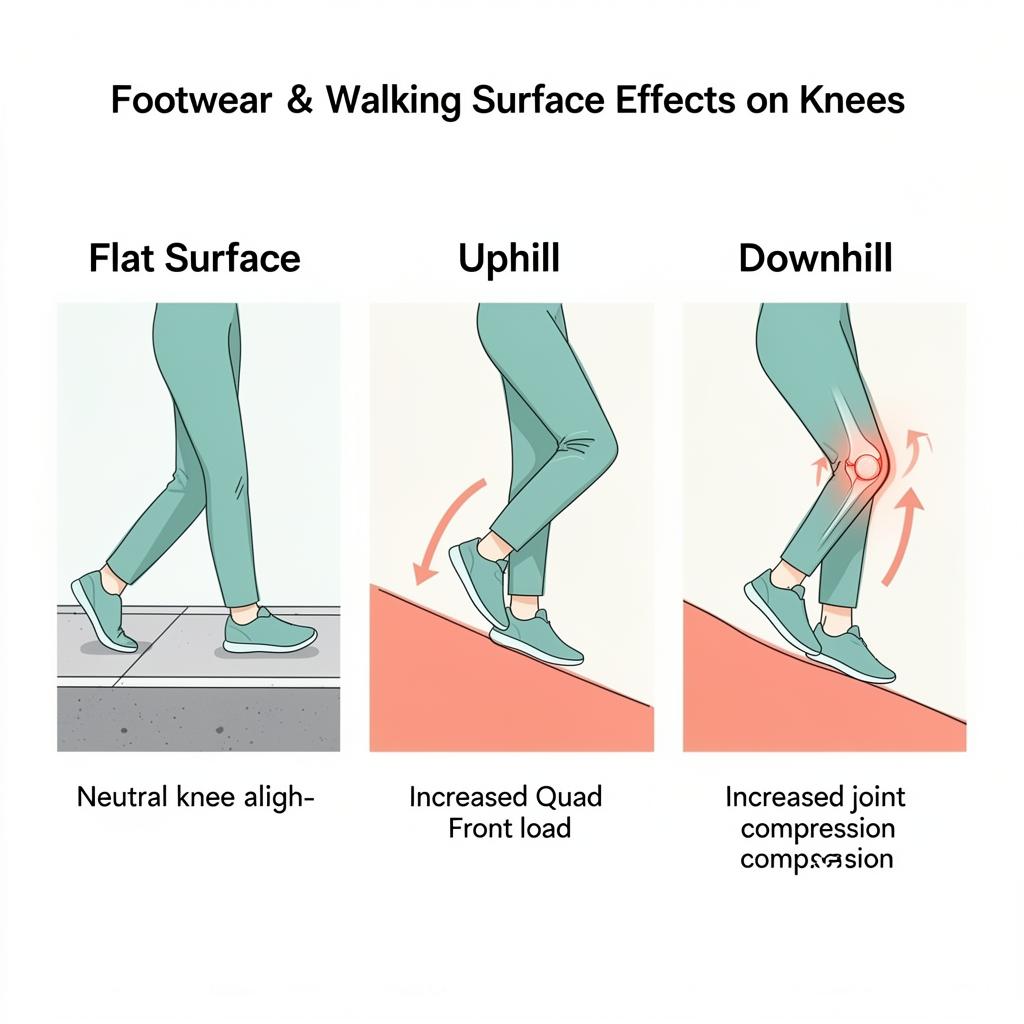
Uphill vs Downhill
Uphill walking increases the workload on the quadriceps and hip muscles but actually reduces impact forces on the knee. Downhill walking, conversely, dramatically increases the compressive forces on the kneecap as the quadriceps work eccentrically (lengthening under load) to control your descent. If hills are unavoidable, take shorter steps on downhill sections and lean slightly forward to reduce kneecap compression.
✓ Quick Tips
- •Replace walking shoes every 300–500 miles or when midsole cushioning feels flat
- •Choose shoes with firm arch support and adequate heel cushioning
- •Use shorter steps on downhill sections to reduce kneecap compression
- •Maintain a moderate pace, not too fast, not too slow
- •Consider walking poles for hilly terrain to distribute load away from knees
How to Walk Without Triggering Knee Pain
The goal is not to avoid walking, walking is one of the best things you can do for your knee health. The goal is to walk smarter so that you can enjoy longer walks without triggering the pain cycle.
Warm Up Before Long Walks
Spend 3 to 5 minutes doing gentle knee bends, leg swings, and ankle circles before setting off on a long walk. This primes the synovial fluid in the joint, activates the supporting muscles, and prepares the cartilage for loading. Starting a long walk with cold, stiff joints is one of the most common triggers for walking-related knee discomfort.
Build Distance Gradually
If you currently walk 2 miles comfortably, don't jump to 5 miles. Increase your walking distance by no more than 10 to 15 percent per week. This gives your cartilage, muscles, and connective tissues time to adapt to increased demands. Sudden increases in distance are a leading cause of overuse knee pain after 40. For more on building knee strength progressively, see our knee strengthening guide.
Take Strategic Breaks
During walks longer than 30 minutes, brief pauses to stretch the quadriceps and calves can reset muscle fatigue and maintain joint lubrication. Even a 30-second standing quad stretch at the halfway point can extend your comfortable walking distance.
Mind Your Walking Form
Keep your posture upright with your eyes forward, not looking down. Land with your foot beneath your body rather than reaching far forward. Take slightly shorter, quicker steps rather than long, loping strides. Engage your core muscles to stabilize your pelvis, which reduces compensatory stress on the knees.
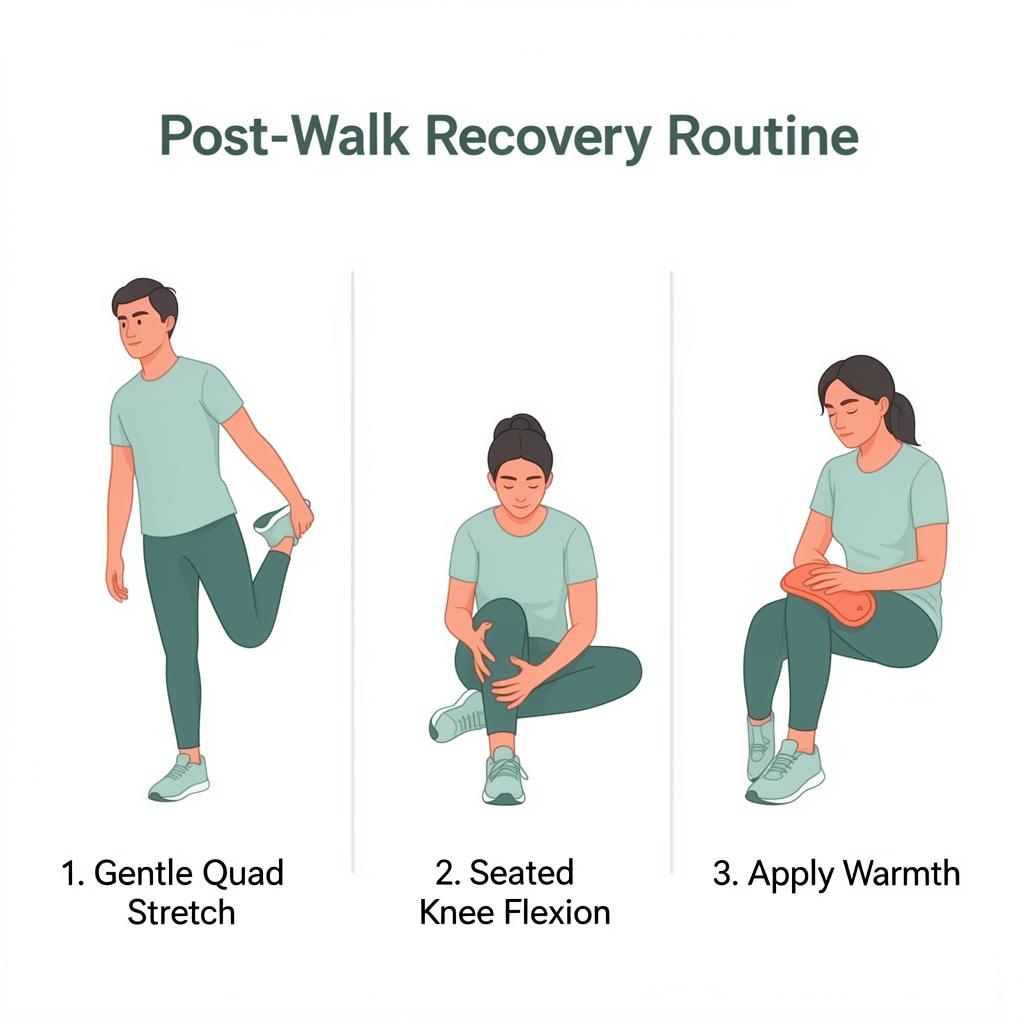
Post-Walk Recovery Routine
What you do in the 30 minutes after a long walk matters as much as the walk itself. A simple post-walk recovery routine can dramatically reduce next-day stiffness and help your knees adapt to walking over time.
Step 1: Gentle Quad Stretch (2 Minutes)
Standing or lying on your side, gently pull your foot toward your buttock until you feel a comfortable stretch in the front of your thigh. Hold for 30 seconds on each side, twice. This releases tension in the quadriceps tendon that attaches to the kneecap and reduces post-walk front knee tightness. Our guide on front knee tightness after activity covers additional stretches.
Step 2: Hamstring and Calf Stretch (2 Minutes)
Place your heel on a low step or curb and gently lean forward with a straight back until you feel a stretch behind the knee and along the calf. Hold for 30 seconds on each side. This addresses the posterior chain tightness that often accompanies post-walk knee stiffness.
Step 3: Apply Warmth (10 Minutes)
After stretching, apply warmth to your knees for 10 minutes using a warm cloth, heating pad, or therapy device. Warmth increases blood flow to the area, promotes muscle relaxation, and helps the synovial fluid maintain its lubricating properties. Our guide on daily knee warmth explains when and how warmth helps most.
Step 4: Gentle Movement (5 Minutes)
After resting with warmth, perform 10 to 15 slow, gentle knee bends (partial squats or sitting-to-standing movements) to circulate fresh synovial fluid through the joint. This prevents the stiffening that occurs when you sit still immediately after a long walk.
Your Post-Walk Recovery Checklist
✓ Gentle quad stretch, 30 seconds each side, twice
✓ Hamstring and calf stretch, 30 seconds each side
✓ Apply warmth, 10 minutes with a warm cloth or therapy device
✓ Gentle knee bends, 10–15 slow partial squats to circulate synovial fluid
✓ Hydrate, drink water to support joint fluid replenishment
When to Modify Your Walking Routine
Walking should enhance your quality of life, not diminish it. While mild post-walk stiffness is normal and manageable, certain patterns suggest you may need to adjust your approach:
- Knee pain begins earlier in your walk with each passing week
- Post-walk stiffness consistently lasts more than 2 hours
- You notice visible swelling after walks
- Your knee feels warm or hot to the touch after walking
- Pain prevents you from walking comfortably the following day
- You experience sharp or catching sensations during walking
If any of these apply, consider shortening your walking distance, switching to softer surfaces like grass or trails, adding more rest days between long walks, and consulting a healthcare provider if symptoms persist. For more on understanding different types of knee discomfort, see our guide on what causes knee pain.
Summary: Walk Longer, Walk Smarter
✓ Warm up for 3–5 minutes before long walks
✓ Build distance gradually, no more than 10–15% per week
✓ Wear supportive shoes with adequate cushioning
✓ Use shorter steps on downhill sections
✓ Take strategic stretch breaks during walks over 30 minutes
✓ Complete your post-walk recovery routine: stretch, warmth, gentle movement
✓ Listen to your knees, adjust distance when needed
If you notice clicking or popping sounds during or after long walks, this is usually related to normal joint mechanics and is not a cause for concern unless accompanied by pain. After particularly long walks, using an infrared knee massager can help support recovery
Golf combines course walking with repeated swings and uneven lies. The golf knee pain guide helps distinguish walking fatigue from lead-knee or trail-knee symptoms during the swing.
Frequently Asked Questions
Why do my knees hurt after long walks but not during short ones?
Short walks don't generate enough cumulative load to exhaust your knee's support systems. During longer walks, the quadriceps and hamstrings gradually fatigue, reducing their ability to absorb shock. As muscle support decreases, more force transfers directly to the cartilage and joint surfaces. For adults over 40 with naturally thinner cartilage, this tipping point arrives sooner, which is why pain tends to appear after a certain distance threshold.
Is knee pain after walking normal after age 40?
Mild knee stiffness or aching after long walks is very common after 40 and does not necessarily indicate a serious problem. As cartilage thins and muscles lose some endurance with age, the knee becomes more sensitive to sustained loading. If the discomfort resolves within an hour of rest and gentle movement, it is generally considered a normal response to activity. Persistent or worsening pain warrants professional evaluation.
Why does the inner side of my knee hurt after long walks?
Inner (medial) knee pain after walking often involves the medial meniscus or the medial compartment cartilage, which bears a significant portion of your body weight during each step. Over time, the repetitive loading of walking can cause micro-irritation in this area. Foot pronation (rolling inward) and knock-knee alignment can increase medial loading, making inner knee pain more common in certain walking patterns.
Why does the outer side of my knee hurt after long walks?
Outer (lateral) knee pain after walking is frequently associated with the iliotibial (IT) band, a thick band of tissue that runs from the hip to the outer knee. During walking, the IT band slides over the bony prominence at the outer knee with each step. Over thousands of repetitions during a long walk, this can create friction and irritation. Bowlegged alignment and hip muscle weakness can increase outer knee loading.
Does walking form affect knee pain?
Yes, walking form significantly influences knee comfort. Overstriding (taking steps that are too long) increases impact forces on the knee. Landing heavily on your heels sends shock waves through the joint. Walking with your feet too close together or too far apart alters the load distribution across the knee. Improving your walking form with shorter, lighter steps and an upright posture can meaningfully reduce post-walk knee discomfort.
How long should post-walk knee stiffness last?
Post-walk knee stiffness should generally resolve within 30 to 60 minutes of rest combined with gentle movement. If your knees take more than 2 hours to feel comfortable after a walk, or if the stiffness is accompanied by visible swelling, warmth, or difficulty bearing weight, it may indicate that the walk exceeded your current joint capacity. Shortening your walking distance and building up gradually is a sensible approach.
Should I continue walking if my knees hurt mildly afterward?
Mild post-walk knee discomfort that resolves within an hour is generally not a reason to stop walking. Walking is one of the best activities for maintaining knee joint health, and some adaptation discomfort is normal when increasing distance or intensity. The key is to avoid pushing through sharp or worsening pain, to build distance gradually, and to incorporate post-walk recovery habits like stretching and warmth application.
What daily habits help reduce knee pain from walking?
Effective daily habits include wearing supportive footwear with adequate cushioning, performing a brief warm-up before walks, building walking distance gradually rather than in large jumps, stretching the quadriceps, hamstrings, and calves after every walk, maintaining a healthy weight to reduce joint loading, and applying warmth to stiff knees after longer walks. Consistency with these habits matters more than perfection.