How This Guide Differs From General Night Knee Pain
The main guide to why knees hurt when sleeping covers night pain at any age, sleep positions, side sleeping, pain behind the knee, throbbing, and broad comfort questions. This page has a narrower job: it looks at the patterns that become especially relevant in midlife and later life.
| Use this guide when | Primary focus | Best next page |
|---|---|---|
| Night knee pain can happen at any age | General causes, positions, throbbing, and sleep comfort | General night knee pain guide |
| Symptoms became relevant after 40 or around menopause | Osteoarthritis, menopause, age-related risk, and morning stiffness | Continue with this focused guide |
Four Patterns to Compare After 40
More than one pattern can be present. The purpose of comparing them is to improve the description you bring to a healthcare professional, not to diagnose the knee from one symptom.
| Pattern | Useful clues | What not to assume |
|---|---|---|
| Osteoarthritis-type pattern | Activity-related pain, stiffness after rest, reduced motion, crepitus, swelling, symptoms worse near the end of the day | Night pain alone does not confirm osteoarthritis |
| Perimenopause or menopause context | Joint or muscle aches with cycle changes, hot flushes, night sweats, or symptoms in more than one area | A new one-sided knee problem should not automatically be blamed on hormones |
| Daily-load or previous-injury pattern | Symptoms follow stairs, walking, kneeling, exercise, a new routine, or an older injury | Age does not make every load response permanent damage |
| Position and pressure pattern | Pain changes when the knees touch, the top leg rotates, or the knee stays deeply bent or fully straight | A pillow response does not identify the underlying cause |
Knee Osteoarthritis and Night Pain After 40
Osteoarthritis becomes more common with age, but imaging changes and symptoms do not always match. A clinical pattern is more useful. NICE guidance describes a typical osteoarthritis presentation in adults 45 or older as activity-related joint pain with either no morning stiffness or stiffness lasting no longer than 30 minutes. These clues support an evaluation; they are not a self-diagnosis.
Earlier osteoarthritis symptoms may be most noticeable with walking, stairs, or at the end of the day. More established symptoms can also occur during rest or wake someone at night. Record swelling, loss of motion, instability, and how the knee responds to movement. A clinician may not need imaging when the clinical pattern is typical, but atypical features can change that decision.

For a wider discussion of age and activity, use the guide to why knee pain may change with age. For a direct comparison of arthritis patterns, see knee osteoarthritis versus rheumatoid arthritis.
Perimenopause, Menopause, and Knee Pain at Night
NHS guidance lists muscle aches and joint pains among the possible symptoms of perimenopause and menopause. Sleep can also be disrupted by hot flushes or night sweats, which can make any existing knee discomfort harder to tolerate. The connection is relevant, but it does not mean every knee symptom is caused by menopause.
A menopause-related context is more plausible when knee discomfort appears within a broader change that may include symptoms in several joints, altered periods, hot flushes, sleep disruption, or other recognized menopause symptoms. A new swollen knee, one-sided mechanical symptoms, an injury, locking, or instability still needs its own knee assessment.
Menopause Context Is Not a Knee Diagnosis
Bring both timelines to an appointment: when menopause or perimenopause symptoms changed and when the knee pattern changed. That helps avoid dismissing a knee problem as age-related while still considering the wider symptom picture.
Read the focused menopause and knee pain guide for a broader discussion of midlife joint symptoms.
Night Pain by Location and Daily Trigger
Location is useful for organizing the story, but no location has only one cause. Pair the exact area with the activity that preceded the episode and the symptoms that appeared with it.

- Front of the knee: record stairs, squats, kneeling, prolonged sitting, and pressure from stomach sleeping.
- Inner or outer knee: record side-sleeping pressure, twisting, joint-line tenderness, locking, or giving way.
- Back of the knee: record fullness, a new lump, loss of extension, and any calf pain or swelling.
- Both knees: record morning stiffness, other painful joints, activity changes, and menopause or systemic symptoms.
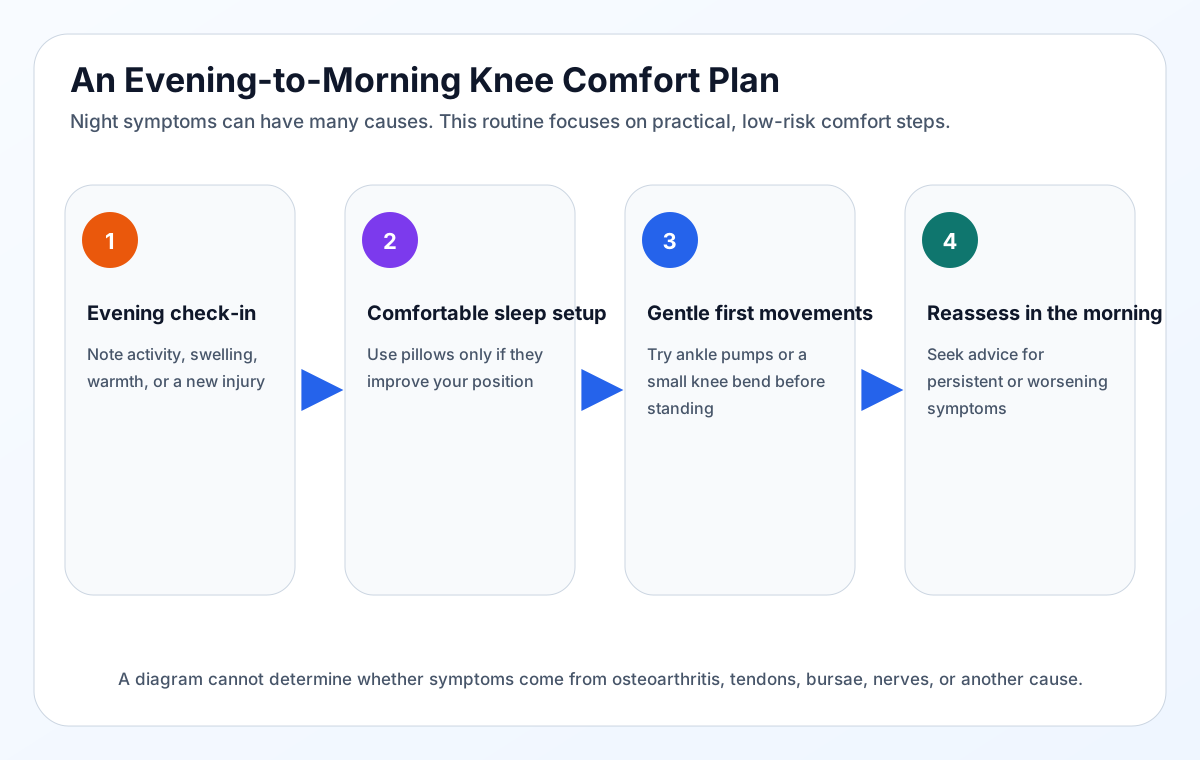
What to Track From Evening to Morning
A seven-day log is often more useful than trying to remember the worst night. Use the same short fields each day:
| Time | Record | Why it helps |
|---|---|---|
| Evening | Walking, stairs, exercise, kneeling, swelling, warmth | Shows whether daily load is linked to the episode |
| During the night | Position, exact location, pain quality, night waking | Separates pressure-sensitive and position-sensitive clues |
| Morning | Minutes of stiffness, swelling, first-step response | Adds a useful osteoarthritis or inflammatory clue |
| Wider context | Other joints, hot flushes, cycle changes, fatigue, fever | Shows whether the knee is part of a broader pattern |
Sleep Positions: Keep This Section Focused
Position changes may reduce pressure, but they do not treat osteoarthritis or menopause-related symptoms. Try one adjustment at a time so you can tell whether it actually changes the night pattern.
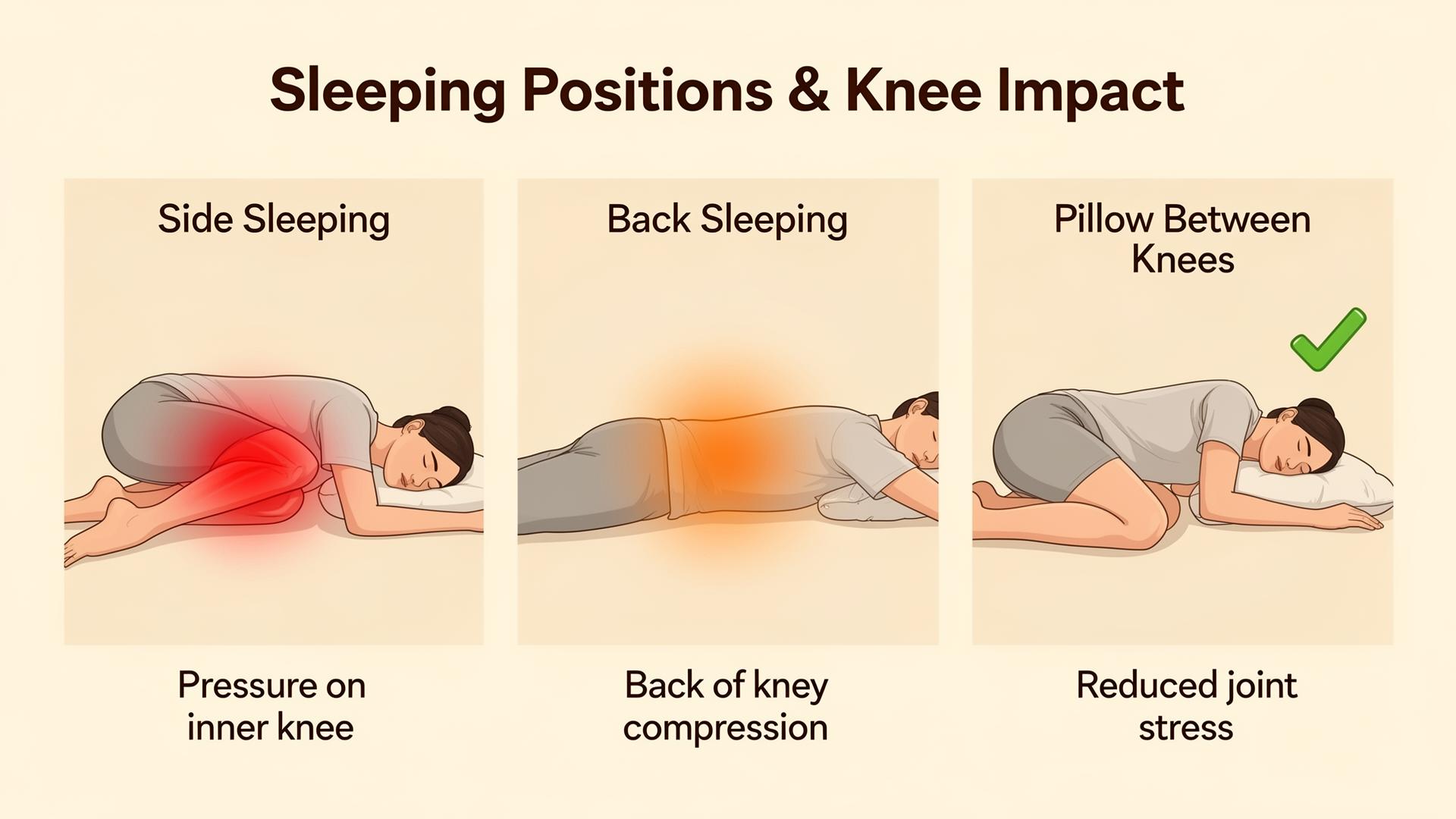
Our guide to sleeping with knee pain compares pillow placement and everyday sleep setups in more detail.
✓ Quick Tips
- •Place a pillow between the knees when side sleeping if knee-to-knee pressure is uncomfortable
- •Try light support under the knees when back sleeping if full extension feels uncomfortable
- •Avoid a very thick pillow that forces the knee into a deep bend
- •Change one part of the sleep setup at a time and record the result
- •Do not force a position when the knee is locked, very swollen, or acutely injured
An Evening Routine That Does Not Hide Warning Signs
The goal of an evening routine is comfort and observation. It should not delay assessment of persistent sleep disruption, progressive symptoms, or warning signs.
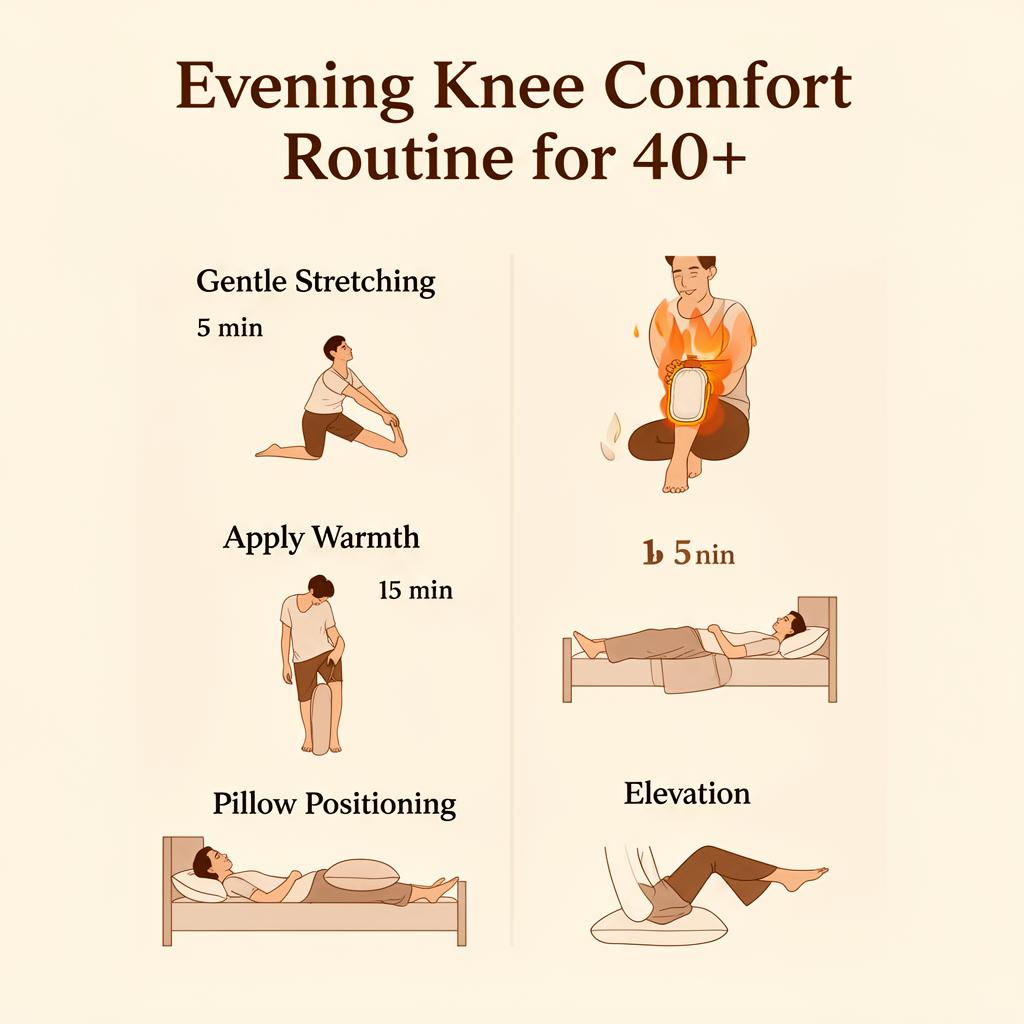
- Check before treating: look for new swelling, redness, unusual heat, deformity, locking, or loss of weight-bearing ability.
- Use gentle movement: a few comfortable bends and straightens may help a stiff knee, but do not push through sharp pain or a blocked motion.
- Choose temperature carefully: gentle warmth may feel comfortable for stiffness when the knee is not newly injured, swollen, hot, or red.
- Prepare the sleep setup: position a pillow before settling so the knee is not left twisted or pressed against the other knee.
- Protect sleep: discuss repeated night waking with a healthcare professional rather than endlessly changing pillows or routines.
When to Get Medical Help
How the Pattern Is Evaluated
A knee assessment usually starts with the history and physical examination. Useful details include exact location, onset, night waking, daily triggers, trauma, swelling, warmth, morning stiffness, mechanical symptoms, other painful joints, systemic symptoms, menopause context, and previous knee problems.
Imaging is not automatic for every adult over 40. Typical osteoarthritis can often be assessed clinically, while atypical symptoms, trauma, persistent loss of function, mechanical symptoms, or concern about another condition may change the investigation.
Frequently Asked Questions
Why can knee pain at night become more noticeable after 40?
Age changes the likelihood of osteoarthritis, previous-injury effects, tendon or bursa irritation, and reduced muscle capacity, but age alone does not identify the cause. Daily load, sleep position, swelling, morning stiffness, menopause symptoms, and loss of function help define the pattern.
Can knee osteoarthritis cause pain that wakes me at night?
Osteoarthritis often causes activity-related pain and short-lived stiffness after rest. More established symptoms can also occur at rest or interrupt sleep. Night waking does not confirm osteoarthritis, so persistent symptoms should be assessed in the context of function, swelling, examination findings, and other possible causes.
Can perimenopause or menopause affect knee and joint pain?
Muscle aches and joint pains are recognized symptoms during perimenopause and menopause. A wider pattern involving several joints, sleep disruption, hot flushes, or cycle changes may be relevant. New one-sided swelling, locking, instability, or a hot red knee should not be attributed to menopause without assessment.
Does morning stiffness mean I have knee osteoarthritis?
No. Morning stiffness can occur for several reasons. Osteoarthritis commonly causes stiffness after rest that eases within about 30 minutes, but this pattern is not a diagnosis by itself. Longer or worsening stiffness, swelling, or symptoms in several joints deserves medical discussion.
Why do my knees hurt at night but feel better after I move?
A prolonged position may make a sensitive knee feel stiff, and gentle movement can sometimes make it feel easier. This can occur with osteoarthritis and other patterns. Record how long the stiffness lasts and whether there is swelling, warmth, locking, or reduced motion.
What sleep position may help knee pain after 40?
There is no single best position. Side sleepers can try a pillow between the knees, while back sleepers can try light support under the knees. The useful setup is the one that reduces pressure without forcing the knee into a painful bend or twist.
Is warmth safe for knee pain at night after 40?
Gentle warmth may feel comfortable for a stiff knee when there is no new injury, swelling, unusual heat, or redness. Do not use heat on a newly injured, hot, red, or acutely swollen knee, and stop if symptoms increase. Warmth does not treat the underlying cause.
When does knee pain at night need urgent assessment?
Seek urgent guidance for a very painful knee, inability to move it or bear weight, major swelling or deformity, true locking, repeated giving way, or a hot red swollen knee with fever or feeling unwell. Concerning calf swelling, breathing symptoms, new marked weakness, or a cold discolored foot also require prompt help.