Why Knee Mobility Naturally Decreases After 50
Knee mobility is the ability of your knee joint to move smoothly and comfortably through its full range of motion, from full extension (straight leg) to full flexion (bent as far as it can go). For most of our lives, we take this mobility for granted. But after age 50, a combination of biological changes begins to gradually reduce how easily and how far the knee can move.
Understanding why this happens is the first step toward doing something about it. The decline in knee mobility after 50 is not caused by a single factor. It is the result of several age-related changes happening simultaneously inside and around the joint.
The good news is that unlike some age-related changes, knee mobility responds remarkably well to consistent daily attention. People who maintain a regular movement practice often retain significantly more mobility than those who become sedentary. For a broader look at age-related knee changes, our guide on why knee discomfort changes with age provides additional context.
How Joint Fluid, Cartilage & Tendons Change After Mid-Life
Three key structures within and around your knee undergo significant changes after age 50, and each contributes to the stiffness and reduced range of motion that many people experience.
Synovial Fluid: Your Joint's Natural Lubricant
Synovial fluid is the clear, viscous liquid that fills the knee joint space. It serves two critical functions: lubricating the cartilage surfaces so they glide smoothly, and delivering nutrients to the cartilage (which has no blood supply of its own). After 50, the cells that produce synovial fluid (synoviocytes) become less active. The fluid they produce may also change in composition, becoming slightly less effective as a lubricant. This means the joint takes longer to "warm up" after periods of inactivity, which is why morning stiffness tends to become more pronounced with age.
Cartilage: Your Shock Absorber
Articular cartilage is the smooth, slippery tissue that covers the ends of the bones in your knee. Throughout your life, this cartilage gradually thins and loses water content. After 50, the rate of cartilage breakdown begins to exceed the body's ability to repair it. Thinner cartilage means less cushioning, more friction between bone surfaces, and reduced smoothness during movement. This does not mean your cartilage is disappearing, but it is becoming less robust at its job. Understanding how knee changes progress after 40 helps put this timeline in perspective.
Several Factors Can Affect Mobility After 50
Mobility can be influenced by osteoarthritis, previous injury, muscle capacity, balance, activity level, sleep, and other health conditions. Age changes risk patterns, but it does not mean every adult has the same cartilage, fluid, or tendon changes.

Age Is Context, Not a Diagnosis
Use symptoms, function, history, and professional assessment to understand a mobility change. New swelling, locking, instability, or a rapid loss of motion deserves medical advice.
Early Warning Signs of Mobility Loss
Knee mobility loss rarely happens overnight. It develops gradually over months and years, which is why many people don't notice it until significant range has been lost. Recognizing the early warning signs allows you to take action before mobility loss becomes difficult to reverse.
Signs to Watch For
- Longer warm-up times: If your knees take more than 15 minutes to feel comfortable after waking or resting, mobility is declining
- Reduced bending range: Difficulty sitting back on your heels, squatting down, or bending your knee past 90 degrees
- Activity avoidance: Finding yourself avoiding stairs, kneeling, gardening, or getting on and off the floor
- Grinding or catching: Feeling a rough, grinding sensation (crepitus) or catching when moving the knee through its range
- Inability to straighten fully: Not being able to lock your knee completely straight, even when sitting with your leg extended
- Increased reliance on support: Needing handrails, armrests, or assistance to stand up, sit down, or navigate stairs
If you notice any of these patterns, it is a signal to prioritize daily mobility work. The earlier you start, the more effective your efforts will be. For those also experiencing knee cracking or popping, these sounds often accompany early mobility changes.
Daily Mobility Routine: Step-by-Step, Age-Friendly
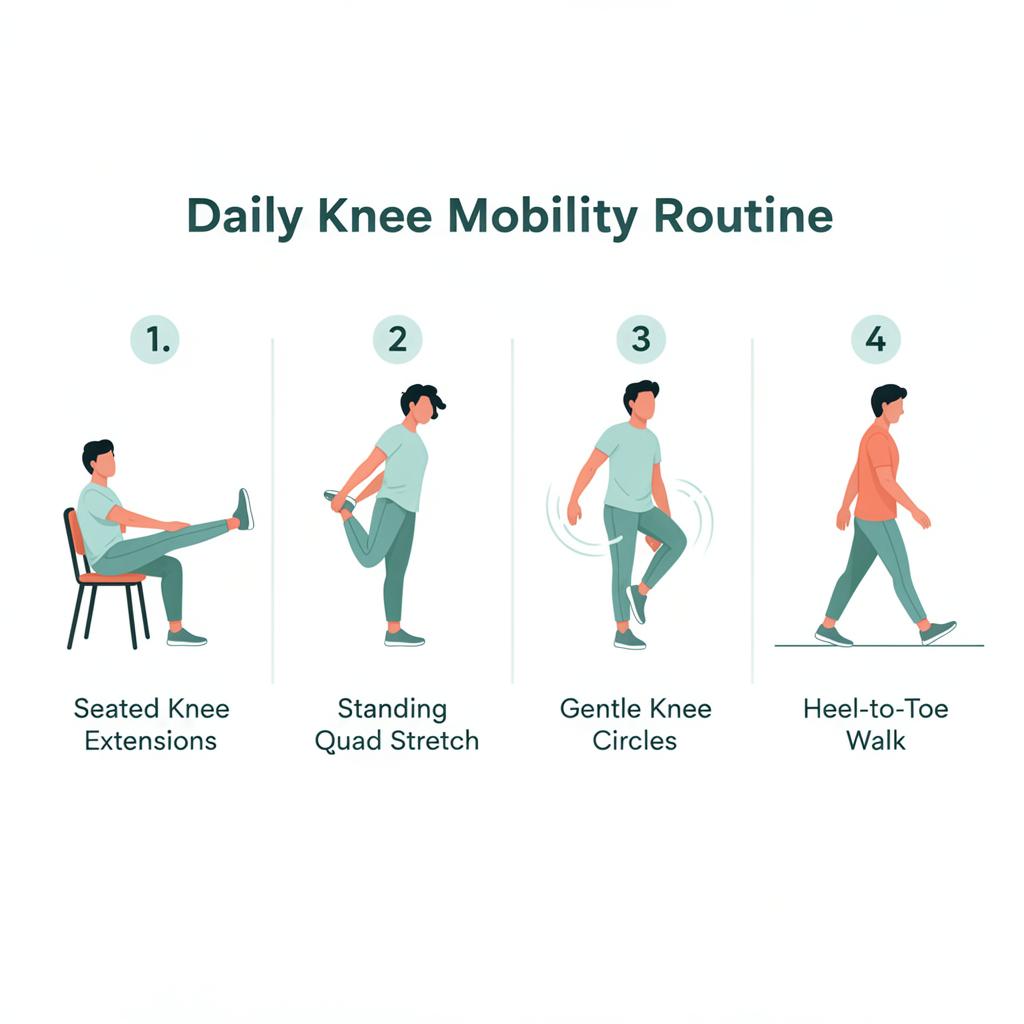
The foundation of maintaining knee mobility after 50 is a simple, consistent daily routine. This routine takes approximately 10 to 15 minutes and can be done at home with no equipment. The key is consistency: doing these movements every day matters far more than doing an intense session once a week.
Step 1: Seated Knee Extensions (2 Minutes)
Sit in a sturdy chair with your feet flat on the floor. Slowly straighten one leg until the knee is fully extended, hold for 3 seconds, then slowly lower it back down. Repeat 10 times on each side. This movement pumps fresh synovial fluid through the joint and gently activates the quadriceps. It is the perfect warm-up before any other mobility work.
Step 2: Standing Quad Stretch (2 Minutes)
Stand near a wall or chair for balance. Bend one knee and gently pull your foot toward your buttock until you feel a comfortable stretch in the front of your thigh. Hold for 20 to 30 seconds, then switch sides. If reaching your foot is difficult, loop a towel around your ankle to assist. This stretch addresses the quadriceps and the quadriceps tendon, both of which stiffen with age. For more exercise options, see our knee exercises guide.
Step 3: Gentle Knee Circles (2 Minutes)
Stand with your feet together and your hands on your knees. Bend your knees slightly and make slow, gentle circular motions, as if drawing small circles with your kneecaps. Do 10 circles in each direction. This movement lubricates the joint surfaces and gently stretches the connective tissues in all directions.
Step 4: Heel-to-Toe Walk (2 Minutes)
Walk slowly in a straight line, placing the heel of one foot directly in front of the toes of the other foot with each step. This movement challenges your balance (which relies on knee stability), engages the small stabilizing muscles around the knee, and moves the joint through a natural walking range of motion.
Step 5: Gentle Cool-Down Walk (2 Minutes)
Finish with 2 minutes of easy, comfortable walking around your home. This integrates the mobility gains from the previous exercises into a natural movement pattern and ensures your joints feel comfortable before moving on to your day.
Gentle Stretching Sequence for Knee Flexibility
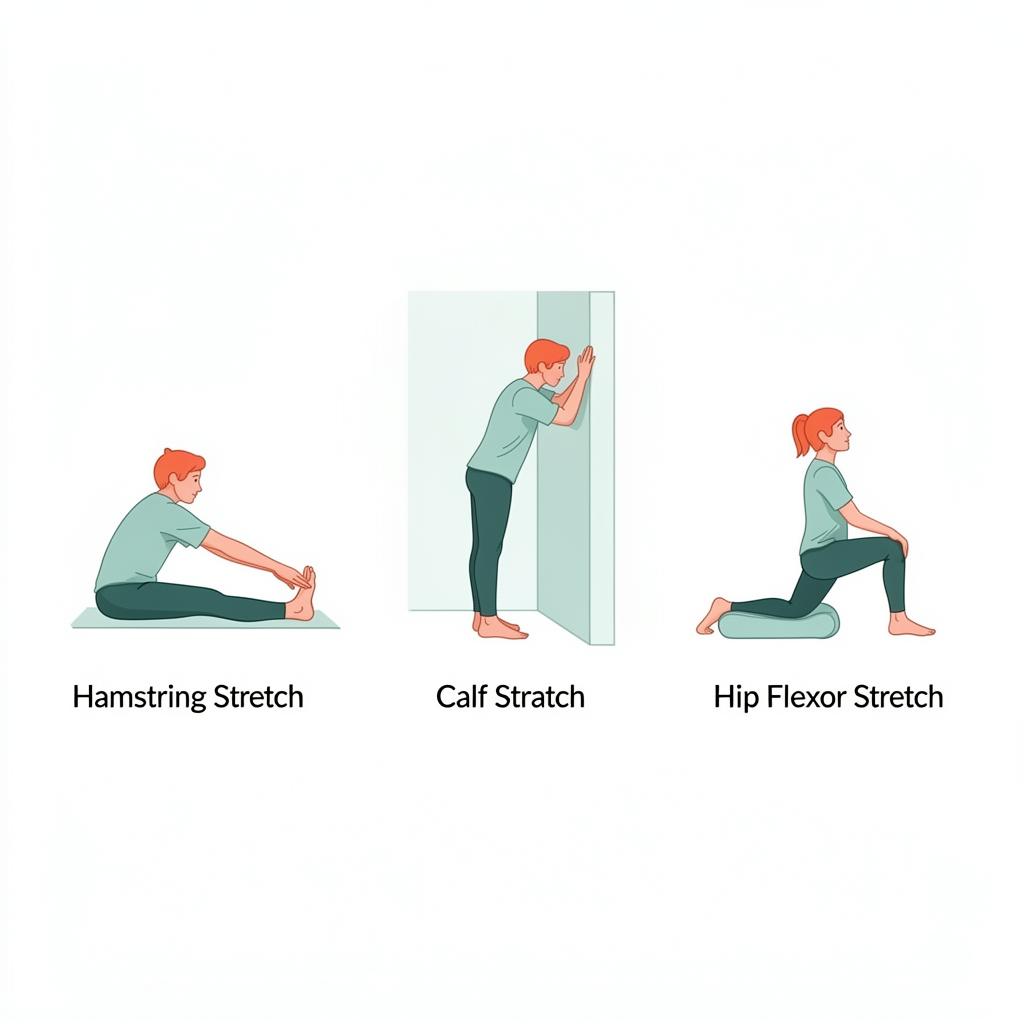
Stretching the muscles around the knee is essential for maintaining flexibility. Tight muscles pull on the joint, restrict its range of motion, and increase the compressive forces on the cartilage. This gentle stretching sequence targets the four key muscle groups that influence knee mobility.
Hamstring Stretch
Sit on the floor (or on the edge of a bed) with one leg extended straight in front of you and the other bent with the foot resting against your inner thigh. Keeping your back straight, gently lean forward from the hips until you feel a comfortable stretch behind the extended knee and along the back of the thigh. Hold for 20 to 30 seconds, then switch sides. The hamstrings directly influence how far the knee can straighten, so keeping them flexible is critical for maintaining extension range.
Calf Stretch
Stand facing a wall with your hands flat against it at shoulder height. Step one foot back about two feet, keeping it flat on the floor with the knee straight. Lean gently toward the wall until you feel a stretch in the calf of the back leg. Hold for 20 to 30 seconds, then switch. Tight calves restrict ankle mobility, which forces the knee to compensate during walking and bending.
Hip Flexor Stretch
Kneel on a cushion with one knee on the floor and the other foot flat in front of you in a lunge position. Gently shift your weight forward until you feel a stretch in the front of the hip on the kneeling side. Hold for 20 to 30 seconds, then switch. Tight hip flexors alter your walking gait and increase the load on your knees. For those with related hip concerns, our guide on the knee, hip, and lower body connection explores these relationships.
IT Band and Outer Thigh Stretch
Stand next to a wall for support. Cross your outside leg behind the inside leg and gently lean your hips toward the wall until you feel a stretch along the outer thigh and hip. Hold for 20 to 30 seconds, then switch sides. A tight IT band contributes to outer knee stiffness and can restrict lateral knee flexibility.
✓ Quick Tips
- •Never stretch into pain. Stop at a gentle, comfortable pulling sensation
- •Hold each stretch for 20 to 30 seconds. Bouncing reduces effectiveness
- •Warm up before stretching with a brief walk or seated knee extensions
- •Stretch after activity, when muscles are warm and more receptive
- •Breathe slowly and deeply during each stretch to promote relaxation
Strengthening Essentials for Adults 50 to 75
Flexibility without strength leaves the knee vulnerable. The muscles around your knee, particularly the quadriceps, hamstrings, and glutes, act as dynamic stabilizers and shock absorbers. Keeping them strong is one of the most effective ways to protect joint mobility and reduce age-related stiffness.
Wall Sits (30 to 60 Seconds)
Stand with your back against a wall and slide down until your knees are bent at approximately 45 degrees (not a full 90-degree bend). Hold this position for 30 to 60 seconds, then stand up slowly. This isometric exercise strengthens the quadriceps without requiring the knee to move through a range that might be uncomfortable. For a complete strengthening program, see our knee strengthening guide.
Mini Squats (10 Repetitions)
Stand with your feet shoulder-width apart, hands on a counter or chair back for support. Slowly bend your knees to about 30 to 45 degrees (a quarter to half squat), pause briefly, then return to standing. Keep your weight in your heels and your knees tracking over your toes. This builds functional strength for the sitting-to-standing movements you perform dozens of times each day.
Standing Leg Raises (10 Each Direction)
Hold onto a chair for balance. Raise one leg forward (front raise), to the side (lateral raise), and behind you (back raise), holding each position for 2 seconds. Do 10 repetitions in each direction on each leg. This strengthens the hip muscles that stabilize the knee during walking and standing.
Seated Straight Leg Raises (10 Each Side)
Sit in a chair with your back supported. Straighten one leg fully, lift it 6 to 8 inches off the floor, hold for 5 seconds, then slowly lower. Repeat 10 times on each side. This targets the quadriceps, the primary muscle responsible for knee extension strength.
Low-Impact Exercises for Long-Term Mobility
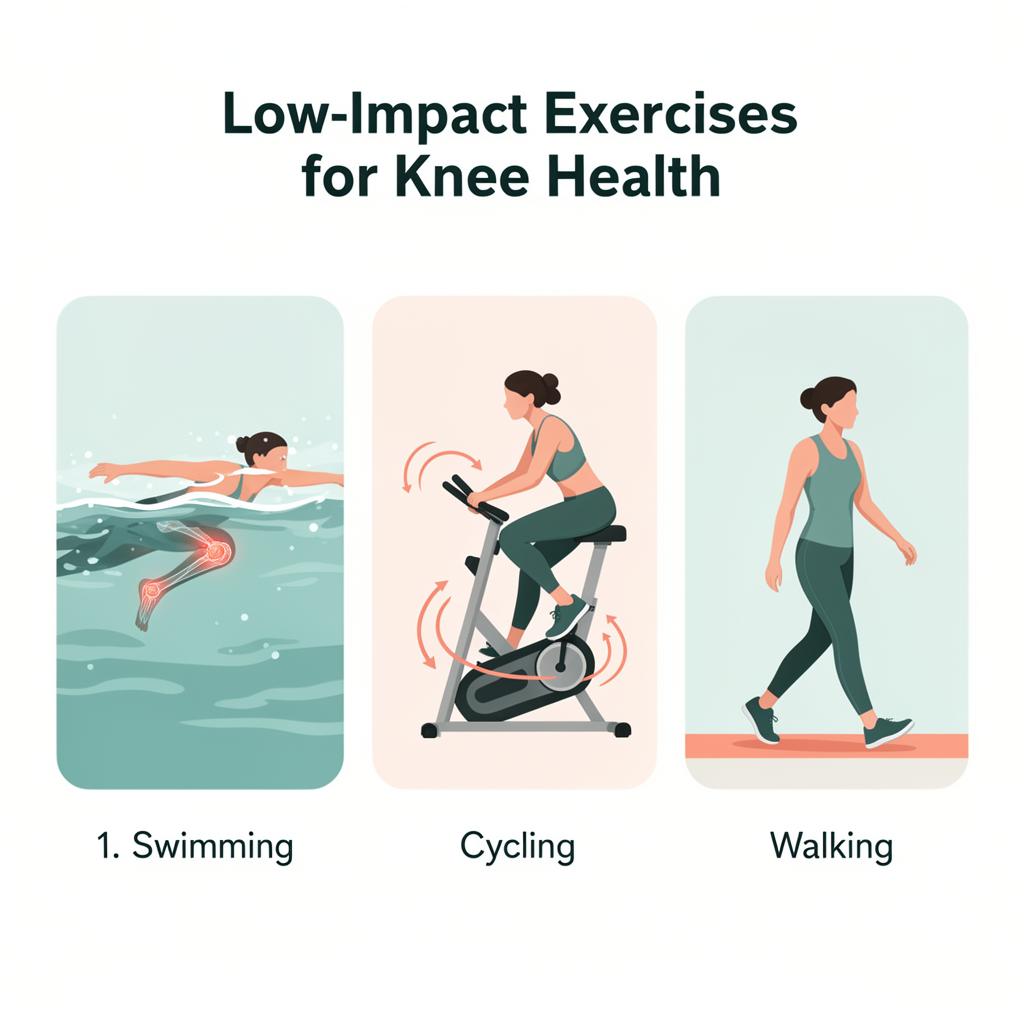
Beyond your daily mobility routine and stretching sequence, incorporating regular low-impact exercise into your week helps maintain knee mobility over the long term. These activities keep the joint moving through its range, build endurance in the supporting muscles, and stimulate ongoing synovial fluid production.
Swimming and Water Exercise
Water buoyancy reduces the weight on your knee joint by up to 90%, allowing you to move through a full range of motion with minimal stress. Swimming, water walking, and aqua aerobics are excellent choices for people with stiff or uncomfortable knees. The resistance of water also provides gentle strengthening benefits.
Stationary Cycling
Cycling moves the knee through a smooth, controlled range of motion with very low impact. Start with the seat high enough that your knee has only a slight bend at the bottom of the pedal stroke. Begin with 10 to 15 minutes at low resistance and gradually increase as comfort allows. This is one of the best exercises for maintaining knee flexion range.
Walking on Flat Surfaces
Regular walking on flat, even surfaces is one of the simplest and most effective ways to maintain knee mobility. Aim for 20 to 30 minutes of comfortable walking most days. If longer walks cause discomfort, start shorter and build gradually. For those who experience knee discomfort after longer walks, our dedicated guide covers how to walk more comfortably.
Chair Yoga and Tai Chi
Both chair yoga and tai chi offer guided, controlled movements that improve flexibility, balance, and body awareness. These practices are particularly valuable for adults over 60 who want a structured, social activity that supports knee health. The slow, deliberate movements are gentle on the joints while effectively improving range of motion.
Building Your Weekly Mobility Schedule
Putting it all together, here is a practical weekly framework that balances mobility, stretching, strengthening, and low-impact exercise:
Your Weekly Knee Mobility Schedule
Every Day: 10-minute daily mobility routine (seated extensions, knee circles, stretches, heel-to-toe walk)
3 Days Per Week: Strengthening exercises (wall sits, mini squats, leg raises) for 10 to 15 minutes
4 to 5 Days Per Week: Low-impact exercise (walking, swimming, cycling, or yoga) for 20 to 30 minutes
Every Evening: Gentle stretching sequence (hamstrings, calves, hip flexors, IT band) for 5 minutes
This schedule is flexible. The most important element is the daily mobility routine, which should happen every day regardless of what else you do. The strengthening and low-impact exercise can be adjusted based on how your knees feel each week. For those also managing discomfort when getting up after sitting, the daily mobility routine addresses many of the same underlying causes.
When to Seek Professional Guidance
While most age-related knee stiffness responds well to consistent daily movement, certain situations warrant professional evaluation:
- Knee mobility continues to decline despite 4 to 6 weeks of consistent daily exercise
- You experience sharp pain (not just stiffness) during gentle range-of-motion movements
- Visible swelling, warmth, or redness accompanies the stiffness
- Your knee locks, catches, or gives way during normal activities
- Mobility loss is significantly greater in one knee compared to the other
- You have difficulty performing basic daily activities like dressing, bathing, or getting in and out of a car
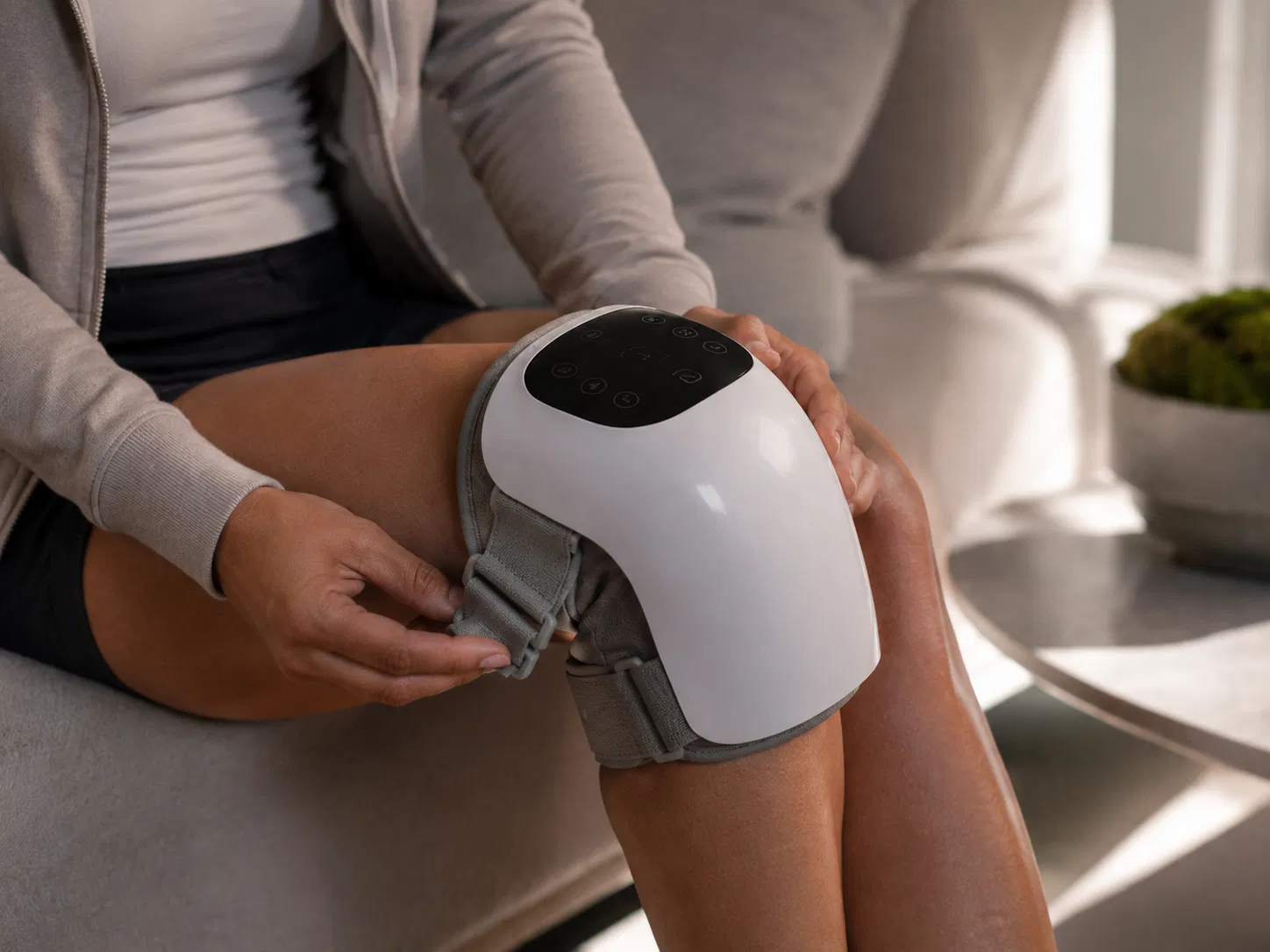
A healthcare provider or physical therapist can assess your specific situation and create a targeted program. For a broader understanding of knee discomfort factors, see our guide on what causes knee discomfort. If you notice knee clicking when walking alongside reduced mobility, this is often related to the same cartilage and fluid changes rather than a separate concern. An infrared knee massager can complement your mobility routine by providing deeper warmth before exercise sessions.
Summary: Your Knee Mobility Action Plan
1. Start each day with 10 minutes of gentle mobility work
2. Stretch the four key muscle groups daily: quads, hamstrings, calves, hip flexors
3. Add light strengthening exercises 3 times per week
4. Choose one low-impact activity you enjoy and do it 4 to 5 times per week
5. Apply warmth to stiff knees before exercise to improve comfort
6. Listen to your body: adjust intensity based on how your knees respond
7. Be patient and consistent: meaningful improvements take 4 to 8 weeks
Frequently Asked Questions
How can I maintain knee mobility after 50?
The most effective approach is a consistent daily routine that combines three elements: gentle mobility movements (like seated knee extensions and knee circles) to maintain range of motion, stretching (hamstrings, quadriceps, calves, hip flexors) to preserve flexibility, and light strengthening exercises (wall sits, mini squats, leg raises) to support the joint. Even 10 to 15 minutes per day can make a meaningful difference when done consistently.
What are simple mobility exercises for stiff knees?
Start with seated knee extensions: straighten your leg fully, hold for 3 seconds, then slowly lower. Repeat 10 times each side. Next, try gentle knee circles: stand with a slight knee bend and make small circular motions with your knees. Finally, heel slides: sitting in a chair, slide your foot forward and back along the floor to move the knee through its comfortable range. These require no equipment and can be done anywhere.
What is a good daily routine for keeping knees flexible?
A practical daily routine takes about 10 to 15 minutes: start with 2 minutes of seated knee extensions to warm up the joint fluid, followed by 3 minutes of gentle stretching (quad stretch, hamstring stretch, calf stretch), then 5 minutes of light strengthening (wall sits, mini squats, standing leg raises). Finish with 2 minutes of gentle walking or heel-to-toe walking to integrate the movements. Morning is ideal, but any consistent time works.
How can I reduce morning knee stiffness after 50?
Morning stiffness happens because synovial fluid settles and muscles cool during sleep. Before getting out of bed, do 10 gentle knee pumps (straighten and bend) while lying down. Then sit on the edge of the bed and do 10 ankle circles each direction. Stand up slowly using your hands for support. Walk around gently for 2 to 3 minutes before attempting stairs. Applying warmth to stiff knees for 5 minutes can also help.
How does aging affect knee mobility?
After 50, several changes contribute to reduced knee mobility. Cartilage gradually thins, reducing the smooth gliding surface between bones. Synovial fluid production decreases, making the joint feel stiffer after inactivity. Tendons and ligaments become less elastic, reducing their ability to stretch. Muscles lose mass and strength (sarcopenia), providing less dynamic support. These changes are natural and gradual, but they can be significantly slowed with consistent daily movement.
Can knee mobility actually improve after age 50?
Yes, absolutely. While you cannot reverse cartilage changes, you can meaningfully improve the functional mobility of your knee through consistent movement. Regular exercise stimulates synovial fluid production, improves muscle strength and endurance, increases tendon and ligament flexibility, and enhances the nervous system's ability to coordinate smooth joint movement. Many people in their 50s, 60s, and even 70s report significant mobility improvements within 4 to 8 weeks of starting a daily routine.
What are the best low-impact exercises for knee mobility?
The top low-impact choices for knee mobility include swimming and water exercises (buoyancy reduces joint loading by up to 90%), stationary cycling (smooth, controlled range of motion with minimal impact), walking on flat surfaces (natural joint movement with manageable loading), chair yoga (guided stretching with seated support), and tai chi (slow, controlled movements that improve balance and flexibility). Start with whichever feels most comfortable and enjoyable.
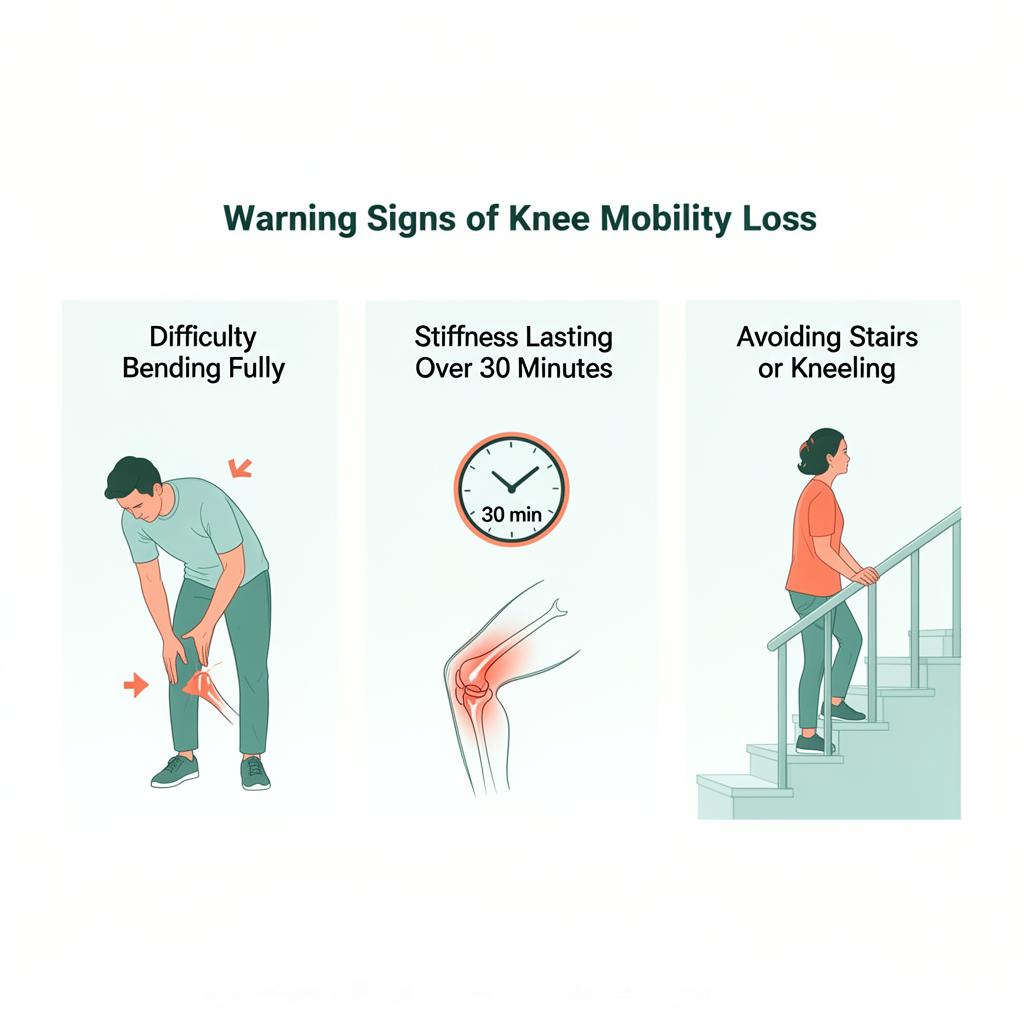
What are warning signs that knee mobility is declining?
Pay attention if you notice: difficulty bending your knee fully (for example, sitting back on your heels becomes impossible), stiffness that lasts longer than 30 minutes after waking or resting, needing to avoid activities you once did comfortably (stairs, kneeling, gardening), a grinding or catching sensation during movement, gradual loss of the ability to straighten your knee fully, or increasing reliance on handrails and armrests. These signs suggest it is time to prioritize daily mobility work.