“How many minutes?” is the first question most people ask about red light therapy, and it is the question product pages are most willing to answer. Unfortunately, minutes are only one piece of the dose. Asking for time without knowing output is like asking how long it takes to fill a glass without knowing how fast the tap runs. A weak light used for twenty minutes and a stronger light used for five minutes may deliver similar energy-or they may not, because beam shape, distance, contact, and coverage also change what reaches the skin.
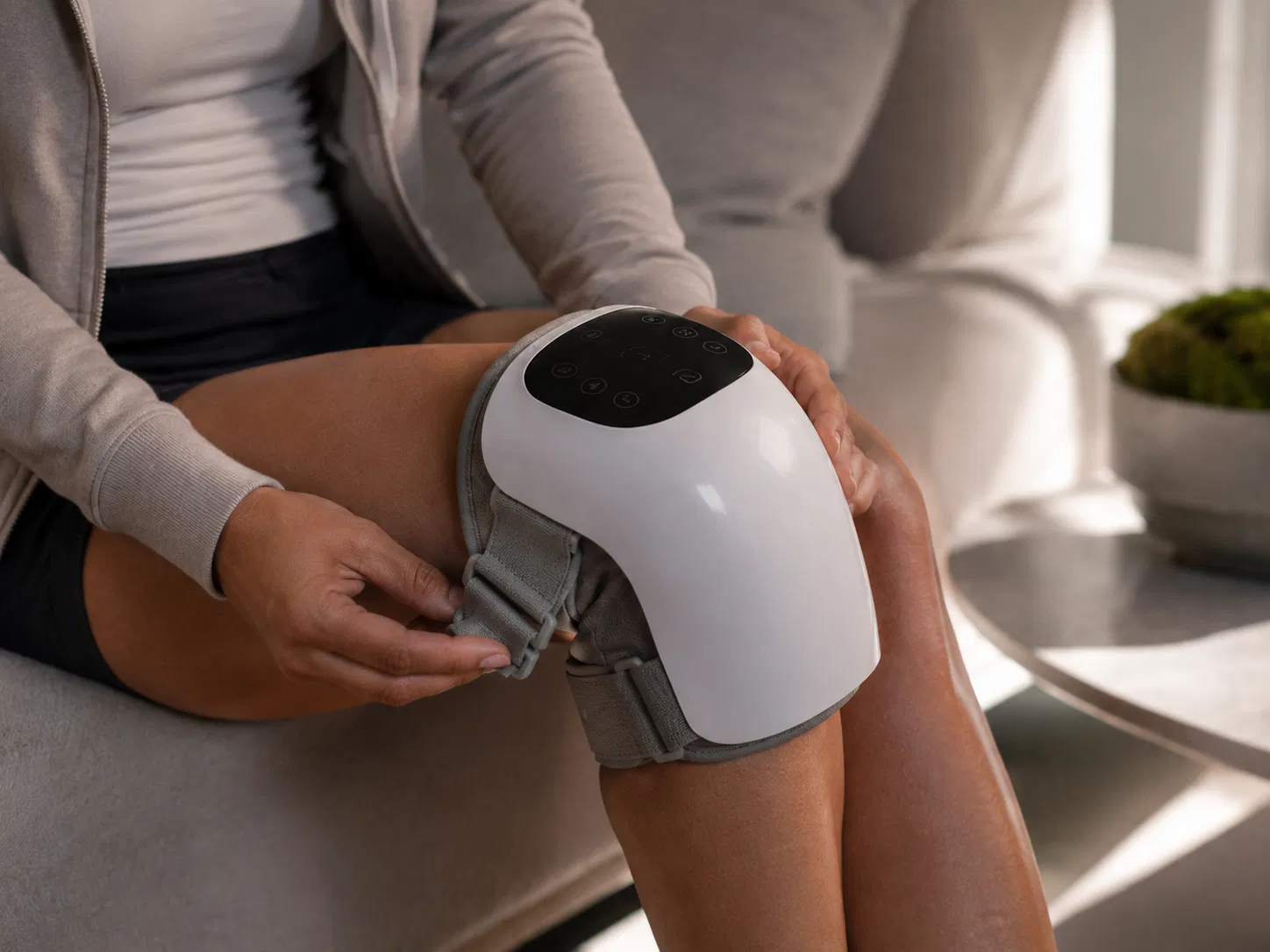
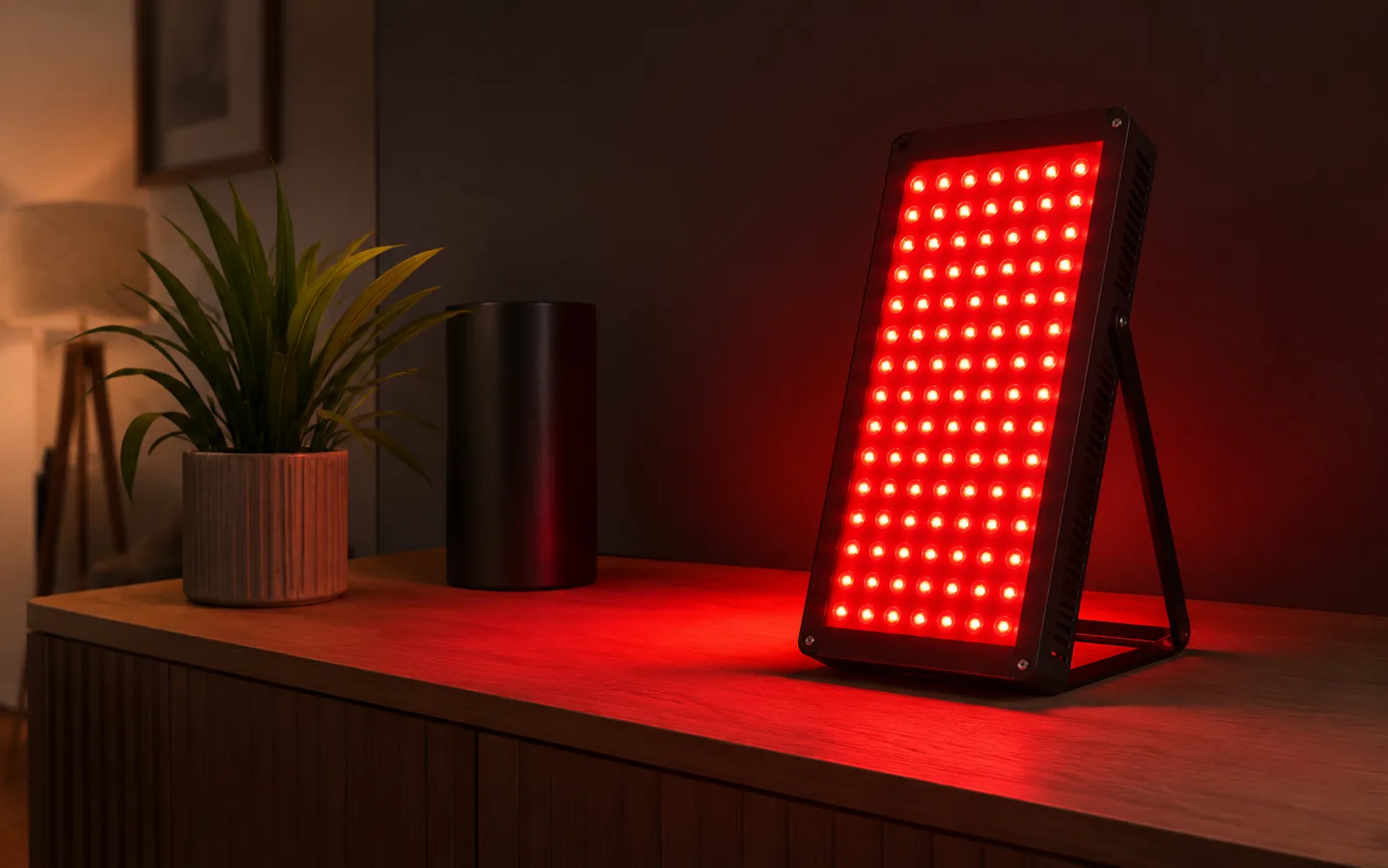
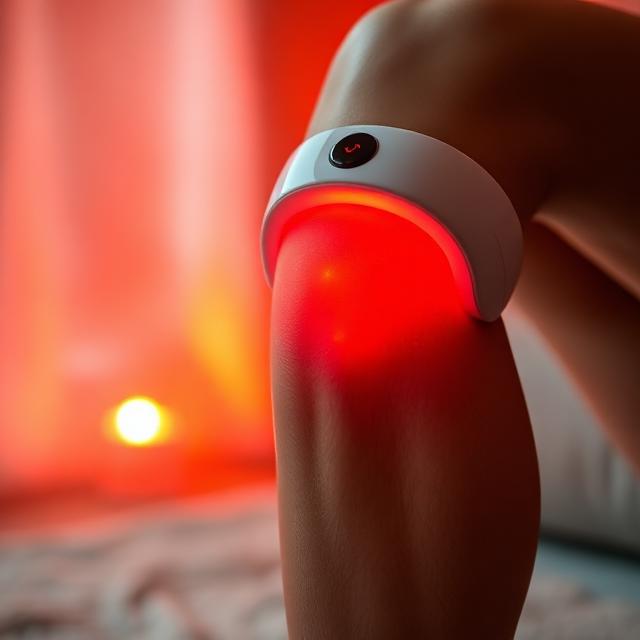
This matters especially for knees. Clinical studies have used point-by-point lasers, clusters of probes, broad LED arrays, different wavelengths, and different treatment schedules. Consumer products include panels held at a distance, flexible wraps pressed against the skin, handheld wands, and heated massagers with small red LEDs. These are not dose-equivalent merely because they glow red.
Our main red light therapy for knees research guide asks whether photobiomodulation may help and summarizes outcomes. This companion guide answers a narrower buyer question: how to understand session time and frequency without pretending that one internet schedule fits every device.
Red Light Therapy, Near-Infrared, and Photobiomodulation
Photobiomodulation is the research term for using non-thermal or low-level visible and near-infrared light to influence biological activity. Red light is visible, commonly discussed in ranges around the mid-600 nanometers. Near-infrared light is invisible and commonly studied in ranges around 800–900 nanometers. Exact bands vary by device and paper.
Photons can be absorbed by cellular chromophores, with downstream effects proposed in mitochondrial signaling, nitric oxide, reactive oxygen species, blood flow, and inflammatory pathways. Those mechanisms are still being refined. The intended effect is not to heat tissue the way a heating pad does, although many consumer products add a separate heating element and high-powered light can generate warmth.
Terminology is messy. Older papers use low-level laser therapy (LLLT), newer papers often use photobiomodulation therapy (PBMT), and retailers use red light, infrared, cold laser, LED therapy, or light therapy. A laser and an LED can share a wavelength but differ in coherence, beam profile, power, spot size, and how treatment is delivered. That is why a laser dose stated “per point” cannot be copied directly onto an LED knee wrap.
Why Time Alone Is Not Dose

Irradiance describes optical power arriving at a surface area and is commonly expressed as milliwatts per square centimeter (mW/cm²). Energy density, often called fluence, is expressed as joules per square centimeter (J/cm²). In a simplified continuous-light calculation:
Energy density (J/cm²) = irradiance (W/cm²) × time (seconds)
When irradiance is listed in mW/cm², divide it by 1,000 to convert to W/cm².
Suppose a device delivers 20 mW/cm² at the skin. That is 0.020 W/cm². A 10-minute session lasts 600 seconds, so the theoretical energy density is 12 J/cm². If another device delivers 5 mW/cm², the same ten minutes yields 3 J/cm². A product that says only “15-minute timer” has not told you the dose.
Even this formula is an estimate. The published irradiance may have been measured at the center rather than across the whole array, at zero distance rather than the recommended distance, before passing through fabric, or with a meter that responds differently to wavelength. Flexible wraps can create gaps around a curved knee. Skin tone, tissue depth, reflection, and movement influence absorption. Pulsed devices require duty-cycle information. If heat causes the device to reduce output, average delivery may change during the session.
The formula is therefore a tool for understanding-not permission to invent your own clinical protocol. Transparent specifications make comparison possible; they do not prove that a dose is therapeutic.
What Wavelength Tells You - and What It Does Not
Wavelength helps determine how light interacts with tissue. Visible red is absorbed more superficially, while near-infrared generally penetrates farther before being scattered and absorbed. “Deeper” does not automatically mean “better.” A knee treatment may aim at skin, superficial tendon, synovial region, or deeper joint structures, and actual energy falls with depth.
Clinical studies often use wavelengths between about 780 and 904 nm for knee osteoarthritis, while consumer devices may combine red LEDs around 630–660 nm with near-infrared LEDs around 810–850 nm. A label that says “infrared” without a wavelength is incomplete. A decorative red LED is also not proven therapy simply because its wavelength sits in a research range. Output, geometry, dose, and protocol matter together.
Be cautious with claims such as “penetrates six inches,” “reaches the cartilage,” or “clinical strength” when no measurement method is provided. Light attenuates as it travels through tissue. Clinical benefit can occur through superficial or indirect pathways without a consumer device delivering a full surface dose to deep cartilage.
What Clinical Knee Studies Used
A 2019 systematic review of randomized placebo-controlled trials reported reduced pain and disability when low-level laser therapy used dose ranges aligned with World Association for Laser Therapy recommendations: 4–8 joules per treatment spot at wavelengths of 785–860 nm and 1–3 joules per spot at 904 nm. Pain reduction peaked two to four weeks after treatment ended in the dose-compliant studies.
Those numbers are frequently misunderstood. They are joules per treatment spot delivered by laser protocols, not J/cm² across a whole wearable and not a universal number of minutes. A clinician may position a probe over several defined points around the joint, delivering a measured energy to each point. A wrap illuminates a broad curved area with multiple LEDs. Adding all point doses together or dividing by a product’s advertised power does not create a valid conversion.
A 2024 systematic review included ten placebo-controlled studies with 542 participants. It found that photobiomodulation may reduce resting pain and may improve disability, but the certainty of evidence was very low, studies had unclear to high risk of bias, and improvements were not always clinically meaningful compared with placebo. The authors did not support PBM as an isolated treatment and called for better dose guidance for different light emitters.
That conclusion should shape home use. Red light is best considered a possible adjunct, not a substitute for strengthening, aerobic activity, weight management when relevant, sleep, and appropriate medicines or procedures. Research heterogeneity is a reason to follow device instructions carefully, not a reason to use more.
So How Long Should a Home Session Be?
The safest general answer is the least dramatic: use the manufacturer’s tested session duration for the exact device, at the specified distance or contact position. Many home knee products use timers around 10–20 minutes, but that is a market pattern rather than a universal clinical standard. A panel that recommends 10 minutes at 15 centimeters is not equivalent to a wrap that touches the skin for 15 minutes.
If the label provides a range, begin at the lower end. Do not add time during the first session because the light feels mild. Photobiomodulation is not judged by sensation, and near-infrared is invisible. If a device combines heat, the warmth may become the limiting factor before the optical dose is reached. Follow temperature settings and inspect the skin.
Longer sessions can also reduce adherence. A sustainable twelve-minute routine performed as directed is more useful than a forty-minute session used twice and abandoned. The goal is enough consistency to evaluate response without creating irritation, heat exposure, or an unrealistic daily burden.
How Often Should You Use It?
Research schedules range widely: two or three sessions per week, five sessions per week, daily treatment, or intensive short courses followed by assessment. Differences reflect the device, dose per session, condition, and study design. There is no evidence-based rule that every consumer knee device should be used daily.
Follow the labeled frequency. When the instructions permit a range, a conservative start could mean using the lower labeled frequency for the first week while checking skin and symptom response, then moving toward the standard schedule if well tolerated. Do not use two sessions back-to-back to “catch up,” and do not place multiple devices over the same area without knowing the combined exposure.
Consistency matters more than intensity. If the protocol is several sessions per week, choose fixed days and connect the session to a useful behavior: gentle mobility, strength work, or an evening wind-down. The routine should make exercise easier to maintain rather than become another reason to delay it.
Why More Is Not Always Better: The Biphasic Response
Photobiomodulation research often describes a biphasic dose response. At very low doses there may be too little stimulus; within a useful range there may be benefit; beyond that range the response can plateau or diminish. Laboratory and animal studies show that increasing irradiance, time, or treatment frequency does not produce a simple straight-line improvement.
This does not give consumers a precise personal “sweet spot,” but it defeats the common assumption that doubling minutes doubles results. It also explains how studies using the same wavelength can disagree when dose differs. A product may be underpowered, a session may be too short, or an aggressive schedule may exceed a useful range.
Treat the timer as a safety boundary, not a challenge. Do not fall asleep wearing an active device, leave it running after the timer ends, or restart it automatically. If the manufacturer’s instructions are vague, contact the company for the tested protocol instead of copying a different brand’s schedule.
Panel vs. Wrap vs. Handheld: Why Geometry Changes Dose
| Device | Dose strengths | Common uncertainty | Protocol detail that matters |
|---|---|---|---|
| Panel | Can provide relatively uniform broad coverage | Output falls with distance and angle | Exact distance, body position, and time |
| Flexible wrap | Close contact and convenient repeatability | Curved gaps, fabric loss, pressure, heat | Fit, skin contact, timer, temperature |
| Handheld wand | Can target defined locations | Uneven movement and skipped areas | Spot size, dwell time, treatment points |
| Clinical laser | Measured point delivery by a professional | Does not translate directly to a home LED | Joules per point and treatment schedule |
Distance is especially important for panels. Irradiance usually falls as you move away, though the exact pattern depends on lenses and array geometry. If a company lists irradiance only “at the surface” but tells you to sit 30 centimeters away, that number may not describe your session. Conversely, pressing a device closer than instructed can change heat and optical exposure.
Wraps feel simpler because they are attached to the knee, but fit still matters. LEDs at the sides may touch while those over the kneecap sit farther away. Tight straps can create pressure discomfort or impair circulation; loose straps create gaps. Use the fit intended by the manufacturer rather than tightening until every LED touches.
A Cautious 4–8 Week Home Trial

Step 1: Record the device and protocol
Write down the brand, model, wavelengths, stated irradiance and measurement distance, session duration, frequency, whether it pulses, whether it adds heat, and the skin-to-device position. Save the instructions. If these details are absent, that limits your ability to compare the product with research.
Step 2: Choose outcomes before starting
Track two or three functional measures: morning stiffness duration, discomfort during a standard walk, stair tolerance, sleep interruption, or ability to complete prescribed exercises. A daily pain score alone is noisy. Function tells you whether the device changes life rather than simply creating a pleasant session.
Step 3: Keep core care stable
Continue exercise and agreed medical treatment. Avoid starting three new supplements, changing shoes, and adding a brace during the same week. If red light is meant to help you warm up or recover, connect it to the same mobility or strengthening routine so the behavior remains consistent.
Step 4: Assess tolerance early
Check the skin after each of the first few sessions. Mild temporary warmth can occur, especially in combined devices, but burning, blistering, persistent redness, rash, increasing swelling, headache, dizziness, or worsening pain are reasons to stop. Do not numb the area with ice before use, because reduced sensation can hide excessive heat.
Step 5: Review benefit at four to eight weeks
Multiweek assessment is more realistic than expecting a dramatic first-session change. Compare your planned outcomes with baseline. Continue only if benefit is meaningful, the routine is tolerable, and it does not displace exercise or necessary care. If nothing changes, more minutes are not the automatic answer. Reassess the device, diagnosis, and broader plan.
Can You Use Red Light Before or After Exercise?
Studies have tested photobiomodulation before and after exercise in different contexts, but knee osteoarthritis evidence does not establish one universal best timing. Practical timing can be based on behavior. Before activity, a session with gentle warmth may make stiffness feel easier and cue a mobility routine. After activity, a comfortable session may support relaxation. The optical effect should not be promised to prevent injury or erase the consequences of excessive training load.
Do not use a device to push through a new sharp pain, unstable knee, or rapidly increasing swelling. A temporary reduction in discomfort can mask the signal that an exercise dose was too high. Progress training based on next-day response and function, not solely on how the knee feels while illuminated.
Can Red Light and Heat Be Combined?
Yes, when a device is designed and labeled to combine them. The two inputs are different: photobiomodulation dose is optical, while heat is thermal. A warm sensation does not tell you how many joules of light reached the skin, and a cool device may still deliver light. Combined products should have clear temperature settings and automatic time limits.
Heat can be comfortable for chronic stiffness without acute swelling. It is not appropriate over every painful knee. Avoid prolonged heat over a new injury, unexplained inflammation, active infection, or a knee that is already red and hot. People with reduced sensation, neuropathy, poor circulation, fragile skin, or an inability to remove the device independently need extra caution and clinical advice.
Our heat versus red light comparison explains how the technologies differ. A device can include both, but research about one feature does not prove the effectiveness of the combination.
Safety Checklist
- Eyes: follow the manufacturer’s eye-protection instructions. Do not stare directly into LEDs or a laser.
- Photosensitizing medicines: ask a pharmacist or clinician about antibiotics, retinoids, cancer medicines, herbal products, and other agents that can increase light sensitivity.
- Skin: avoid use over an active rash, infection, fresh surgical site, or open wound unless the device and treating clinician specifically allow it.
- Unexplained swelling: a very hot, red, rapidly swollen knee needs assessment, not an experimental home dose.
- Impaired sensation: neuropathy or numbness can hide excessive heat or pressure.
- Pregnancy: safety for treatment near the abdomen and systemic considerations are not established; seek medical guidance.
- Cancer: do not treat over a known or suspected active cancer area without approval from the oncology team.
- Recent injection or surgery: ask the treating clinician when light, heat, and pressure can resume.
- Electrical and battery safety: inspect cables, charging components, fabric, and heat damage; stop using a malfunctioning device.
FDA guidance for home-use devices emphasizes reading and keeping the instructions, understanding how the device operates, using a reliable source, maintaining the equipment, and contacting the supplier or clinician when something is unclear. FDA regulation of a category does not mean the agency recommends a specific product.
How to Read a Product Specification Page
A useful product page should list wavelengths, irradiance with measurement distance or contact condition, treatment area, recommended duration, frequency, heat range if present, timer, eye guidance, contraindications, and warranty or support. “Medical grade,” “FDA registered,” or “clinically proven wavelengths” are not substitutes for these data. Facility registration is not the same as device clearance, and a wavelength appearing in a paper does not validate a product’s dose.
Irradiance claims deserve context. Ask whether the value is peak or average, measured at the center or across the array, and measured through any cover material. If a product uses pulsing, ask for duty cycle and whether the listed irradiance is on-time peak or time-averaged. These questions may sound technical, but manufacturers making precise therapeutic claims should be able to answer them.
For FlexiKnee specifically, use the published device instructions and timer rather than reverse-engineering a clinical dose from this article. We do not claim a joule-per-square-centimeter value unless wavelength, irradiance at the skin, geometry, and measurement method are verified for the product. Transparent limits are more trustworthy than false precision.
Common Dosing Mistakes
Copying a protocol from another device
A panel, laser, and wrap can have completely different output. A twenty-minute recommendation from an online forum is meaningless without the product and conditions.
Using heat sensation as a power meter
Near-infrared light is invisible and photobiomodulation can be non-thermal. Added heat may come from separate elements. “I barely felt it” does not prove underdosing, and “it got very hot” does not prove a stronger optical treatment.
Adding sessions after a missed day
Treatment schedules are not bank accounts. Doubling up can increase irritation without restoring a missed effect. Resume the normal labeled schedule.
Treating every painful condition the same way
Osteoarthritis research cannot automatically be applied to an acute ligament injury, gout flare, infection, blood clot, or postoperative knee. Diagnose important symptoms before choosing a device protocol.
Stopping exercise because the device feels easier
Passive comfort is valuable only when it supports function. The 2024 evidence review does not support photobiomodulation as an isolated knee osteoarthritis treatment. Strength and movement remain central.
When to Stop and Seek Care
Stop the device and seek advice for a burn, blister, persistent skin discoloration, widespread rash, eye symptoms, dizziness, worsening pain, or new swelling. Seek urgent care for a hot red swollen knee with fever, inability to bear weight, major trauma, a locked joint, or sudden one-sided calf swelling. Chest pain or breathlessness with possible clot symptoms is an emergency.
A device can be functioning correctly while the diagnosis is wrong. If a four-to-eight-week routine produces no meaningful change, do not simply keep escalating time. Review the cause of pain, exercise dose, sleep, medication options, and whether a clinician or physiotherapist should assess the knee.
Bottom Line
There is no single correct answer such as “15 minutes every day” for every red-light device and every knee. Minutes describe exposure time, not dose. A defensible protocol needs the device’s wavelength, irradiance at the treatment position, geometry, treatment area, and tested instructions. Clinical laser doses per treatment point cannot be directly converted to a consumer LED wrap.
Use the exact product instructions, begin at the conservative end when a range is offered, avoid back-to-back or extended sessions, and track function over four to eight weeks. Treat red light as an optional complement to exercise and evidence-based care. The best protocol is not the one with the most minutes; it is the one that is transparent, tolerable, consistent, and meaningfully helps you move.
Frequently Asked Questions
How long should I use red light therapy on my knee?
Use the duration in the device's instructions. Many home devices use sessions in the general range of 10 to 20 minutes, but that range is not interchangeable across products because irradiance, wavelength, contact, distance, treatment area, and heat differ. A stronger device may deliver the same energy in less time.
How often can I use red light therapy on my knees?
Follow the labeled schedule. Research protocols vary from several sessions per week to daily treatment for limited periods. For a home device, consistency within the manufacturer's instructions is more sensible than adding extra sessions. More frequent treatment is not automatically more effective because photobiomodulation may have a biphasic dose response.
Is daily red light therapy too much?
Not necessarily for a device labeled for daily use, but daily use is not universally correct. The answer depends on output, session length, skin contact, heat, and the manufacturer's tested instructions. Do not convert a low-output device's schedule to a different product or double sessions because the light feels gentle.
What is the best red light therapy dose for knee pain?
There is no single proven consumer-device dose for every knee. Clinical laser research has reported benefits at particular joules delivered per treatment point, but those point doses cannot be directly converted into minutes on a broad LED wrap. The most defensible approach is to use a device with transparent specifications and follow its instructions.
What does irradiance mean in red light therapy?
Irradiance is optical power arriving at a surface area, commonly expressed in milliwatts per square centimeter. Together with time, it helps estimate energy density: J/cm² = W/cm² × seconds. Irradiance should ideally be measured at the actual treatment distance or contact position.
Is 10 minutes of red light therapy enough?
It may be enough for one device and too little or too much for another. At 20 mW/cm², 10 minutes theoretically equals 12 J/cm² if the stated irradiance reaches the skin consistently. At 5 mW/cm², the same time equals 3 J/cm². Product geometry and measurement quality can make real delivery different from the calculation.
Can I use red light therapy and heat together?
Some devices combine light and warmth, but combined use increases the importance of temperature limits, skin checks, and following instructions. Heat sensation does not tell you the optical dose. Avoid use over a newly injured, markedly swollen, red, or unusually hot knee until the cause is clear.
How long before red light therapy works for knee pain?
It is more useful to assess a consistent routine over several weeks than to judge a single session. Many studies use multiweek treatment periods. Track walking, stairs, stiffness, sleep, and exercise tolerance over roughly four to eight weeks, while keeping exercise and other core care in place. Stop if symptoms worsen or there is no meaningful benefit.
Who should not use red light therapy on the knee?
Avoid or seek clinical advice for unexplained hot swelling, active infection, open wounds not covered by the device instructions, impaired sensation, photosensitizing medicines, known light sensitivity, recent procedures, pregnancy-related uncertainty, or treatment over an active cancer area. Follow eye-protection guidance and stop for burns, persistent redness, rash, dizziness, or worsening pain.
Does red light therapy replace exercise for knee osteoarthritis?
No. A 2024 systematic review found very low-certainty evidence and did not support photobiomodulation as an isolated treatment. It is best considered an optional complement to therapeutic exercise, activity management, weight management when relevant, and medical care.