What best should mean for a house slipper
For indoor footwear, best is a practical match between the shoe, your foot, and your home. You may wear it for a brief walk to the bathroom, several hours at a kitchen counter, or frequent trips between rooms. Those uses differ from running, hiking, and outdoor sandals. A slipper that feels cozy while you sit may not be the pair you want for repeated walking and standing.
Start with security and comfort rather than a treatment promise. The heel should not repeatedly escape, the toes should not grip to keep the shoe on, and the sole should feel predictable on your usual floor. You should be able to fasten the pair safely without balancing on one leg. These are useful buying checks even when the exact cause of knee discomfort has not been established.
This guide does not rank brands or claim hands-on product testing. Direct clinical trials identifying a best house slipper for knee pain are lacking. Instead, it combines footwear research with falls guidance and an everyday fit checklist. If a product claims to realign your knees, rebuild cartilage, or remove pain permanently, ask for evidence for that exact product and outcome rather than accepting a generic reference about shoes.
What footwear studies actually tell us
A randomized trial involving 164 people with symptomatic medial knee osteoarthritis compared flat flexible shoes with stable supportive shoes. The supportive group had greater improvement in walking pain, while the between-group difference in function was not significant. These were shoes worn for substantial daily periods, not a trial establishing the best indoor slipper. The study supports considering the whole shoe rather than assuming that flatter and softer must be better.
A later trial combined exercise with either flat flexible or stable supportive footwear in 97 people with medial knee osteoarthritis. It found no significant between-group difference in walking-pain change at the main three-month assessment. Different populations and programs can produce different results. The practical conclusion is not that shoes never matter, but that a single design feature does not determine everyone's symptoms.
Laboratory work also measures knee loading in different shoes. Those measurements help researchers understand movement but do not directly tell you which slipper will feel comfortable after preparing dinner. A loading change is not automatically a pain change, and neither is a complete falls assessment. Keep the clinical outcome, experimental setting, and actual footwear category separate when reading a buying guide.
Heel security comes before plushness
The MOBILIZE Boston study followed older adults and examined footwear reported at home falls. Being shoeless or wearing slippers was associated with more serious injury among those who fell compared with wearing other shoes. Because it was observational and grouped different footwear together, it cannot prove that every slipper causes falls or identify one protective design. It does reinforce why an indoor footwear decision should include safety, not just knee comfort.
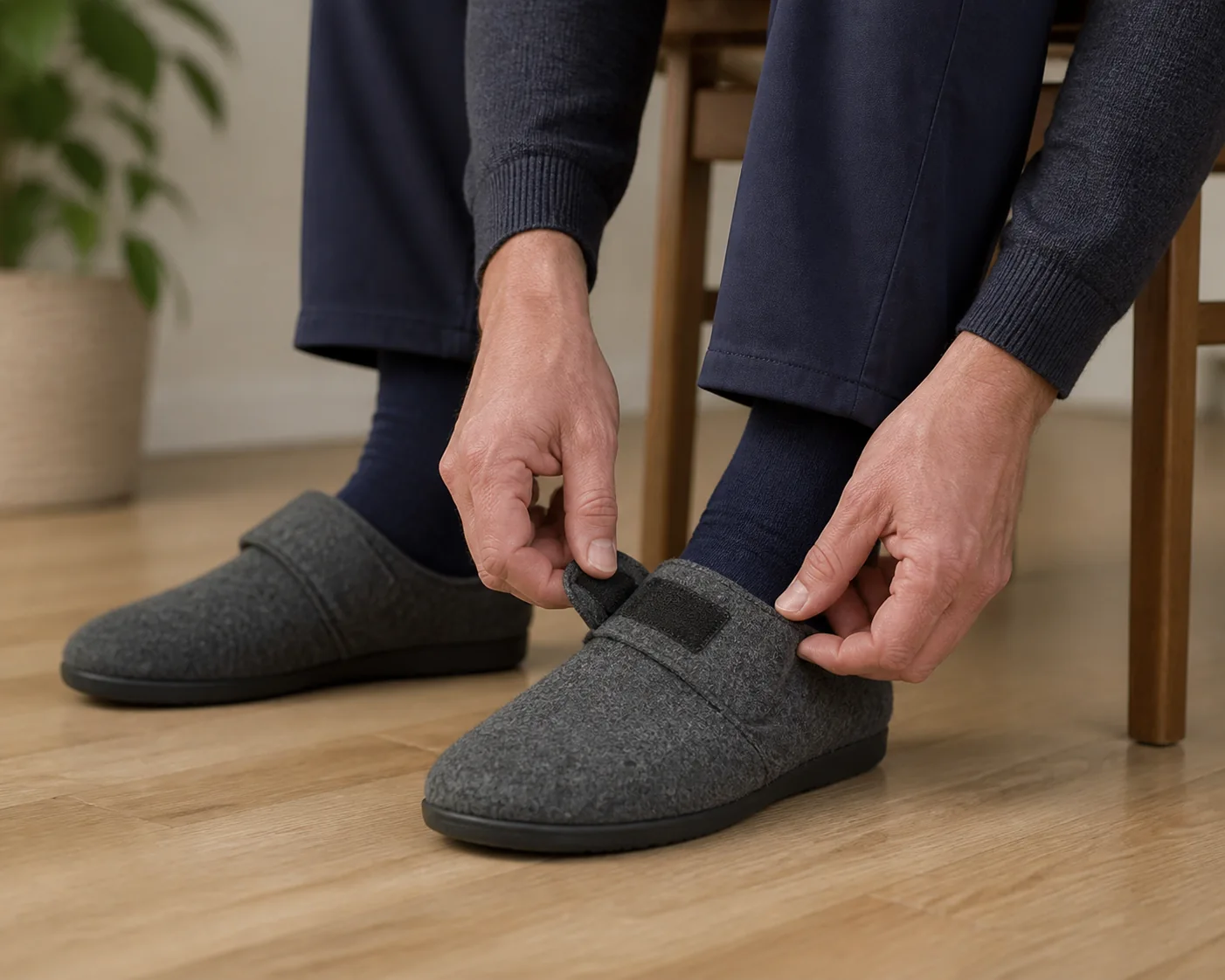
A closed-back slipper or dedicated indoor shoe gives the heel a place to sit. A suitable strap or fastening can add adjustability and reduce the tendency to shuffle just to keep the pair attached. That does not mean every closed-back design fits well. The heel can still rub, the opening can still be too loose, and a narrow upper can still compress the forefoot.
Backless slippers are convenient to put on, but convenience can come with repeated slipping or a change in how you walk. This matters especially if you have difficulty lifting the feet, use a walking aid, or have fallen before. Guy's and St Thomas' falls guidance specifically cautions against loose slippers and backless footwear. Choose an option you can put on securely without needing to claw it with your toes.
Try fastening while seated. If reaching the foot is difficult, look for an opening and closure you can manage, or discuss a long-handled aid with an occupational therapist. Do not select a permanently loose pair just because it is easier to step into. The right solution should support both getting dressed and walking safely once the shoe is on.
Look at the base and the floor together
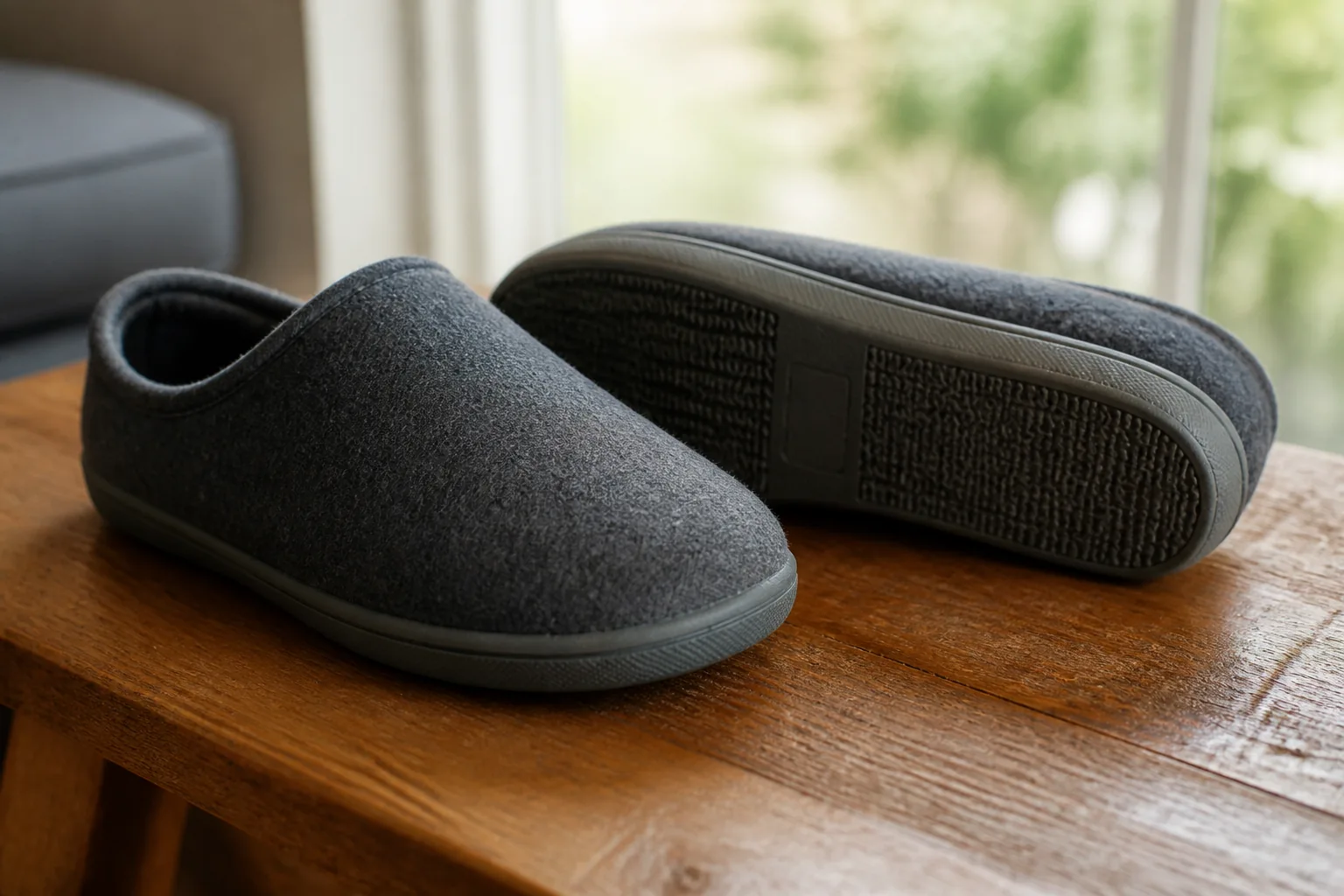
A low broad base is a sensible starting point for stable indoor footwear. Check that the sole sits evenly rather than tipping to one side. A very tall or narrow platform may feel less predictable when turning around furniture. Avoid choosing by the word orthopedic alone. The actual shape under your foot and your ability to move comfortably matter more than a category name.
Grip is a relationship between the outsole and the surface. A pair that feels fine on carpet may behave differently on smooth tile or polished wood. Keep floors dry and clear, and do not deliberately test a new sole on a wet surface. A non-slip claim is not a guarantee against falling. Check for worn smooth areas, debris, or a sole that catches unexpectedly as you turn.
A shoe cannot compensate for a loose rug, trailing cable, poor lighting, or a rushed night-time walk. NHS falls advice recommends secure well-fitting shoes or slippers with good grip alongside broader home-safety measures. Look at the route you actually use after getting out of bed. A clear path and accessible light are part of the same decision as where you leave the slippers.
| Feature | Useful check | Reason to reconsider |
|---|---|---|
| Heel retention | The heel stays seated during a few ordinary steps | Repeated slipping, shuffling, or toe gripping |
| Fastening | You can adjust it while seated | It cannot secure the upper without pinching |
| Base | A low broad platform sits evenly | The shoe rocks, leans, or feels unstable |
| Outsole | Texture remains intact and feels predictable on dry floors | Smooth wear, cracking, or unexpected catching |
| Toe area | Toes have comfortable length and width | Rubbing, curling, pressure, or numbness |
| Footbed | Cushioning and contour feel comfortable while standing | A hard pressure point or sinking that feels unsteady |
Cushioning is useful only within a good fit
Softness is easy to notice with your hand, but hand pressure does not reproduce standing and walking. A plush lining can conceal a narrow toe box or a loose heel. A deep foam footbed may feel welcoming for the first few moments yet change how securely your foot sits in the upper. Try the entire shoe, not just the cushion.
Memory foam is a material description, not a clinical outcome. So are wool, felt, fleece, and shearling. Wool slippers can be structured or floppy, and memory-foam slippers can have secure or insecure bases. Choose warmth and texture according to preference, then independently assess the fastening, fit, sole, and walking feel. No upper material establishes that a pair will reduce knee pain.
Arch contour is another personal fit issue. A gentle contour may feel comfortable, while a pronounced bump may create pressure for someone else. Do not assume more arch support is automatically better. If the footbed presses sharply, makes you shift your weight, or causes new foot discomfort, the design needs reconsideration. You do not need to endure pain to prove that an arch is being corrected.
Slipper styles: useful tradeoffs
Rather than choosing a universal winner, narrow the category according to your routine. A closed-back felt slipper may suit someone who wants warmth and modest structure. An adjustable house shoe may be easier to fit around a fuller instep. A clean pair of ordinary supportive shoes reserved for indoor use may provide a familiar alternative when traditional slippers never feel secure.
An indoor-only pair does not need to look medical. What matters is that the construction and fit meet your needs. Conversely, a health-related name does not make a loose upper or slippery sole suitable. Compare the same practical features across categories, and be willing to leave the slipper category entirely if an indoor shoe gives you a better combination of access, security, and comfort.
| Indoor footwear style | Potential practical advantage | Check carefully |
|---|---|---|
| Closed-back felt or wool slipper | Warmth with heel coverage | Whether the opening holds the heel and the sole has suitable grip |
| Adjustable house shoe | A fastening can accommodate fit differences | That adjustment does not hide swelling needing assessment |
| Indoor-only walking shoe | Familiar secure construction for more walking at home | Weight, ease of fastening, and comfort on your floors |
| Backless mule slipper | Quick access | Heel slipping, shuffling, and suitability with balance problems |
| Very soft sock-style slipper | Warmth while resting | Retention, sole protection, and grip during walking |
Fit both feet, in the socks you use at home
Try both shoes rather than judging the fit from one foot. Use the socks you expect to wear, because thick winter socks can change the available space considerably. Check length, forefoot width, and depth over the toes. Do not buy a pair that depends on the lining compressing enough to stop it hurting. Materials may settle, but a painful break-in period is not a useful requirement.
Allow for normal day-to-day variation without accepting a sloppy fit. Adjustable closures may help, but recurrent or unexplained swelling needs attention rather than simply a larger size. If one foot or leg has suddenly become more swollen, pause the shopping experiment and seek advice. An asymmetric change should not be treated as a footwear-sizing inconvenience.
Women's and men's ranges may have different lasts, widths, and available sizes. The label does not tell you whether the shoe matches your foot. Compare actual measurements and the manufacturer's chart, and use the return policy to protect a careful indoor trial. If you have difficulty finding sufficient width or depth, a podiatrist can help identify the fit requirement without promising that one brand will solve the knee.
Can you add insoles to slippers?
An insert changes the space inside a shoe. Adding one can raise the heel, reduce toe depth, or make a previously secure upper feel tight. A compatible removable footbed and enough internal volume are important. Do not stack a full-length insole on top of a thick existing liner just because both are described as supportive. The resulting fit may be worse than either component alone.
If you use prescribed orthoses, ask which indoor footwear can accommodate them. Bring the actual orthoses when trying shoes. Once inserted, repeat the heel-retention and toe-room checks, because the original fit is no longer the final fit. An insole cannot reliably turn a floppy backless slipper into a secure shoe. The insole guide discusses fit and evidence separately.
A fair home trial is more useful than a quick squeeze test
Check the retailer's return conditions before wearing the pair, then try it on clean dry indoor flooring if permitted. Begin with a few ordinary steps near stable support. Notice whether the shoe stays with the foot during a turn and whether the toes feel crowded. Do not make the first test a prolonged cleaning session, a flight of stairs, or a wet bathroom floor.
If the initial fit is comfortable, compare a short familiar routine with a pair you already trust. Keep the activity similar: standing briefly at the counter, walking between two rooms, or getting up from a chair. Record foot comfort, knee comfort, and stability separately. A shoe might feel soft underfoot yet less secure, or secure yet wrong for the shape of your toes.
Check again later. A new pressure mark or altered walking pattern matters even if the first minute felt good. Do not attribute every change in knee symptoms to the slippers, especially if you also walked farther, changed exercise, or spent more time standing that day. A repeated pattern under similar conditions is more informative than one unusually good or bad afternoon.
| Trial question | Encouraging finding | Stop or reassess finding |
|---|---|---|
| Does the pair stay on? | Heel remains secure without toe gripping | Slipping or shuffling to retain the shoe |
| Is there enough room? | Toes remain comfortable in your usual socks | Pinching, numbness, or a new pressure mark |
| Does walking feel steady? | Ordinary steps and turns feel predictable | Rocking, catching, or increased uncertainty |
| How does the knee respond? | No clear worsening during a comparable routine | Repeated symptoms or a changed gait |
Think about standing time as well as footwear
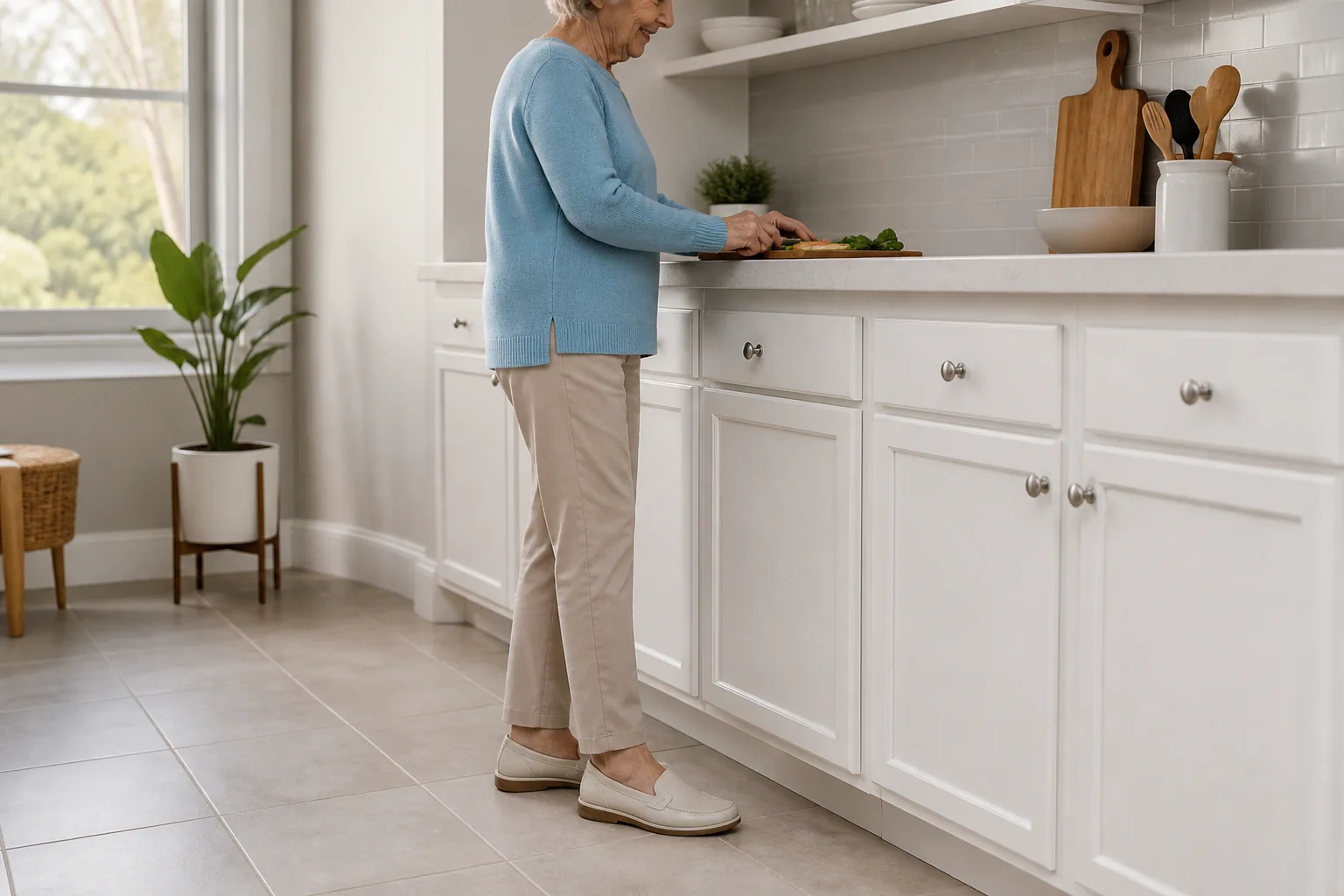
Even a well-fitting house shoe cannot remove the effects of a much longer day on your feet. If the knee becomes uncomfortable during cooking or chores, look at the length of the task, opportunities to sit, and how often you turn or carry items. Keep frequently used objects within reach. A shoe change is only one variable in the larger indoor routine.
For example, test the new footwear during an ordinary short kitchen task rather than assuming it gives you permission to double your standing time. If symptoms improve, maintain that manageable routine while assessing whether the change repeats. If symptoms persist across several secure comfortable pairs, look beyond footwear. Our guide to knee pain when getting up after sitting covers another common home trigger.
Wear, washing, and night-time access
Check the pair periodically for a stretched upper, compressed footbed, smooth outsole, cracked sole, or heel that leans. A slipper can look clean and still stop holding the foot securely. There is no universal replacement interval because use, material, body size, and floor surfaces differ. A change in fit or walking comfort is a reason to inspect it rather than wait for a calendar deadline.
Follow the washing instructions and let the pair dry completely. Heat or an unsuitable wash cycle can alter materials and fit. Recheck the shoes after cleaning, particularly if the upper has shrunk or the sole has distorted. Keep them in a consistent reachable position without leaving them in the walking path. At night, use a light and sit to put them on securely if needed.
When to Get Medical Help
Seek assessment for persistent knee pain, repeated falls or near-falls, new foot weakness, reduced sensation, or skin damage. Severe knee pain, inability to bear weight, major swelling, locking, or fever with a hot red knee needs prompt care. New unexplained one-sided leg swelling is not a shoe-fit problem. People with diabetes-related foot risk or circulation problems should obtain individualized footwear advice.
The best indoor footwear decision is one you can explain: this pair fits, stays on, works on my dry floors, and feels comfortable in a realistic routine. That is a stronger basis than a brand ranking or a claim that every painful knee needs the same arch, foam, or sole. Keep comfort, stability, and the need for medical assessment as separate checks.
Frequently Asked Questions
What are the best slippers for knee pain?
There is no proven best brand for every knee. Prioritize secure fit, heel retention, a low broad base, suitable grip, comfortable cushioning, and room for the toes. A dedicated indoor shoe may be a better option than a loose backless slipper.
Can slippers cause knee pain?
A loose, worn, unstable, or uncomfortable pair may contribute to an awkward walking pattern, but timing alone does not prove it caused knee pain. Compare with familiar secure footwear while keeping activity similar, and seek assessment if symptoms persist.
Are memory foam slippers good for bad knees?
Softness can feel pleasant, but memory foam alone does not establish knee benefit. Check whether the whole shoe stays stable, retains the heel, and remains comfortable after standing. A very soft footbed on an insecure base may not suit someone with balance concerns.
Are wool slippers supportive enough?
Wool describes a material, not the shoe's support or grip. A wool slipper can have secure heel coverage and a structured sole, or it can be loose and flexible. Compare the construction and fit rather than relying on the upper material.
Are closed-back slippers better than backless slippers?
Closed-back styles or suitable fastening can help keep footwear on the foot. Falls guidance advises secure footwear and cautions against loose or backless styles, especially when balance or mobility is a concern. Fit still needs checking.
Do slippers need arch support for knee pain?
Not everyone needs a pronounced arch contour. The footbed should feel comfortable rather than press sharply into the arch. Footwear trials do not establish one arch shape as a treatment for all knee pain.
Can I put orthotic insoles in slippers?
Only if the footwear has enough depth, suitable heel retention, and a compatible removable footbed. Do not stack inserts into a cramped slipper. Follow the prescriber's advice for custom orthoses and recheck fit after the insert is added.
Is barefoot walking better than slippers for knee arthritis?
It depends on comfort, balance, foot health, and the floor. Laboratory loading findings do not prove that barefoot walking is best for symptoms or falls risk. People with reduced sensation, skin concerns, or repeated falls need individualized advice.
When should I replace house slippers?
Replace or reassess them when the heel no longer holds, the sole is worn smooth or uneven, the upper has stretched, the footbed is compressed, or walking comfort has changed. There is no universal replacement month that fits every pair and routine.