Why breaststroke is different from other pool movement
Water supports the body, but moving through it still requires force. In breaststroke, the legs recover into a bent position, the feet turn to engage the water, and the kick drives the body forward before the legs come together for the glide. That is a different task from walking in water, aqua jogging, or using a small flutter kick. The absence of a running impact does not remove knee demand.
The kick also has a rotational component. If you try to create more propulsion by forcefully turning the lower leg or snapping the legs together, the knee may feel uncomfortable even at a leisurely overall swimming pace. Conversely, a strong swimmer can accumulate many repetitions without feeling breathless. Your cardiovascular effort does not reliably tell you how much a particular knee movement is being repeated.
This guide concerns breaststroke technique and training, not a general judgment that swimming is bad for knees. Many people find a suitable water activity comfortable. The practical task is to identify which part of the session provokes symptoms and whether a change in stroke, effort, or exercise choice helps. Different water activities should be treated as different movement options rather than one interchangeable category.
What breaststroker's knee does and does not mean
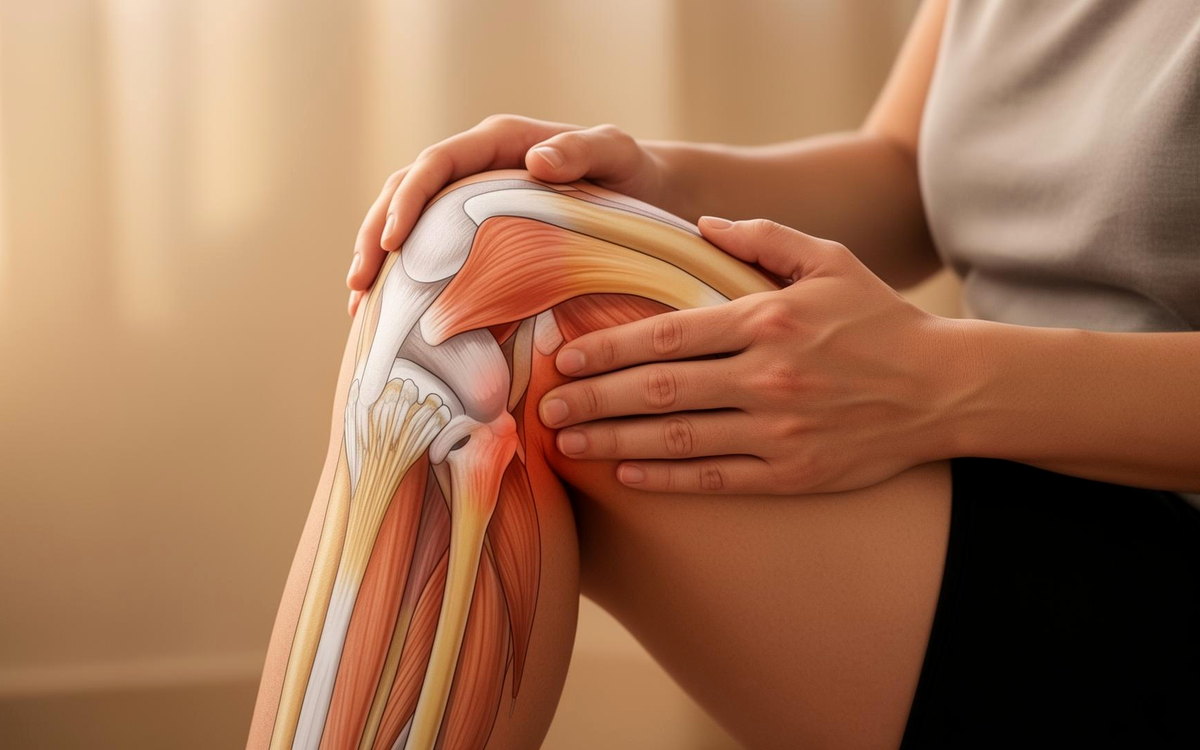
Breaststroker's knee is commonly used to describe knee pain linked with the stroke, often along the inner side. It is not a precise diagnosis. Older clinical studies reported tenderness in different locations, including around the inner kneecap region and medial ligament area. A descriptive sports label cannot tell you whether your own pain comes from a ligament, tendon, joint structure, or another cause.
Much of the classic evidence comes from small studies of competitive swimmers several decades ago. One examined 23 symptomatic swimmers with underwater filming; another combined biomechanical and arthroscopic observations. These studies helped establish that the kick deserves attention, but they do not provide a modern universal treatment protocol for every recreational swimmer. Their findings should be interpreted with the participants and methods in mind.
A later MRI case report described a young swimmer with inner-knee symptoms and a particular imaging finding. A case report shows what happened in one person, not the probability of that finding in everyone who has pain after a swim. Do not use an image search to diagnose your own knee. Clinical history and examination determine whether imaging is needed and what an image means.
Locate the painful moment in the stroke
Try to describe the timing after you have stopped, without repeatedly provoking the pain to make sure. Does it occur as you bring the heels back, turn the feet out, begin pushing against the water, or finish the kick? Is it present on both sides? Does the discomfort also happen when you push off the wall, climb the pool steps, or walk to the changing room?
Separate a kick problem from a session problem. A knee may tolerate several easy lengths but complain during a long kick set or late in the workout. It may feel fine in open swimming but hurt with repeated forceful turns. Those differences are useful for a coach and clinician because they suggest which exposure should be reviewed first, without claiming to identify a damaged tissue.
| When symptoms appear | What to discuss | What not to assume |
|---|---|---|
| Heels recover toward the seat | Amount of bending, body position, and how the legs recover | That you simply need a stronger stretch |
| Feet turn outward or start the push | How rotation is shared through the legs and how forceful the kick is | That more turnout will improve comfort |
| Legs sweep together | Kick width, speed, timing, and fatigue | That one narrow-kick rule fits everyone |
| Wall push-off or pool exit | Depth of the knee bend and force during that separate task | That breaststroke technique is the only issue |
| Later that day or next morning | Total kicks, recent training changes, and other activity | That a pain-free swim guaranteed a tolerated dose |
Reduce the painful kick before perfecting it
If each kick reproduces pain, stop that movement. Swimming a few more lengths to see whether it warms up can become repeated exposure to the same problem. You may be able to continue with a familiar comfortable alternative, but the whole session should stop if pain persists, you change your movement to protect the knee, or you feel unsafe getting out of the pool.
Technique work is more useful when the knee is calm enough to learn without a pain-driven compensation. Do not begin by adding hard drills, a long kick set, or extra turnout stretches. First reduce the provoking exposure and check whether ordinary walking and stairs remain near baseline. A persistent painful knee deserves a clinical assessment while the coach helps review the swimming task.
Keep a simple session record: stroke mix, approximate lengths or time, kick-only work, effort, turns, and symptoms later. You do not need a complicated training platform. The purpose is to distinguish a small comfortable dose from a larger one that repeatedly causes a flare. That information also helps prevent an apparently easy alternative from quietly becoming another demanding session.
Review kick width without chasing a magic angle
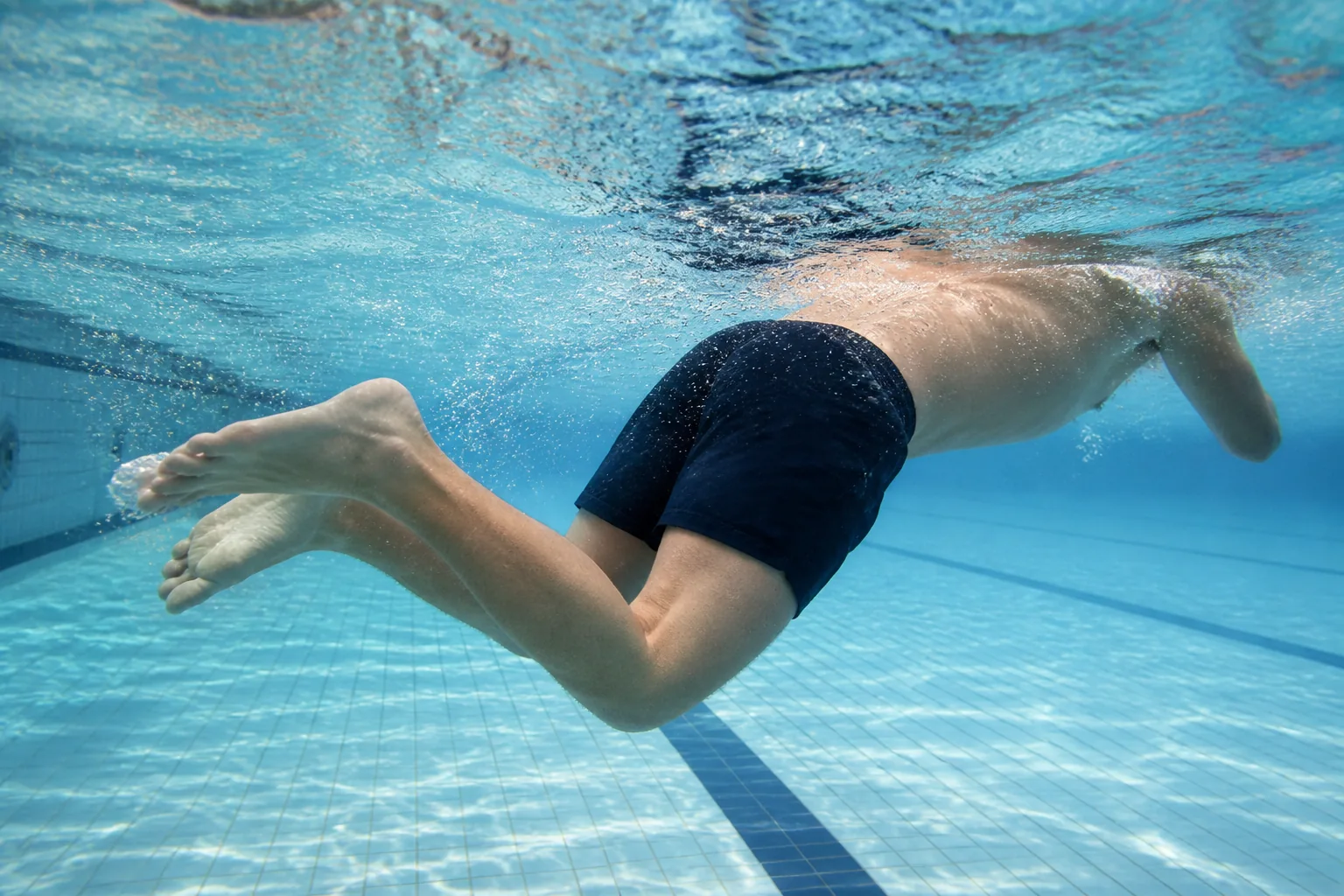
Kick width is worth discussing because an exaggerated wide movement may feel different from a more compact one. But the answer is not to clamp the knees together at all costs. Your hip movement, ankle position, timing, and ability to coordinate the stroke all contribute. A change that looks tidy from the pool deck can still feel forced to the swimmer.
An older study surveyed 391 athletes and assessed 21 swimmers in more detail. It reported an association involving hip-abduction angles at kick initiation, while several detailed comparisons did not show statistically significant differences between injured and uninjured groups. That combination is not a reliable basis for prescribing a narrow range of degrees to every reader. The original paper should not become a universal do-it-yourself angle rule.
Ask a qualified coach to watch your movement at easy effort and, if appropriate, use underwater video. The useful questions are whether the recovery is unnecessarily large, whether the feet are being forced outward, and whether the kick becomes abrupt with fatigue. Try only a small coached change at a time. If the movement hurts, do not repeat it merely to obtain cleaner footage.
Turnout should not be forced through the knee
Breaststroke involves turning the feet to engage the water, but that does not mean you should twist a painful knee into position. Do not hold the thigh fixed and force the foot outward, use a partner to push your range, or copy an extreme flexibility demonstration. The movement of the whole leg matters, and an apparent technique limitation may reflect mobility, coordination, pain, or several factors together.
A clinician can assess whether a hip or ankle restriction is relevant and whether a particular exercise is appropriate. A coach can then help integrate comfortable movement into the stroke. Those roles complement each other. More flexibility is not automatically better, and a swimmer who already has considerable joint motion may need a different approach from someone whose movement is restricted.
Swim England's technique guidance describes a coordinated recovery and kick with the legs behind the body rather than pulling the knees far toward the chest. That is a useful coaching framework, not a rehabilitation prescription. Use its breaststroke technique guidance alongside individual feedback rather than trying to hold several rigid positions while swimming through pain.

Kickboards and drills can increase repetition
If you swim with a group, tell the coach about the planned limit before the session starts. Agree on what you will do when the group begins breaststroke kick work and how you will leave the set if symptoms appear. A clear alternative is easier to follow than making a decision while trying to keep pace with everyone else.
A kickboard supports the arms but does not remove the knee's role in breaststroke kicking. A kick-only set may concentrate more repetitions into a short period than mixed-stroke swimming. If the kick is the problem, using a board while continuing the same motion is not necessarily a rest. Review the number of kicks and their effort, not only the distance written on the session plan.
Drills are also exercise, even when their purpose is technique. Several short drill blocks added before the usual workout can increase total exposure considerably. If a coach changes your kick, agree on a small initial dose and what response should lead you to stop. Avoid layering a new drill, harder kick effort, and a longer swim into the same return session.
Equipment such as fins, resistance devices, or paddles changes the task in other ways. Do not add them as an automatic knee workaround. A pull buoy may reduce kicking for a swimmer who can use it safely, but it can increase demands elsewhere and does not solve painful turns. Ask for a session alternative that fits your overall abilities rather than moving the workload blindly to another body part.
Turns, push-offs, and pool access are separate exposures
Pay attention to the wall. Drawing into a deep tuck and pushing off forcefully asks something different of the knee from gliding through the lane. In a short pool, those push-offs happen frequently. If symptoms occur at the wall rather than during the kick, tell the coach that specifically. Simply removing breaststroke may not change the painful part of the session.
Use a comfortable controlled turn and avoid an unnecessarily forceful push while the issue is being assessed. Do not practice a new turn in a crowded lane if pain affects your control. Pool ladders, steps, slippery decking, and climbing out at the edge also matter. Choose an accessible exit and ask staff for help if needed; finishing the swim safely includes getting out safely.
Choosing another stroke or water activity
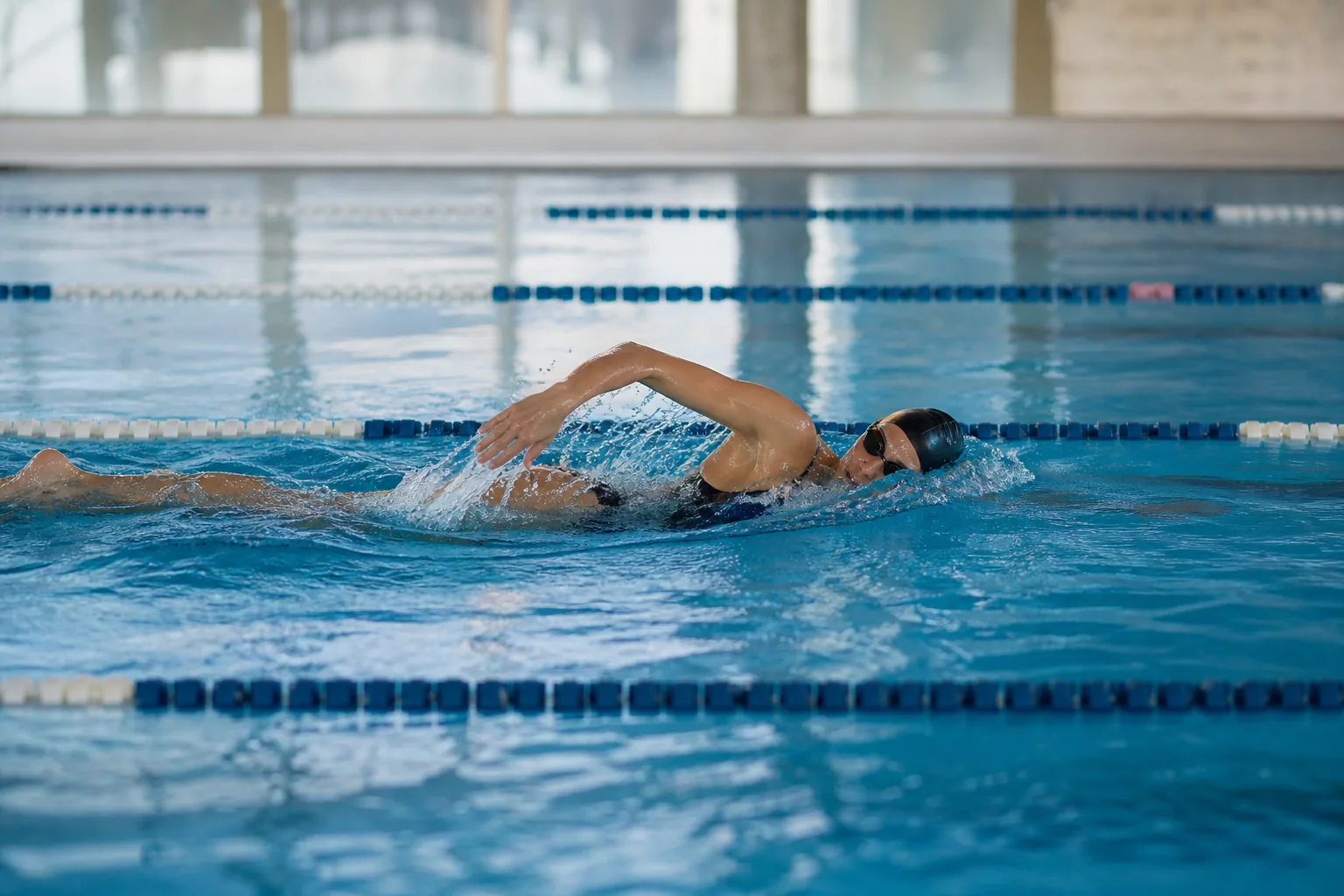
Some swimmers find easy front crawl or backstroke more comfortable because the flutter kick differs from breaststroke's whip kick. That is a possible alternative, not a guarantee. Hard flutter kicking, prolonged sessions, and forceful push-offs can still be demanding. Start with a familiar easy version and stop if the knee response worsens or if another area becomes uncomfortable.
If breaststroke is the only stroke you know confidently, do not attempt an unfamiliar one alone in deep water. A lesson or supervised session may be a better investment than forcing a painful stroke to work. Shallow-water movement or another land-based activity may also be appropriate, depending on your health and access. Safety and confidence are part of exercise selection, not optional extras.
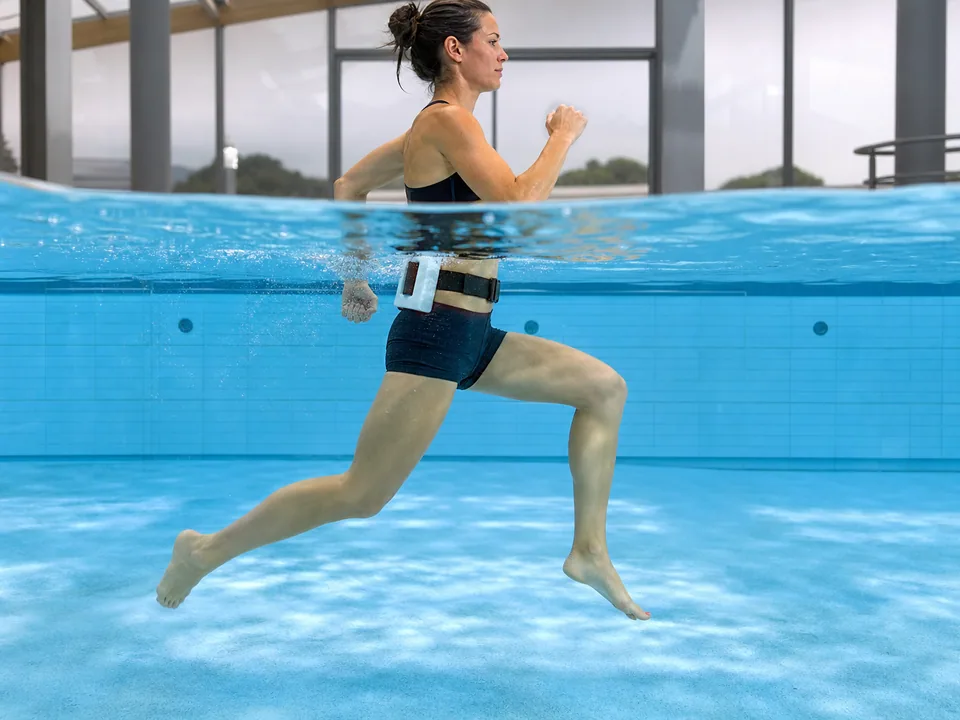
Water walking and aqua jogging are distinct from swimming breaststroke. They can let you explore a different movement pattern, but they still need an appropriate dose and setup. The separate aqua-jogging guide covers that activity without assuming that buoyancy makes every water exercise interchangeable. A suitable alternative is one that stays comfortable during and after the session.
| Alternative | What changes | What still needs checking |
|---|---|---|
| Easy front crawl | Flutter kick instead of the breaststroke whip kick | Kicking effort, shoulder tolerance, and push-offs |
| Easy backstroke | A different body position with a flutter kick | Confidence, lane awareness, and comfortable technique |
| Appropriate pull-buoy work | May reduce active kicking | Swimming skill, upper-body workload, and turns |
| Water walking or aqua jogging | A separate upright or supported movement task | Depth, balance, access, and symptom response |
| A comfortable land activity | Removes the provoking swimming pattern | Its own fit, dose, and medical restrictions |
A gradual return is a sequence, not a deadline
There is no reliable universal number of days for breaststroker's knee to resolve because the label covers different problems. Start from your current daily function and the plan agreed with your clinician when assessment is needed. A knee that remains swollen, locks, or hurts while walking is not ready for repeated technique tests simply because a week has passed.
When an easy coached reintroduction is appropriate, keep it brief and separate it from a hard workout. Check the response during the kick, after leaving the pool, later that day, and the next morning. Repeat the same manageable dose before adding more. If symptoms return, reduce the exposure and discuss the pattern rather than assuming you need to push through an adaptation phase.
| Step | Useful marker | Reason to pause |
|---|---|---|
| Settle the provoking exposure | Daily movement is near the usual baseline | Ongoing swelling or worsening ordinary walking |
| Review technique and dose | A clear small change and a short test are agreed | Multiple forced corrections or painful drills |
| Reintroduce easy kicking | The dose is comfortable during and afterward | Increasing pain or a protective movement pattern |
| Repeat before progressing | The response remains manageable across sessions | Each session leaves a worse next-day knee |
| Add distance or effort gradually | Only one workload variable changes at a time | A sudden return to hard kick sets and sprint turns together |
Strength work and recovery need an individual plan
A broader program may include lower-limb strength, mobility, and control work, but the right exercises depend on the assessment and what you can tolerate. Do not use a generic list of deep squats, twisting stretches, and high-volume kicks as a treatment package for an undiagnosed knee. The knee exercise guide provides general context, not a replacement for specific rehabilitation.
Also review what changed outside the pool. A new leg workout, longer walks, more stairs, or a return to running may contribute to the total demand. Sleep and recovery opportunities can affect how manageable the week feels. A swim that has not changed on paper can occur within a much harder overall week. Record those differences before blaming one isolated technique feature.
When to Get Medical Help
Seek prompt care for severe pain, major swelling, inability to bear weight, locking, deformity, or fever with a hot red knee. Arrange assessment for recurrent inner-knee pain, giving way, symptoms after an injury, or pain that now affects normal walking and stairs. After surgery, obtain specific advice about wound healing, pool access, and breaststroke kicking before returning.
Bring the useful details: painful kick phase, recent training changes, whether other strokes hurt, and the later response. A coach can help describe the movement, but cannot rule out medical causes from technique alone. The aim is to return to a sustainable enjoyable activity with a manageable knee, whether that eventually includes breaststroke or a different option.
Frequently Asked Questions
Why does breaststroke hurt my knees?
The kick combines knee bending and straightening with rotation and force against the water. Its width, timing, effort, and repetition may exceed your current tolerance. Pain can also have causes unrelated to technique, so persistent symptoms need assessment.
What is breaststroker's knee?
It is a descriptive term commonly used for knee pain associated with breaststroke, often on the inner side. It does not identify a single damaged structure. Different swimmers can have different clinical findings despite similar symptoms.
Should I stop breaststroke if my inner knee hurts?
Stop the painful kick rather than repeatedly swimming through it. You may be able to use another comfortable stroke or activity, but stop the session if symptoms continue or your movement changes. Swelling, locking, or instability needs assessment.
Will a narrower breaststroke kick fix knee pain?
Not necessarily. Kick width is only one variable, and forcing the knees together can create a different awkward movement. Older studies do not establish a universal safe angle. Have a coach and, when needed, a clinician review your individual movement.
Is freestyle better than breaststroke for painful knees?
Some people tolerate a relaxed flutter kick better because it avoids the same whip-kick pattern. Freestyle is not guaranteed pain-free, and hard kicking or forceful wall push-offs can still be uncomfortable. Test an easy familiar alternative rather than replacing one hard session with another.
Can I use a kickboard with breaststroker's knee?
A kickboard does not remove knee demand and may increase the number of isolated kicks. Do not continue painful breaststroke kick sets because you are holding a board. Discuss a suitable drill or alternative with your coach.
Should I stretch my knees to improve breaststroke turnout?
Do not force the knee into rotation or have someone push the feet outward. Hip and ankle movement, coordination, and training dose all matter. A clinician can assess a genuine mobility restriction and recommend appropriate exercises.
How long does breaststroke knee pain take to settle?
There is no single recovery time because the label covers different problems. Progress depends on the cause, severity, daily symptoms, and response to changing the painful activity. Return by symptom response and professional guidance rather than a fixed number of days.
Can I swim breaststroke after knee replacement?
Ask your surgeon and physiotherapist about wound healing, pool entry, stroke choice, and the kick itself. Permission to enter a pool does not automatically clear forceful breaststroke kicking. Follow your procedure-specific rehabilitation plan.