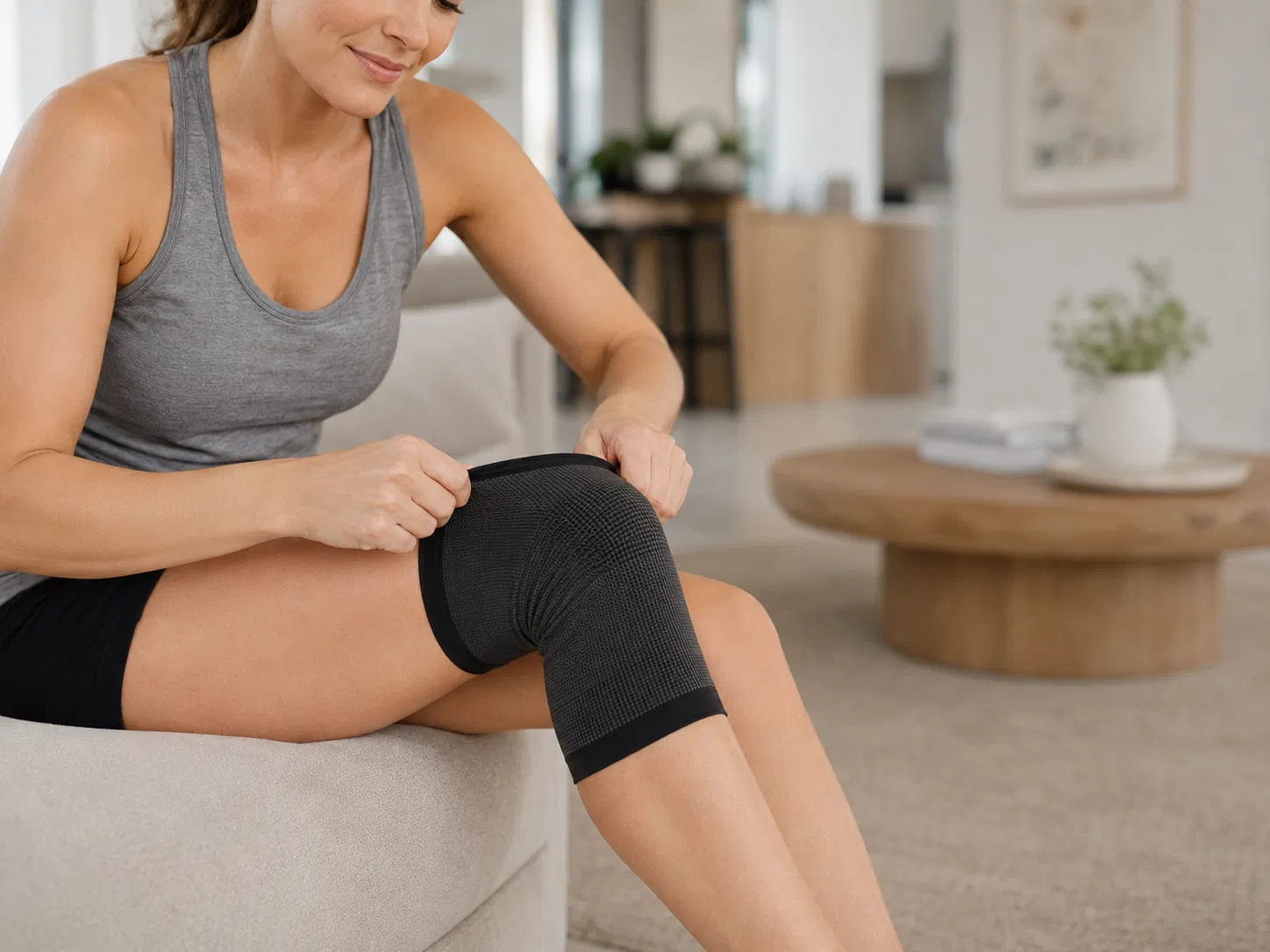
A planned floor transfer is different from recovering after a fall
Getting up after intentionally sitting on the floor starts with a known situation. Getting up after a fall starts with an unanswered injury question. Do not apply a practice routine automatically to a fall. Pain, dizziness, an unusual limb position, or a possible head impact may change what is safe to do next.
If you may have injured your head, neck, back, or hip, or cannot get up safely, call for appropriate help. Use your local emergency number when needed. Avoid repeated efforts that leave you exhausted and farther from support. A helper should not try to drag you upright simply because you are embarrassed to remain on the floor.
The rest of this guide explains planning and professional teaching for floor transfers when there is no suspected new injury. It does not replace emergency advice or a rehabilitation plan. If the main issue is pain rising from an ordinary chair, see the knee pain after sitting guide instead.
Why the floor is harder than a chair
A floor transfer asks you to move through a larger change in height than standing from a typical seat. Depending on the method, you may need substantial knee bending, pressure through a kneeling leg, arm support, balance, and a controlled weight shift. A person can manage walking reasonably well while finding this particular combination difficult.
That difficulty is not a diagnosis. Knee pain, hip stiffness, hand arthritis, reduced strength, balance concerns, and fear after a previous fall can all influence the movement. An assessment should consider the whole transfer rather than assuming the knee is the only limiting factor.
The route matters too. A method demonstrated by a flexible young athlete may demand a deep squat or single-leg balance that does not suit you. Your goal is not to rise without using your hands to impress anyone. It is to return to a stable position using an appropriate amount of support.
Set up the room before you get down
Choose a clear area beside suitable stable furniture, with enough space for the route you have been taught. Remove loose rugs, cords, and objects that could interfere with your feet or hands. A surface that slides under pressure can make an otherwise familiar movement unpredictable.
Furniture must tolerate the direction of force you will place on it. A rolling office chair, lightweight side table, or folding chair is not a reliable substitute for a fixed support. Even a heavy chair can move on some floors. Ask a therapist to assess the actual furniture and room when your confidence is limited.
Keep a phone or alarm within reach, not on a high counter across the room. If you are practicing with assistance, explain the plan before starting. The helper should know when to offer guidance, when to stop, and when professional assistance is needed. Presence alone does not make an improvised lift safe.
A supported half-kneeling route may suit some people
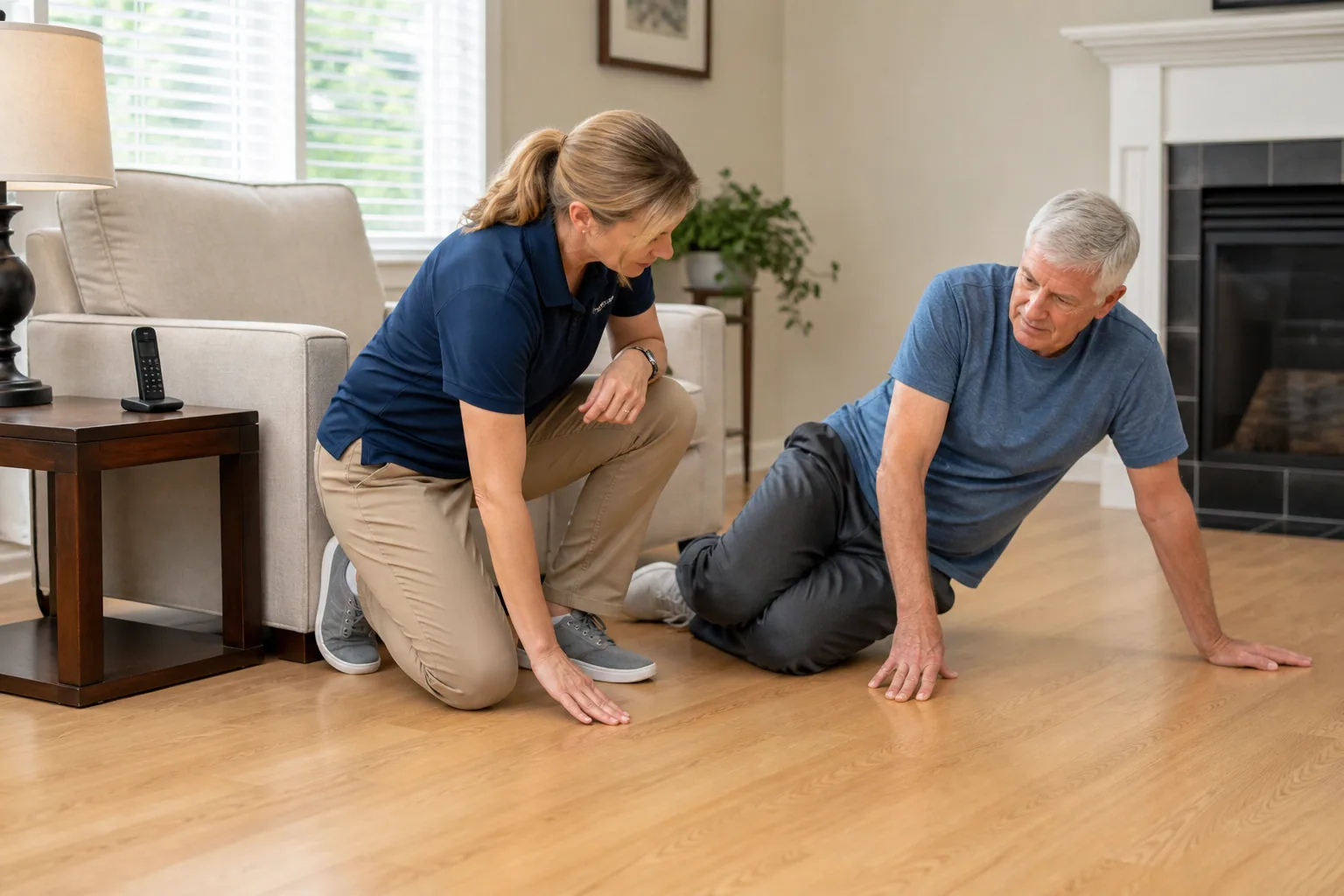
Many professionally taught floor-rise methods use a stable support and pass through a kneeling position. Broadly, a person moves toward the support, brings one foot forward into half-kneeling, and uses coordinated leg and arm effort to rise or reach a seat. The precise sequence depends on their abilities and the environment.
This route is not compulsory. It may be unsuitable when kneeling is painful, knee bending is restricted, the wrists cannot take support, or balance is uncertain. A recent operation may impose additional restrictions. Do not force the movement because a diagram makes it appear straightforward.
When a therapist teaches the route, ask which leg should come forward, where the hands should go, and how to pause safely between stages. Practice the difficult transition under supervision rather than repeating the entire transfer until tired. Knowing how to stop in a stable position is as important as knowing how to finish.
What if you cannot kneel?
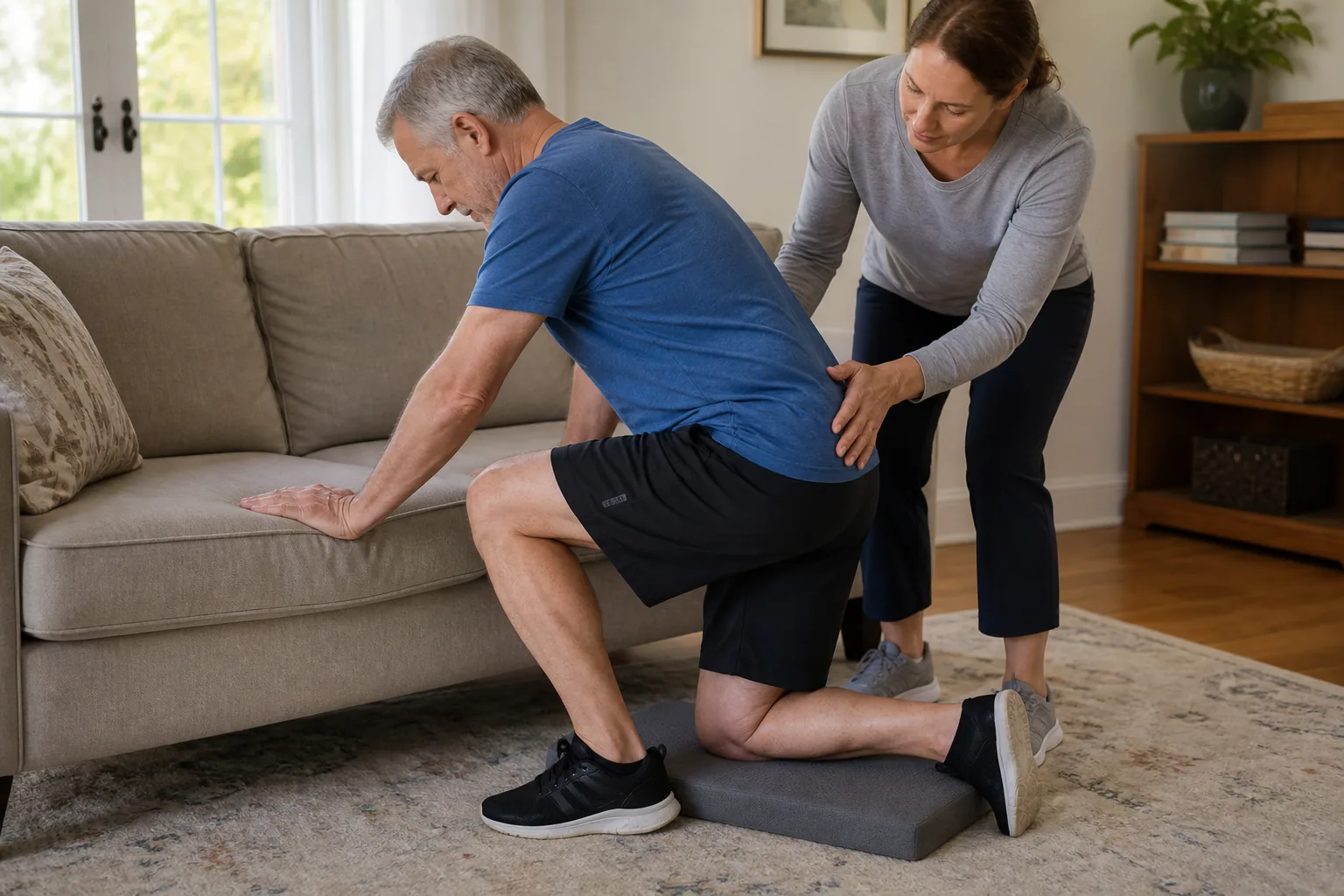
Explain whether the problem is pressure on the front of the knee, the amount of bending, or both. Padding may help contact discomfort for some people but does not remove the joint's bending demand. If kneeling remains unsuitable, a therapist can assess another route rather than simply adding more cushions.
Some people use an intermediate seat or another transfer technique after instruction. The appropriate height, stability, hand position, and direction of movement are individual. Do not build a tower of loose cushions or climb an improvised stack of stools. An alternative is only helpful if it reduces the overall risk.
For people who cannot rise safely with ordinary support, specialist lifting equipment or trained assistance may be the right answer. That is not failure. The practical goal is a reliable way off the floor without injuring the person or helper, not preserving the appearance of independence at any cost.
Match the obstacle to the support you need
| Main obstacle | What to discuss | Avoid |
|---|---|---|
| Pressure when kneeling | Whether suitable padding or a non-kneeling route is appropriate. | Assuming thicker padding fixes restricted motion. |
| Limited knee bending | A route that respects available movement and restrictions. | Forcing a deep squat or kneeling position. |
| Painful hands or wrists | Different support surfaces or transfer assistance. | Pulling harder through an already painful arm. |
| Poor balance | Supervision, fixed support, and a safer route. | Practicing near stairs or unstable furniture. |
| Low strength or fatigue | Short supervised practice and possible equipment. | Repeated failed attempts until exhaustion. |
| Recent fall or injury | Injury assessment before transfer practice. | Treating the event as a routine exercise challenge. |
This table helps organize a conversation rather than select a technique by itself. Several obstacles can occur together. A method that reduces knee pressure may increase demand on the arms; a route with less bending may require more balance. A good assessment considers these trade-offs together.
How a helper can be useful without hauling you upright
A helper can clear the area, bring a phone, contact assistance, and help you remember a professionally taught sequence. They can also notice signs that you should stop, such as increasing pain, dizziness, or loss of control. Those roles are valuable even when they do not physically lift you.
Unplanned pulling under the arms or lifting by the hands can injure both people. The person on the floor may not be able to take weight as expected, and the helper may lose balance. If a transfer requires physical assistance, ask for appropriate training and equipment rather than relying on strength or goodwill.
Agree on clear communication. Say which movement is about to happen, where support will be, and what word means stop. Avoid several helpers giving different instructions at once. A calm, predictable sequence is easier to follow than rushed encouragement to get up quickly.
If you cannot get up, make help reachable
Call for assistance using a phone, personal alarm, or another available method. Tell the responder whether you fell, where you are, whether you may be injured, and whether you can move safely. If there is a possible serious injury, follow emergency instructions rather than attempting to move closer to the door.
While waiting, keep warm and as comfortable as the situation allows. If you have not been advised to remain still because of injury, the responder may guide appropriate small position changes. Do not copy a general instruction to crawl or shuffle when pain or a suspected fracture makes movement unsafe.
A plan made in advance is easier to use under stress. Consider where the phone usually sits, whether someone can enter the home, and who knows your routine. A personal alarm can be worth discussing when falls or difficulty rising are recurrent. It supports access to help; it does not replace assessment of the cause.
Practice the skill without turning it into a fitness test
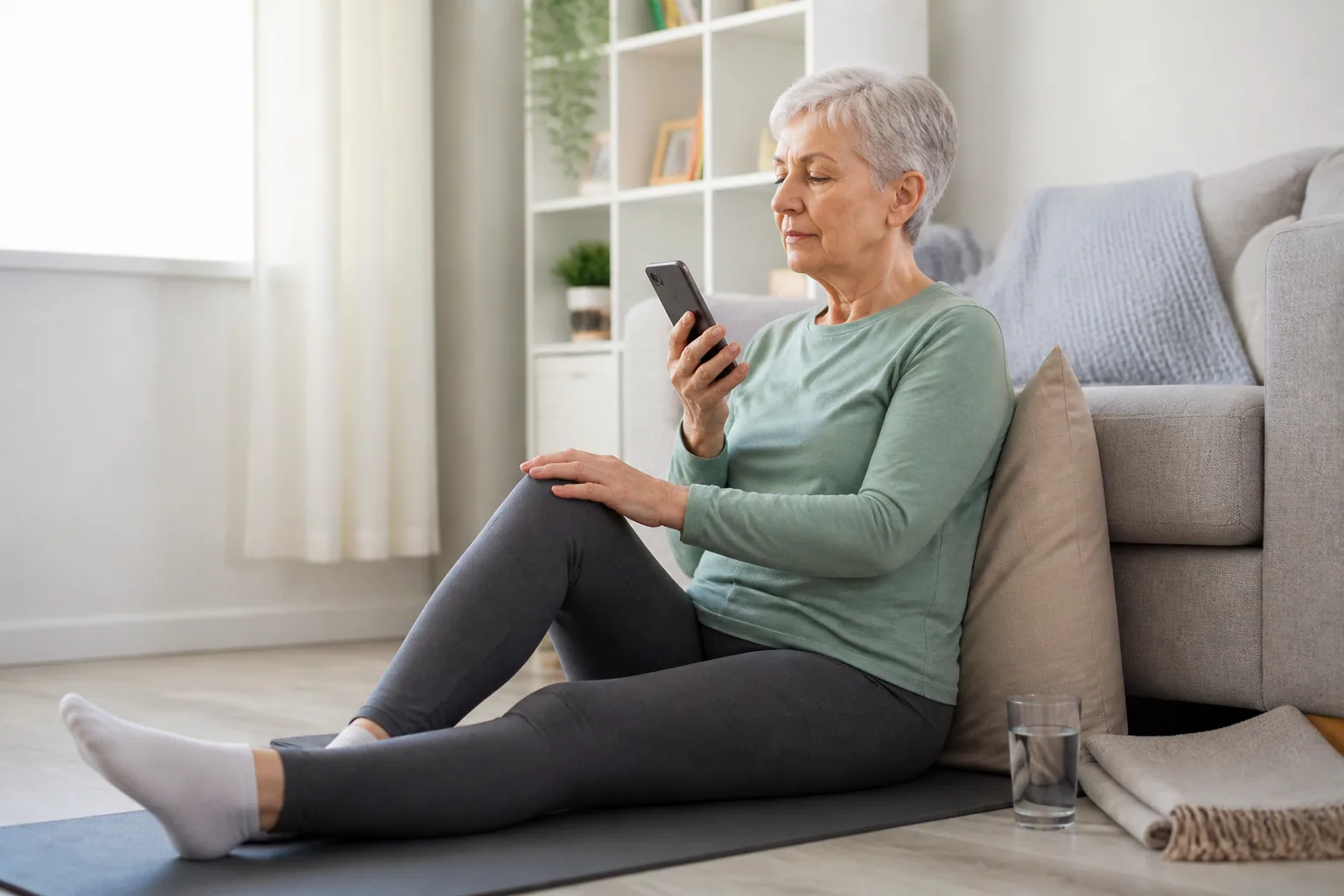
Do not get down alone simply to discover whether you can get up. Start with a professional demonstration and appropriate supervision. The first goal may be understanding one transition or learning how to position the support, not completing several repetitions.
Fatigue changes the task. A transfer performed once with good control may become much harder after repeated attempts. Keep practice short enough that the final movement remains deliberate. If symptoms increase, stop and discuss the cause instead of treating the discomfort as a necessary training effect.
Practice should also include the descent when appropriate. Getting down may require different control from getting up, and a rushed descent can create the very problem you hoped to prevent. Ask how to choose a stable finishing position and how to avoid ending farther from the support than planned.
Build capacity separately from the floor transfer
A therapist may recommend strength, balance, or mobility work based on the limiting factors they identify. That programme should be distinct from repeatedly testing the full floor rise. Improving a component can make the task easier without requiring you to attempt the most difficult version every day.
For someone with limited mobility, supported or seated exercise may be an appropriate starting point. Our seated knee exercise guide discusses accessible movement options, but it does not guarantee floor-transfer readiness. Being able to complete a chair routine is not the same as safely managing a floor transition.
A formal chair-stand assessment also measures a different task. Do not interpret a score as permission to try an unsupported floor rise. The height, balance demand, and available hand support differ. Use each assessment for its intended purpose and ask how the result connects to your actual daily goal.
Reduce unnecessary trips to floor level
You can make daily life easier while working on transfer ability. Move frequently used items from very low cupboards, use an appropriate long-handled tool, or choose a supported seat for a hobby. These changes reduce the number of difficult transfers without requiring you to abandon the activity.
For gardening or household tasks, a stable setup at a higher level may be more useful than kneeling longer with thicker pads. Our kneeling protection guide explains the difference between cushioning and changing the task. Protection is not a substitute for a workable route back to standing.
When playing with children or pets, decide how you will get up before sitting down. Choose a location beside suitable support and keep the exit space clear. Asking someone to move a toy or bring a chair before the transfer is easier than improvising once the knee is already uncomfortable.
Questions for a home or therapy assessment
| Question | Why it matters |
|---|---|
| Which stage is limiting me? | The answer may involve motion, pressure, strength, balance, or several factors. |
| Is this furniture suitable? | Support must remain stable under the actual direction of loading. |
| What is my non-kneeling option? | Painful kneeling should not be forced as the only route. |
| What should my helper do? | Guidance and trained assistance differ from an improvised lift. |
| How do I stop midway? | A safe pause prevents rushing through a difficult transition. |
| What is the plan if I cannot rise? | A reachable phone, alarm, and contact plan reduce uncertainty. |
Bring a description or photographs of the room if an in-home visit is not available. Mention hand problems, dizziness, recent surgery, and previous falls even if the appointment is mainly about knee pain. These details can change the safest route. A transfer is a whole-person task, not just a knee exercise.
Ask for instructions in a form you can revisit, and confirm that they describe your own method rather than a generic handout alone. If the home layout or symptoms change, request a review. The plan should remain usable in the environment where you need it.
When to Get Medical Help
Call for urgent help after a fall with possible head, neck, back, or hip injury, deformity, severe pain, or inability to rise safely. New weakness, fainting, chest pain, or breathing difficulty also requires urgent attention. Recurrent falls or increasing difficulty with transfers deserves assessment even when no single fall seems serious.
A reliable route is more useful than an impressive one
Use the support and assistance your situation requires. A planned transfer, stable furniture, and a clear help strategy can make floor-level activities less daunting. If kneeling is not suitable, seek an assessed alternative. Independence includes knowing when to use equipment, change the task, or call someone to help.
Frequently Asked Questions
How do I get up from the floor with bad knees?
For planned practice, have a clinician teach a route matched to your strength, balance, and knee tolerance. Stable furniture may help, but no single method is safe for everyone.
What if kneeling hurts too much?
Do not force it. Ask about a seated intermediate-height transfer or another professionally assessed alternative rather than improvising a deep squat.
Should I get up immediately after a fall?
Check for injury first. If you may have injured your head, neck, back, or hip, or cannot rise safely, call for help instead of attempting repeated transfers.
Can someone pull me up by my arms?
Avoid an unplanned manual lift. It can injure both people. Helpers should follow appropriate training or contact assistance.
Can I use a rolling chair?
No. A rolling or unstable chair can move when loaded. Support must be appropriate, stable, and positioned for the transfer.
Will a knee pad make kneeling safe?
Padding may reduce contact discomfort, but it does not remove bending demands or override injury and surgical restrictions.
Can I practice alone?
Not if you are uncertain you can return safely. Arrange suitable supervision and a way to call for help before getting down.
Does difficulty rising mean my knees are damaged?
Not necessarily. Strength, balance, confidence, joint motion, and the transfer method all contribute. Persistent difficulty deserves assessment rather than a diagnosis from one attempt.