Start with the moment the pain appears
Think back to the first clear symptom, not just the point when the round became uncomfortable. Was it during the backswing, as weight moved toward the target, at impact, or during the finish? Did the knee feel normal when swinging but begin to ache on a long descent? Did you notice it only when getting out of the car afterward? These details are more informative than saying the knee hurts after golf.
Do not repeat a painful swing to find the exact frame. A description from the original event is enough. If a normal practice video already exists, it may help a coach understand the movement without asking you to reproduce a painful episode. Sudden symptoms after slipping, twisting, or catching a foot need an injury assessment when function is affected, even if the shot itself looked ordinary.
| Pattern | Useful question | What it does not prove |
|---|---|---|
| Pain during one swing phase | Which phase, which knee, and did the foot stay planted? | A particular ligament or meniscus injury |
| Ache building through the round | How many holes, how much walking, and how hilly was the course? | That the swing is harmless or arthritis is the cause |
| Symptoms on slopes or uneven lies | Does level walking feel different? | That a new shoe or insole will solve it |
| Pain after a slip or twist | Was there swelling, loss of movement, or giving way? | That being able to finish the hole excludes injury |
Lead knee and trail knee are better labels than left and right
The lead knee is on the target side of your stance. It is the left knee for a golfer who swings right-handed and the right knee for someone who swings left-handed. The trail knee is the other knee. Handedness matters because advice about a golfer's left knee often silently assumes a right-handed swing. Write both the physical side and its swing role in your symptom notes.
The knees do not perform identical jobs. During the swing, the lead knee moves through changing flexion, extension, rotation, and load as the body turns and transfers pressure. The trail knee participates in the backswing and the movement toward the target, then changes position as the trail heel releases. Describing these roles does not mean that either knee should be fixed rigidly in place.
Biomechanics studies help explain why lead and trail symptoms deserve separate consideration. An original study of older adult golfers compared lower-limb joint moments during the swing with walking and standing from a chair. The demands differed by joint, direction, and side. That supports a practical distinction between swinging and walking, but it cannot tell an individual golfer which tissue is painful or provide a safe maximum number of swings.
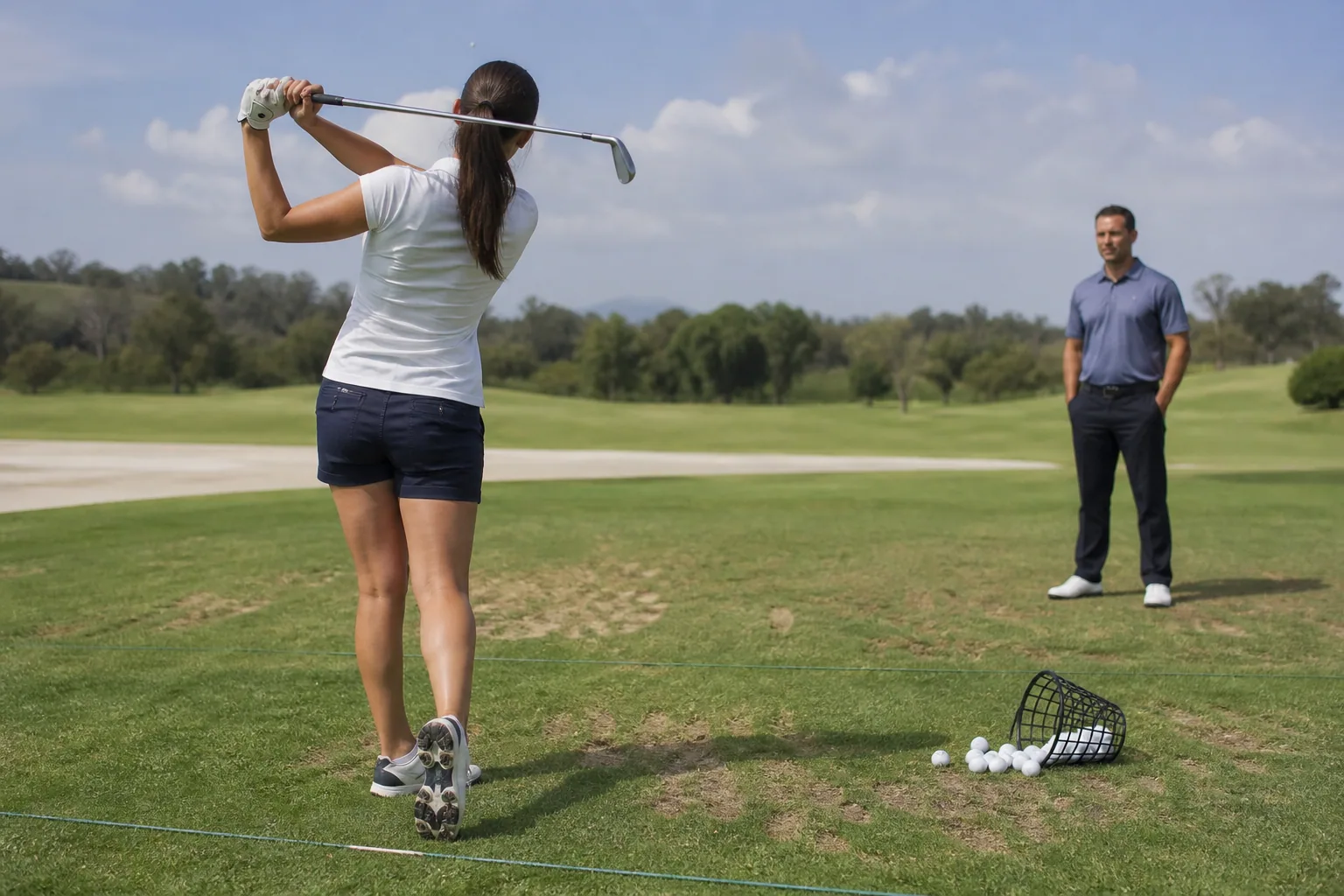
Golf is not one knee load
A round includes more than the swings counted on the scorecard. Warm-up balls, rehearsal swings, walking between shots, standing while others play, bending to retrieve a ball, getting into a buggy, and moving across bunkers all contribute. A player returning after several quiet weeks may underestimate the total because golf does not feel like a conventional workout.
Consider a golfer who normally practices for half an hour on a flat range, then plays a hilly eighteen-hole course with a bag on one shoulder. If symptoms appear late in the round, the extra walking and carrying deserve attention alongside technique. Conversely, a golfer who rides between every shot but has immediate pain at the finish cannot assume that removing walking has removed the relevant demand.
There is no universal number of holes that is safe for a sore knee. The useful comparison is with your recent baseline. Note whether the session was longer, the surface less predictable, the weather more tiring, or the preceding day unusually active. A long gardening session or leg workout can matter even when the golf schedule itself has not changed.
Separate course walking from swing rotation
If symptoms are mild, no injury warning signs are present, and ordinary walking is comfortable, think about which part of the activity can be reduced. A shorter, flatter round can reduce walking demand. A practice session with fewer easy shots can reduce swing repetitions. Changing both may be necessary during a flare, but keep a record so you know what you actually tolerated.
A cart is an option for reducing distance, not a medical clearance. You still have to walk to balls, negotiate uneven ground, rotate through shots, and get in and out. On some courses, cart restrictions leave substantial walking from the path. Ask about the real route rather than assuming a cart turns a demanding course into a short outing.
A push trolley removes a carried bag from your shoulders, but it still has to be managed on slopes. Do not replace one difficult task with another that worsens symptoms. If walking is the main limitation beyond golf, our guide to knee pain after long walks helps organize distance, terrain, and recovery questions.

What pain location can and cannot tell you
Front-of-knee symptoms, inner joint-line pain, outer discomfort, and pain behind the knee are useful descriptions. They are not reliable shortcuts to a diagnosis. The same place may hurt with different conditions, and discomfort from one structure can overlap the area associated with another. Swelling, movement loss, timing, previous injuries, and an examination help make sense of location.
A twisting episode with joint-line pain and catching may make a clinician consider a meniscal injury among other possibilities. AAOS notes that meniscus tears can cause swelling, catching, and restricted movement. None of those symptoms alone proves a tear, and being able to walk immediately afterward does not settle the question. Do not turn a list of symptoms into a home twisting test.
For a broader map, use our knee pain location guide. A knee that becomes physically stuck belongs in a different category from an occasional noise. Our locking versus catching guide explains that distinction, including why a newly locked knee needs urgent assessment.
Technique changes should be small and individualized
Online advice often recommends flaring the lead foot, widening the stance, shortening the backswing, or allowing the trail heel to lift. Each can change movement, but none is a universal remedy. Foot angle studies examine biomechanical variables under particular laboratory conditions. A lower value for one measured moment is not proof of lower injury risk, and one adjustment can change demand elsewhere.
A study examining lead-knee osteoarthritis risk factors investigated stance-related mechanics, rather than following golfers long enough to show which technique prevents arthritis. More recent work in knee replacement biomechanics also explores foot rotation, but an artificial joint is not interchangeable with every natural knee. These findings can inform a professional discussion without becoming a prescription for a precise foot angle.
Tell a qualified coach which movement is uncomfortable and what your clinician has restricted. Ask for one modest adjustment at a time and keep the session brief. The aim is a comfortable, balanced movement you can control, not a dramatic new swing while the knee is irritable. Stop if pain increases, balance deteriorates, or the movement starts to feel guarded.
| Variable to discuss | Reason to review it | Practical boundary |
|---|---|---|
| Stance and foot angle | They influence how the body can turn over the feet | No forced angle or universal degree target |
| Swing effort and repetitions | A range bucket can add substantial repeated demand | Do not test improvement with maximum-speed swings |
| Footwear and traction | Grip and comfort differ with surface and shoe condition | Avoid deliberately slippery shoes or insecure footing |
| Uneven lies and bunkers | They change stance, balance, and getting in or out | Use a simpler practice setting while rebuilding tolerance |
Footwear matters, but more grip is not always the whole answer
Golf shoes need to fit well and provide appropriate traction for the conditions. A slipping foot can create an unexpected movement, while a firmly planted foot interacts with the body's rotation. That does not establish a simple rule that spikes cause knee pain or spikeless shoes prevent it. Surface, swing, shoe geometry, and personal comfort all contribute.
Inspect worn soles, heel hold, pressure points, and whether the shoes feel stable on the actual course. If symptoms began after changing shoes, record that change without ignoring a simultaneous increase in playing time. Do not add a new insole, alter the stance, and increase practice volume together, then assume the result identifies which change helped.
A knee support is similarly specific to the problem. Some assessed conditions may warrant a prescribed brace, while a sleeve may simply feel reassuring. Neither should be used to override instability or a clinician's restrictions. Our brace versus compression sleeve guide explains why these are different categories of support.
Prepare for the round you can currently tolerate
A warm-up is an opportunity to notice readiness, not to erase warning signs. Begin with comfortable everyday movement and easy practice appropriate to your current ability. If walking to the tee already causes a limp, do not use increasingly forceful swings as a way to loosen the knee. Reconsider the session before the social pressure of the round makes stopping harder.
Allow time between practice shots. A rapid sequence from a large bucket can hide how much repetition you are accumulating. Keep early sessions on a predictable surface, with a comfortable effort and an easy stopping point. The fact that a wedge is shorter does not guarantee that every knee load is lower, so choose the task by your actual response rather than club length alone.
Strength and conditioning may form part of a longer-term plan, particularly when your current capacity does not match the amount you want to play. The programme should fit the assessed problem and include relevant leg, hip, balance, and general fitness work. Golf pain is not proof of weak quadriceps, and doing more squats is not an automatic first response to a new injury.
A return plan needs separate checkpoints
For a mild, improving problem that has been assessed when necessary, rebuild the parts of golf separately. Comfortable daily walking does not automatically mean readiness for repeated full swings. Equally, a few comfortable shots do not establish readiness for hours on a hilly course. Plan the exit before starting, so stopping early feels like part of the plan rather than a failed round.
| Checkpoint | What to observe | Reason to pause |
|---|---|---|
| Ordinary daily activity | Walking, stairs, and usual getting up without a worsening pattern | A limp, swelling, or declining movement |
| Brief easy practice | Comfort, balance, and later symptoms with limited repetitions | Pain that escalates or alters the swing |
| Shorter course exposure | The combined effect of walking, waiting, and swinging | Symptoms building from hole to hole |
| Later and next-day review | Whether the knee returns to its familiar baseline | A progressively worse response across sessions |
Do not use a fixed pain score as permission to continue. A mild number accompanied by new swelling or giving way is different from a familiar ache that settles promptly. Keep notes on function as well as discomfort: how you walked afterward, whether stairs changed, and whether the knee moved normally the next morning. Those details make progression decisions more meaningful.
If you have arthritis or a knee replacement
A previous diagnosis does not explain every new symptom. A golfer with established arthritis can also sustain an injury, develop a new movement restriction, or have a flare that needs a different plan. Compare the current episode with your familiar pattern and contact your clinician when it is substantially different, especially if swelling or function changes.
After surgery, the operating team's restrictions take priority over general golf advice. A repaired meniscus, ligament reconstruction, and knee replacement involve different tissues and timelines. Explain whether the operated knee is your lead or trail knee and whether your goal is range practice, nine holes with transport, or walking a full course. Those are not equivalent activities.
Research in healthy older golfers describes considerable individual variation in movement. It should not be converted into a promise that all older players can copy one position safely. Your current balance, other joints, recovery, and surgical advice matter more than matching a professional golfer's finish.

What to bring to an assessment
Prepare a short timeline with the first painful session, any distinct twist or slip, and the knee's lead or trail role. Include the course profile, holes played, walking or cart use, practice volume, footwear changes, and symptoms outside golf. Mention previous surgery and any current restrictions. These details help the clinician distinguish an activity pattern from a possible new injury.
Ask what findings support the working explanation, which activities are currently appropriate, and what would trigger reassessment. If a scan is discussed, ask what decision it would change. Imaging can answer important questions in selected situations, but it should be interpreted alongside the history and examination rather than used as a standalone explanation for every painful round.
When to get medical help
Seek urgent assessment for a newly locked knee, inability to bear weight, severe pain, major swelling or deformity, or a hot red knee with fever. Arrange assessment for recurring pain, giving way, a persistent limp, or symptoms that limit daily activity despite reducing golf. Do not force a stuck knee straight or use a support or massage device to finish the round.
The useful question is which part of golf needs to change
Golf knee pain is best approached by separating the swing from the course. Identify the lead or trail knee, describe the timing, account for total walking and practice, and pay attention to changes in function. Small, well-observed adjustments can make the pattern clearer. If the knee is not improving or the story suggests injury, a focused assessment is more useful than collecting more swing tips.
Frequently Asked Questions
Why does my left knee hurt after golf?
For a right-handed golfer, the left knee is the lead knee and experiences different demands from the trail knee during the swing. For a left-handed golfer it is the trail knee. Walking distance, slopes, previous injuries and other knee conditions also matter, so the side alone cannot identify the cause.
Which knee takes more stress in a golf swing?
Research generally describes more demanding loading and rotation at the lead knee, but the size and direction of forces vary with technique, measurement method and the individual. Greater measured load does not mean that a particular swing causes injury or that the trail knee cannot hurt.
Can walking the golf course cause knee pain?
A long round can exceed current walking tolerance, especially with hills, uneven lies, a heavy bag or more standing than usual. Symptoms that build with the holes played may reflect cumulative demand, but persistent or worsening pain still deserves assessment.
Should I use a golf cart if my knee hurts?
A cart can reduce walking demand when that is the aggravating part and walking is otherwise safe. It does not remove swing rotation, awkward lies or repeated getting in and out. A cart is not a way to continue playing through a new injury or locked knee.
Will flaring my lead foot stop golf knee pain?
Changing foot angle can alter knee mechanics, but no angle is a proven cure for all golfers. Discuss small technique changes with a qualified coach and, when symptoms persist, a clinician. Avoid forcing an unfamiliar position or sacrificing secure footing.
Can I play golf with knee arthritis?
Many people remain active with knee arthritis, but the appropriate amount of golf depends on symptoms, function and individual advice. Shorter rounds, suitable terrain and a gradual build-up may help manage demand. A sudden change, new locking or a markedly swollen knee should not be dismissed as routine arthritis.
Does a knee brace make golf safe?
A brace may have a role for a specific assessed problem, but it does not establish that a knee is safe for twisting or a long round. A soft sleeve is not the same as an injury-specific brace. Persistent instability requires evaluation, not simply a tighter support.
When can I return to golf after knee surgery?
Follow the operating team's guidance because repair type, healing stage and restrictions differ. Walking a course and completing repeated full swings are separate milestones. Your lead or trail side, terrain and recent function should be considered in the return plan.
When is golf knee pain urgent?
Seek urgent assessment for a knee that becomes stuck and cannot straighten, inability to bear weight, severe pain, major swelling or deformity, or heat and redness with fever. Stop the round after a significant twist with new instability or rapidly developing swelling.