The knee support aisle is one of the more confusing places in a pharmacy. Products that look almost identical range from a few dollars to several hundred, the descriptions all use the same words, and nothing on the packaging tells you which problem each one was designed for. Most people end up choosing on price or on which box makes the boldest promise, then conclude that knee supports do not work when the one they bought does nothing for them.
The category is actually quite logical once you separate it out. There are four broad types, they sit on a clear scale from least to most supportive, and each one matches a specific pattern of symptoms.
The Four Kinds of Knee Support
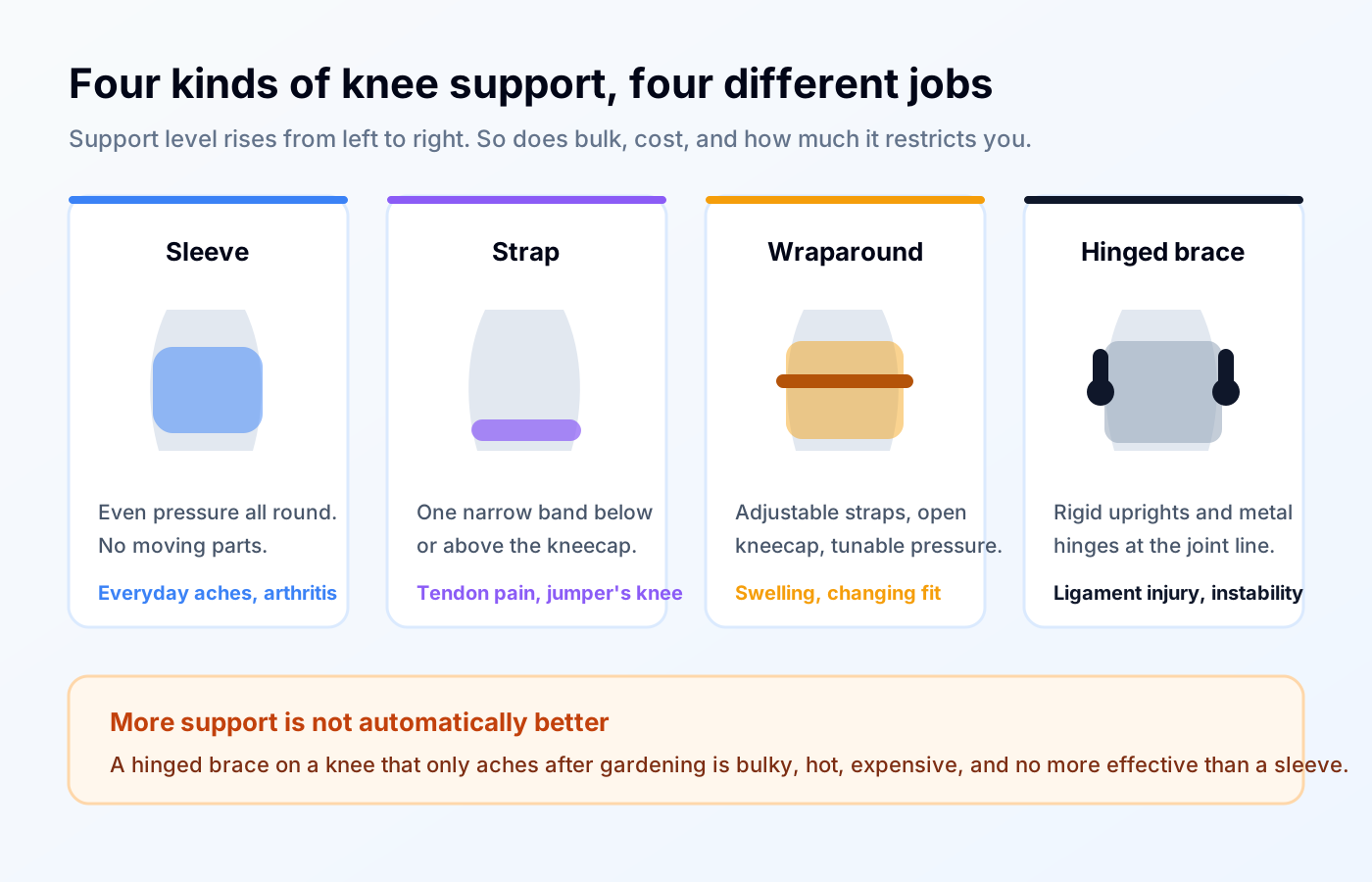
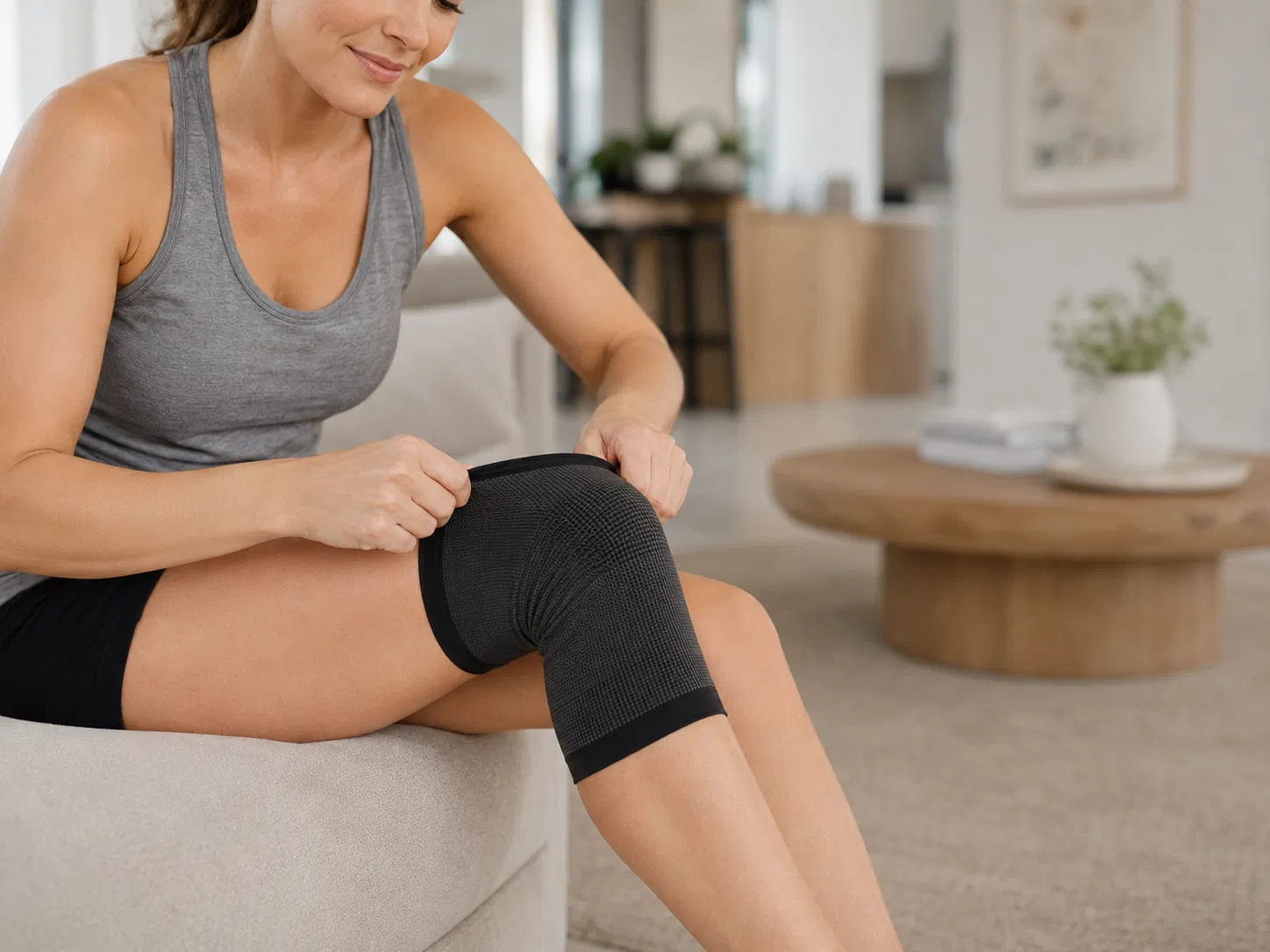
A compression sleeve is a simple elastic tube that you pull on. It has no straps, no hinges and no adjustments. It applies even pressure around the whole joint, holds warmth against it, and gives your nervous system a constant stream of information about where the knee is in space. That last effect, sometimes called proprioceptive feedback, is a large part of why sleeves feel reassuring even though they add no real mechanical support.
A patellar strap is a narrow band worn just below, or occasionally above, the kneecap. It applies focused pressure to the tendon rather than the joint as a whole. It is a specialist tool that works well for a specific complaint and does very little for anything else.
A wraparound support fastens with adjustable straps instead of pulling on, usually with an opening over the kneecap. The adjustability is the point: pressure can be retuned during the day, which suits knees that swell and settle, and it is far easier to put on for anyone with hand or hip limitations.
A hinged brace adds rigid uprights and mechanical hinges either side of the joint. This is the only category that genuinely resists side to side and rotational forces. It is heavier, hotter, more expensive and more restrictive, and for the right knee it is the only thing that will do.
| Support type | What it actually does | Best matched to | Where it falls short |
|---|---|---|---|
| Compression sleeve | Even pressure, retained warmth, positional feedback | Everyday aches, arthritis stiffness, mild swelling, general activity | No mechanical stability at all, and sizing varies widely by brand |
| Patellar strap | Focused pressure across the tendon below the kneecap | A sharp, pinpoint pain during jumping, running or stairs | Does nothing for diffuse ache, stiffness or swelling |
| Wraparound support | Adjustable compression, often with an open kneecap | Swelling that changes through the day, difficulty pulling a sleeve on | Bulkier under clothing, straps can loosen with activity |
| Hinged brace | Genuine resistance to side to side and rotational force | Ligament injury, instability, post surgical and clinician guided use | Hot, heavy, expensive, and overkill for an ordinary ache |
What Compression Can and Cannot Do
It is worth being precise here, because the marketing rarely is. Compression around a joint does three things reasonably well. It keeps the area warm, which many people find eases stiffness. It provides constant sensory feedback, which improves confidence in the knee and often changes how carefully someone moves. And it applies gentle pressure that can help with minor everyday swelling.
What compression does not do is hold the joint together. An elastic sleeve cannot meaningfully resist the forces involved when a knee buckles sideways. If your knee gives way, no amount of fabric tension will change that, and treating a stability problem with a sleeve mainly delays the assessment that would identify what is actually wrong.
It also does not treat the underlying condition. A sleeve can make an arthritic knee more comfortable during a walk. It does not slow the arthritis. That distinction matters when deciding how much to spend and what to expect.
The Copper Question
Copper infused sleeves are among the most heavily searched and most heavily marketed products in this category, so they deserve a direct answer rather than a polite one. The compression element of a copper sleeve works exactly as compression works in any other sleeve. The copper itself is the part without support behind it.
Controlled studies comparing copper containing garments with visually identical garments without copper have generally found no meaningful difference in pain or function. The proposed mechanism, copper being absorbed through intact skin in quantities sufficient to influence joint inflammation, is not established. Consumer protection authorities have also taken action over unsupported health claims made for copper based products.
None of which means you should avoid them. If a copper sleeve fits well and you like the fabric, wear it. Just choose it the way you would choose any sleeve, on fit, breathability, durability and price, and do not pay a premium expecting the metal to do something the elastic is not already doing.
Choosing Based on Your Symptoms

That first question does most of the work. Instability is a different category of problem from discomfort, and it usually reflects something structural in the ligaments or meniscus. A knee that buckles under you, catches, locks, or that you no longer trust on uneven ground should be assessed by a clinician before you buy any support, because the right brace for a ligament problem is chosen on the basis of what the ligament is doing.
If the knee aches but feels secure, start at the least restrictive end. A plain sleeve is cheap, easy to wear, and gives you information: two weeks of honest use tells you whether compression and warmth help you at all. From there the details narrow it down. Pain concentrated right under the kneecap on stairs and when kneeling, with some puffiness, often does better with a wraparound that leaves the kneecap open. A sharp, pinpoint pain just below the kneecap during running or jumping is the classic case for a strap. General morning stiffness from arthritis usually calls for a sleeve worn during the stiff hours rather than continuously. Swelling that changes through the day is the clearest argument for adjustable straps, because a fixed sleeve that fits at breakfast may be too tight by evening.
For a specific look at what to expect on stairs, which is the single most common trigger people describe, our guide on knee pain going down stairs covers the mechanics in more detail, and the knee arthritis guide covers where support fits into a broader plan.
Fit Matters More Than Category
A well fitted sleeve outperforms a poorly fitted brace every time, and sizing is where most purchases go wrong. Brands measure at different points on the leg and their charts do not agree, so a medium in one range can be a large in another. Measure your own knee, follow that brand's chart rather than your usual size, and check the fit against a few simple criteria: it should stay in place while you walk without being pulled up, feel firm but not pinching, leave no numbness or colour change below it, and still allow you to bend the knee fully.
If you fall between two sizes, size up for all day comfort and down for sport. Our knee compression sleeve sizing guide walks through the measurement and the four point fit check in detail. If you would rather start with something already matched to that chart, our FlexiKnee compression support sleeve uses graduated knit compression with an open kneecap position, and is the category we would suggest trying before anything firmer.
Where a Heated Massager Fits, and Where It Does Not
Because we make a heated knee device, it is worth being clear about the category boundary rather than blurring it. A support is worn during activity to change how the joint feels while you use it. A heated massager is used at rest to work on stiffness and comfort before or after activity. They are not substitutes for each other, and a device that applies heat and massage will not stabilise a knee any more than a sleeve will.
In practice many people end up using both, for different moments of the day: a sleeve for a long walk or a shift at work, warmth in the evening when the joint is stiff and sore. If that is the pattern you are in, our comparison of smart heated knee braces covers where these overlap and where they do not. On our own side of that line, the FlexiKnee heated knee massager is a recovery device for stiff evenings, and we would not suggest it as an answer to an unstable knee.
When Support Is Not the Answer
There are situations where reaching for any support is the wrong first move. A knee that has swollen significantly, that is hot or red, that locks in position, that gives way, or that will not take your weight needs assessment rather than compression. Pain that keeps waking you at night, or that has been steadily worsening for weeks despite sensible self care, belongs in the same category.
The risk with support is not that it is dangerous, it is that it works just well enough to postpone finding out what is going on. Used sensibly, a sleeve makes an ordinary ache more manageable while you build strength and stay active. Used as a substitute for an answer, it can quietly cost you months.
Brands, Price Tiers, and What You Are Paying For
Prices in this category run from a few dollars for a supermarket sleeve to several hundred for a fitted brace, and the relationship between price and benefit is not linear. It helps to know roughly what each tier buys you.
At the budget end, a basic sleeve gives you compression and warmth. The fabric is usually thinner, it may lose elasticity within months, and sizing tends to be less consistent. For finding out whether compression helps you at all, that is perfectly adequate and arguably the sensible first purchase.
The mid tier, where most recognisable sports brands sit, generally buys better fabric, more reliable sizing, silicone grip bands that stop the sleeve sliding down, and construction that survives regular washing. If you have established that a sleeve helps and you wear one most days, this is where the money is actually well spent, because a sleeve that stays in place gets worn and a sleeve that slides down gets abandoned in a drawer.
At the top end you are usually paying for either a genuine hinged brace with engineered joints, which is a different product category altogether, or for a marketing story. Medical grade compression brands, specialist sports supports and clinician fitted braces can be worth their price for the right knee. Premium sleeves distinguished mainly by an infused mineral, a proprietary fabric name or an athlete endorsement generally are not. When comparing two products at very different prices, the honest question is whether the difference lies in the hinges, the sizing precision and the build quality, or only in the packaging.
How Long Should You Wear It Each Day?
There is no universal number, but a few principles hold. Wear it for the activity that provokes the symptoms rather than continuously out of habit. For most people that means putting a sleeve on for a long walk, a shift on your feet, a gardening session or a run, and taking it off afterwards. Sleeping in a compression sleeve is generally unnecessary and makes it harder to notice if the fit is too tight.
Watch for the signals that the fit is wrong rather than the duration. Numbness, tingling, colour changes below the sleeve, deep indentations in the skin, or the sleeve needing constant readjustment all mean the size or style is not right. Discomfort that increases the longer you wear it is not something to push through.
The more interesting question is what you are doing with the time the support buys you. A sleeve that lets you complete a daily walk comfortably is doing exactly its job, provided that walk is part of building capacity rather than a substitute for it. If, after two or three months, you find you cannot manage the same activities without it, the answer is almost never a firmer support. It is strength work for the muscles around the knee and hip, which is the only intervention in this whole category that changes what your knee can tolerate.
The Bottom Line
Match the support to the problem, not to the price. For everyday aching, stiffness and mild swelling in a knee that feels stable, a well fitted compression sleeve is the sensible starting point and it is the cheapest experiment you can run. For a sharp pinpoint pain below the kneecap, try a strap. For swelling that shifts through the day or difficulty getting a sleeve on, choose a wraparound. For genuine instability, get assessed first and let the findings determine the brace.
Ignore the metal, the marketing and the brand names, spend your attention on fit, and remember that every category of support works best as a companion to strengthening rather than a replacement for it. The support gets you comfortably through today. What you do with your legs over the next three months is what changes next year. If a sleeve helps but the ache keeps returning, look further down the chain as well: tight calves and footwear support are two of the most common reasons a knee stays irritated no matter what you wrap around it.
Tape is another category rather than a lighter version of a brace or sleeve. Compare elastic and rigid methods in the knee taping guide for stability and patellofemoral pain, including what each method can and cannot reasonably provide.
Coverage also matters: a sock supports a different area from a knee sleeve. The compression socks versus knee sleeves comparison separates lower-leg coverage, knee coverage, fit, and the symptoms that need assessment before buying compression.
Frequently Asked Questions
Is a knee brace or a compression sleeve better?
Neither is better in general, because they solve different problems. A compression sleeve adds even pressure, warmth and a sense of position, which suits everyday aches, arthritis stiffness and mild swelling. A hinged brace adds mechanical stability against side to side movement, which matters after a ligament injury or when the knee gives way. If your knee aches but feels secure, start with a sleeve. If it buckles, locks or feels unstable, get it assessed before buying anything.
Do copper compression knee sleeves actually work?
The compression works. The copper is the part with no convincing evidence behind it. Controlled studies of copper infused garments have generally found no advantage over identical garments without copper, and claims about copper being absorbed through the skin to reduce joint inflammation are not supported. If you like a copper sleeve, wear it, but choose it on fit, fabric and price rather than paying a premium for the metal.
Can I wear a knee sleeve all day?
Many people do, and for a mild everyday ache it is usually fine, provided the fit is snug rather than tight, there is no numbness, tingling or colour change below the sleeve, and you take it off at night. If you find yourself unable to function without it, that is a signal to build strength rather than to buy a firmer one.
Does wearing a knee sleeve weaken your muscles?
There is no good evidence that ordinary sleeve use weakens the muscles around the knee. The realistic risk is behavioural rather than physiological: a support that removes discomfort can delay the strengthening work that produces lasting improvement. Use the support to stay active, and use that activity to build capacity.
Which knee support is best for arthritis?
For general osteoarthritis ache and morning stiffness, a plain sleeve worn during the stiffest hours is the usual starting point, and warmth is often the part people value most. Where arthritis affects mainly one side of the joint and causes significant pain, clinicians sometimes prescribe a specialised unloader brace, which is fitted rather than bought off the shelf.
What support is best for running?
For general running discomfort, a lightweight sleeve is the least intrusive option. For a sharp, specific point of pain just below the kneecap, a single patellar strap frequently works better than a full sleeve and is cooler over distance. Neither replaces addressing training load, footwear and leg strength, which is where running knee problems usually originate.
Do knee sleeves help with swelling?
Mild compression can help manage minor everyday swelling and often makes the joint feel more secure. It is not a treatment for a knee that is visibly swollen, warm or has ballooned after an injury. New or significant swelling should be assessed, because compression over an undiagnosed problem simply hides the signal.
How do I know my sleeve is the right size?
Measure rather than guess, because sizing varies widely between brands. A correctly sized sleeve stays in place when you walk without needing to be pulled up, feels firm without pinching, leaves no deep marks or numbness, and does not restrict full bending. If you sit between two sizes, most people do better sizing up for all day comfort and down for sport.