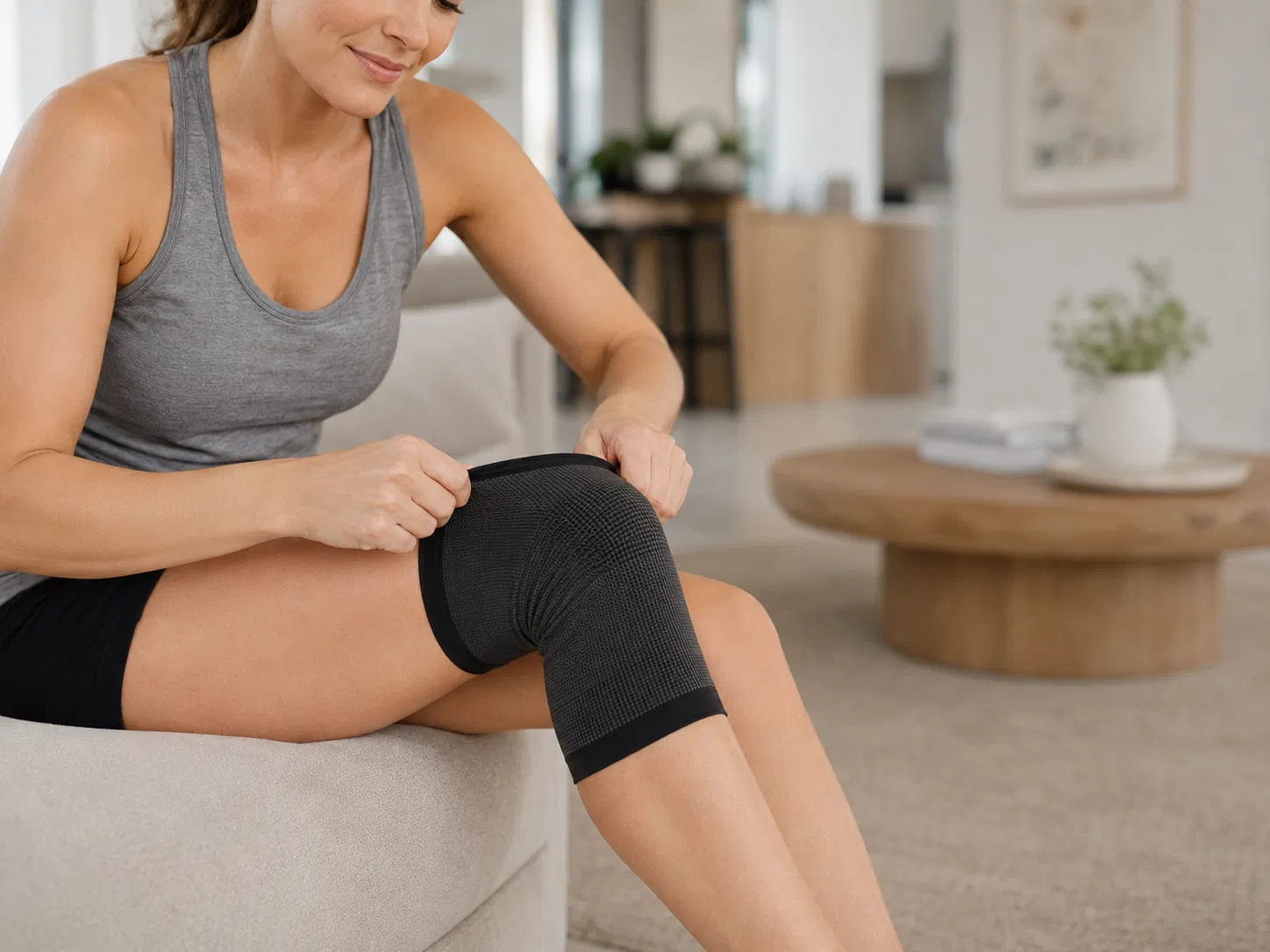
A knee that feels more secure as soon as tape is applied can tempt someone to treat every problem as a taping problem. Yet a person asking how to tape a knee for stability may want confidence during a squat, relief around the kneecap on stairs, or protection for a knee that buckles after an injury. Those situations should not receive the same answer. Tape can be a reasonable short-term experiment for patellofemoral pain, but it should not be presented as structural protection for an unstable joint.
This guide focuses on pain around or behind the kneecap, often called patellofemoral pain or PFPS. If the main issue is a recent injury, repeated giving way, or a displaced kneecap, arrange an assessment before trying to secure the knee with adhesive strips. If symptoms are mainly behind the patella during stairs or bending, the guide to pain behind the kneecap explains the broader pattern.
What Does Knee Taping for Stability Actually Mean?
People use the word stability in at least three ways. It can mean a pleasant sense of support, better awareness of where the knee is, or true mechanical restraint after ligament damage. Tape may influence the first two. Ordinary kinesiology tape cannot meaningfully replace an ACL, MCL, or other injured stabilizing structure. Rigid patellar tape applies more force locally, but it is designed to change symptoms or patellar guidance, not to hold the entire knee together during unpredictable sport.
This distinction matters because feeling better for ten minutes is not proof that the joint has become safer. Adhesive on the skin changes sensory information. That can alter confidence, muscle timing, or how a person performs a task. A rigid strip may also change patellar position or pressure for a short period. These effects can be useful, but they are not tissue repair and do not guarantee protection from another injury.
KT Tape vs Rigid Patellar Tape
| Feature | Elastic kinesiology tape | Rigid patellar tape |
|---|---|---|
| Main intent | Sensory input, light support, and movement awareness | Clinician-tailored directional force around the patella |
| Movement | Stretches with the skin and usually permits full motion | Stretches very little and may feel more restrictive |
| Application | Product-specific layouts, often around rather than across the patella | Often placed over protective underwrap after an individual assessment |
| Evidence | Mixed short-term pain and function findings | May help selected responders as part of a combined plan |
| Important limit | Does not provide structural knee stability | Not a universal patellar correction or ligament brace |
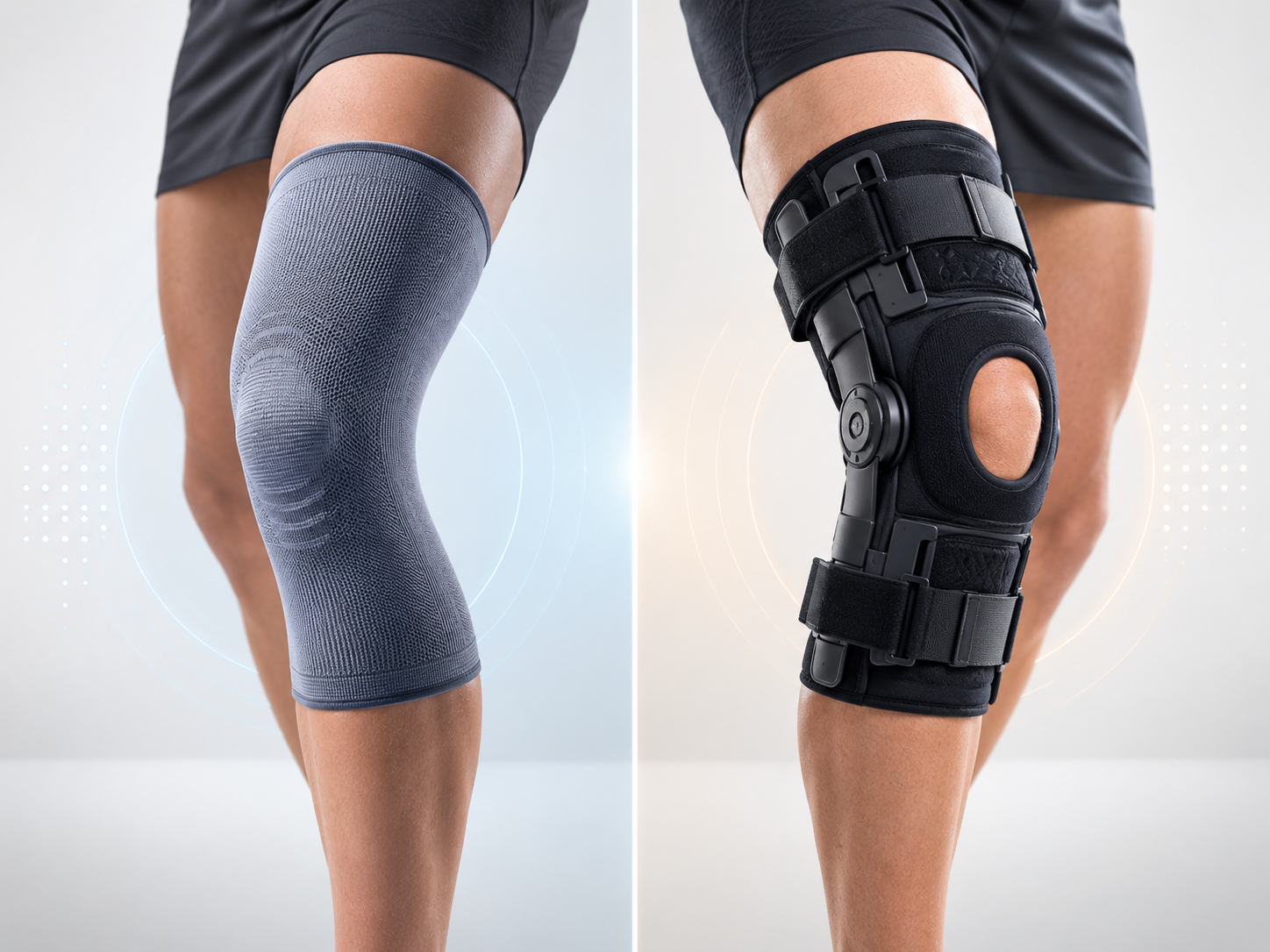
A sleeve and a brace are different again. Compression can provide warmth and a general sense of support, while a prescribed brace may use hinges, straps, or a patellar opening for a specific purpose. The knee brace versus compression sleeve guide compares those options without treating them as interchangeable with tape.
What the Evidence Says About Patellofemoral Pain
Clinical guidance does not make taping the foundation of patellofemoral care. The 2019 clinical practice guideline supports tailored patellar taping for immediate pain reduction and improved short-term exercise participation in selected people. A more recent best-practice guide places education and knee-targeted, with or without hip-targeted, exercise at the center. Taping can be added according to a person's needs and response.
Trials help explain the caution. An older randomized study found that adding patellar taping to a physical therapy program did not produce extra benefit beyond the exercise program itself. Studies of kinesiology tape have reported short-term improvements in some pain or function measures, yet results vary with the comparison, technique, follow-up, and outcome chosen. Some trials combine tape with exercise, making it difficult to isolate what the adhesive contributed.
Small samples and brief follow-up are common. A change immediately after application can be real for the person and still tell us little about long-term recovery. It is also possible for a sham or non-corrective tape layout to influence symptoms through sensory input and expectation. The sensible conclusion is neither that tape never works nor that it realigns every kneecap. It may offer temporary symptom relief for a responder while a broader program builds capacity.
Is the Pain Pattern Actually Patellofemoral?
Patellofemoral pain is usually felt around or behind the kneecap and is often aggravated by squatting, stairs, running, jumping, or prolonged sitting. It is not diagnosed by one sore spot or by the way the patella looks. Pain directly at the lower pole of the kneecap during jumping may fit a patellar tendon pattern, which is covered separately in the Spanish squat and patellar tendon guide.
Swelling changes the question too. A visibly puffy knee after a sudden twist, a large training increase, or an unexplained flare should not simply be taped more tightly. Use the knee swelling after exercise guide to separate ordinary post-load irritation from signs that need assessment. Tape can hide the outline of swelling without addressing its cause.
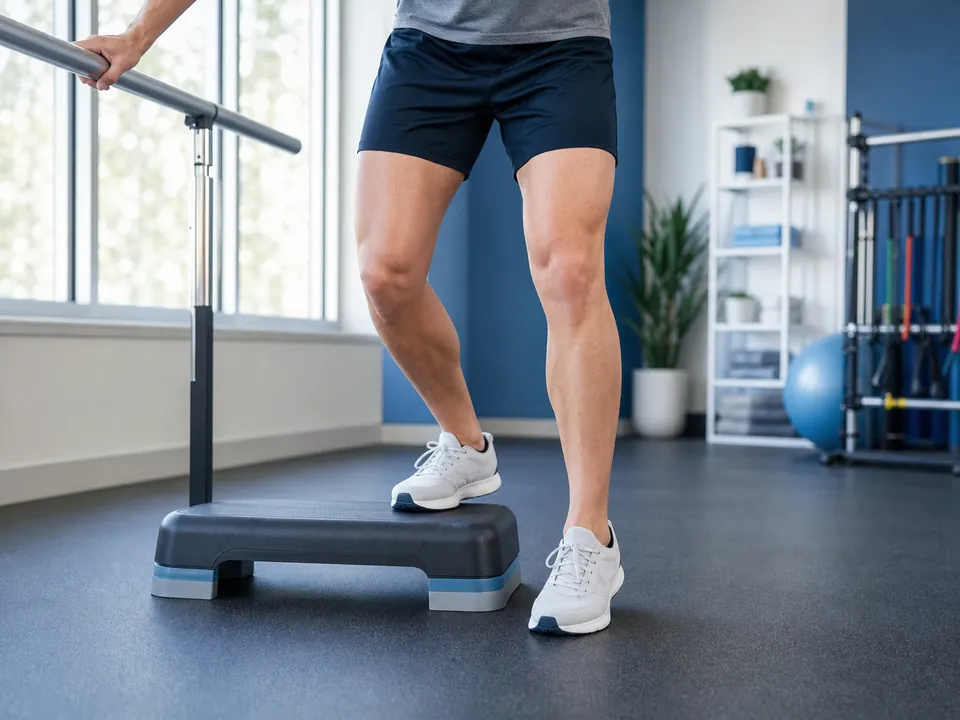
Before taping, choose one repeatable task that reflects the problem: a shallow squat, a controlled step-down, or a familiar stair. Note pain, confidence, range, and movement quality. This is not a self-diagnosis. It gives a clinician or informed user a clearer way to decide whether the tape changed anything useful.
Clinician-Tailored Application, Not a Universal Pattern

A clinician may examine skin, ask where the pain occurs, assess patellar mobility, and test more than one direction or tape type. The tape is then judged by what happens to the selected task. A meaningful response might be less pain on the same step, smoother control, or enough comfort to complete the prescribed exercise. If there is no clear improvement, there is little reason to keep adding strips.
Rigid taping is sometimes described as a medial-glide technique, but not every painful kneecap needs to be pushed medially. Tilt, rotation, skin sensitivity, symptom location, and the chosen task can change the approach. Protective underwrap may reduce direct adhesive exposure, though it does not eliminate allergy or irritation. A clinician-tailored method is more defensible than copying a diagram that promises to correct everyone.
Elastic tape layouts often use a strip or split tails around the patella, leaving the kneecap and the crease behind the knee free. Product adhesives and stretch properties differ. Avoid universal tension percentages from social videos, especially when the product instructions use a different scale. Ends are commonly laid without stretch to reduce edge pull, but the exact technique should follow the product or professional guidance.
A Practical Before-and-After Response Test
- Choose one relevant movement. Use the same stair, squat depth, or low step-down each time rather than several unfamiliar tests.
- Record the baseline. Note pain location, intensity, confidence, and whether the movement changes to avoid discomfort.
- Apply a safe, appropriate technique. The skin should be clean, intact, and dry, and the tape should not form a tight ring around the leg.
- Repeat the exact task. Keep height, depth, speed, footwear, and support the same.
- Keep it only for a useful response. A vague feeling of tightness is not enough if pain and function are unchanged or worse.
- Recheck later. Skin comfort and the knee's response during normal activity matter, not only the first repetition.
A low step-down is particularly useful because its height and range can be controlled. The step-down exercise guide explains how to scale that task. Tape should make a planned exercise easier to tolerate, not become permission to double volume, add weight, and test a run on the same day.

How to Use Tape Without Letting It Replace Rehabilitation
The most productive use is often during a limited set of exercises or an unavoidable daily task. If tape makes a squat or stair more comfortable, use that window to practice the movement at a manageable dose. The durable target remains muscle capacity, task tolerance, and confidence without depending on adhesive for every repetition.
Patellofemoral programs commonly include quadriceps and hip work, then gradually restore the tasks that matter. A general knee strengthening guide can help organize the larger plan. Choose resistance, range, and weekly exposure from the knee's response rather than assuming tape has raised every limit.
Track what happens after the tape is removed. If the same task is gradually easier over several weeks, the program may be building capacity. If relief exists only while the tape is on and the baseline never changes, reassess the load, diagnosis, exercise choice, sleep, recovery, and other contributors. Dependence is not inevitable, but tape should have a defined purpose rather than becoming a ritual.
Skin Safety, Wear Time, and Removal
Do not tape over broken skin, a surgical incision, infection, rash, blister, or active dermatitis. Avoid an adhesive that has caused a previous reaction. Reduced sensation or poor circulation can hide warning signs, so seek individual guidance before use. Hair removal, lotions, sweat, and aggressive cleaning can also affect both adhesion and skin irritation.
There is no universal number of hours or days that is safe for every person and product. Follow the label or clinician, inspect the skin around the edges, and do not use extra glue or another wrap to force loose tape to remain. Remove it immediately for burning, increasing itch, blistering, numbness, tingling, a cold or discolored foot, swelling below the tape, or worsening pain.
Removal should be slow and close to the skin. Support the skin with one hand and peel the tape back at a low angle rather than pulling it upward or ripping it off quickly. Product guidance may allow warm water or an approved adhesive remover. Stop if the skin begins to lift, tear, or bleed.
Common Knee Taping Mistakes
- Wrapping around the entire knee. A tight circumferential band can irritate skin, crease behind the knee, and affect comfort or circulation.
- Using more stretch for more support. Excess tension raises the chance of skin pull without turning elastic tape into a brace.
- Taping an unexplained swollen knee. Covering the symptom can delay assessment and does not remove joint fluid.
- Copying one directional correction. Rigid patellar taping should be selected and tested, not assumed from a generic picture.
- Skipping the retest. If the relevant movement does not improve, the tape has not earned a place in the plan.
- Training far beyond the usual dose. Temporary relief does not prove that the knee can recover from a larger session.
When to Get Medical Help
Remove the tape and seek advice for persistent burning, blistering, numbness, color change, a cold foot, swelling below the tape, or rapidly increasing pain. Arrange prompt assessment after a clear injury when the knee swells quickly, looks deformed, cannot bear weight, locks, or repeatedly gives way. A hot, red, swollen knee with fever or feeling unwell needs urgent medical guidance rather than another taping attempt.
The Bottom Line
Knee taping can be a useful short-term adjunct for some people with patellofemoral pain, especially when a clinician-tailored application produces a clear improvement in the same painful task. Elastic KT tape mainly changes sensory input and provides light support. Rigid patellar tape can apply more directional force, but it is not a universal realignment technique. Neither provides structural stability for a ligament injury. Protect the skin, retest function, keep the dose sensible, and use any temporary relief to support a progressive exercise plan rather than replace one.
Frequently Asked Questions
Does knee taping really improve stability?
Tape may improve the feeling of support, body awareness, or confidence during a task, but that is not the same as restoring a torn ligament or preventing the knee from giving way. Elastic tape provides little structural restraint. Rigid tape can apply more directional force around the patella, yet it is not a substitute for assessment, rehabilitation, or a brace prescribed for genuine ligament or patellar instability.
Is KT tape or rigid tape better for patellofemoral pain?
There is no universally better option. Elastic kinesiology tape is flexible and is usually used for sensory input or light support. Rigid patellar taping can be tailored to change symptoms during a squat, step-down, or stair task. Clinical guidance favors taping only as an optional short-term adjunct when an individual response test shows a meaningful benefit, not as a stand-alone treatment.
How do I tape my knee for patellofemoral pain syndrome?
A single online pattern cannot account for pain location, skin condition, patellar mobility, limb shape, or the task that hurts. A clinician may test elastic or rigid layouts and retest a relevant movement immediately. If you self-apply a familiar product, follow its instructions, avoid wrapping around the whole knee, keep the crease behind the knee clear, and stop if symptoms or skin reactions worsen.
How long should kinesiology tape stay on the knee?
There is no safe universal wear time. Adhesive, skin sensitivity, sweat, activity, and clinician instructions differ. Follow the product label or the professional who applied it, inspect the edges and surrounding skin regularly, and remove it sooner for itching, burning, blistering, numbness, color change, swelling below the tape, or increased pain. Longer wear is not stronger treatment.
Can knee tape help pain when squatting or using stairs?
It may reduce pain during those tasks for a responder, which is why a before-and-after squat, step-down, or stair test can be useful. The effect should be obvious enough to matter and should not create pain elsewhere. A temporary improvement can help someone perform a prescribed exercise, but the tape does not explain the cause or replace progressive hip and knee strengthening.
When should I not tape my knee?
Do not apply tape over an open wound, infection, rash, blister, active dermatitis, or known adhesive allergy. Seek individual guidance with reduced sensation, circulation problems, fragile skin, or a recent incision. Do not use tape to keep training through rapid swelling, locking, repeated giving way, inability to bear weight, or a hot red knee with fever.