Search results often use step downs exercise, single leg step down, lateral step down, and heel tap exercise for slightly different drills. This guide covers a controlled lowering exercise from a small platform. It is not a diagnosis test and it is not the same as simply walking down a staircase. If ordinary stairs are the main problem, start with the knee pain going down stairs guide instead.
The exercise can practice single-leg strength, balance, and control. Find a repeatable version, then add demand without losing the quality that made the starting version useful.
Step-Down, Step-Up, and Stair Descent Are Different Tasks
A step-up begins on the floor and raises the body onto a platform. The working leg produces force to lift you. A step-down begins on the platform. The stance leg controls the body as it lowers, then reverses the motion before the free foot accepts meaningful weight. That controlled lowering phase is often described as eccentric quadriceps work because the knee extensors produce force while lengthening.
A real stair descent continues from one step to the next and includes weight transfer, timing, handrail use, and momentum. A training step-down usually stops after a light heel or toe tap and returns to the starting position. It lets you adjust the height, range, support, and tempo more precisely than a full staircase. Practicing the drill may support stair capacity, but success on a low box does not prove that a painful stair problem is solved.
Laboratory research in healthy adults found greater modeled patellofemoral force and stress during a forward step-down than during forward or lateral step-ups performed to a standardized knee angle. This describes how the tasks differed in that study. It does not establish a dangerous force threshold, predict pain, or mean that step-downs damage healthy knees. It does explain why changing from a step-up to an equal-height forward step-down may feel like a meaningful progression.
Choose the Variation Before You Judge the Form

Lateral step-down
Stand sideways near the edge and lower the free heel toward the floor beside the box. This version makes the tap point easy to see and often works well for a shallow range. Keep the stance foot fully supported. Do not hang half the foot off the edge just to reach farther.
Forward step-down
Face forward and reach the free heel toward the floor in front. In a study of healthy young adults, the forward version used more knee flexion and ankle dorsiflexion than the lateral version and showed observed movement faults more often. That finding supports choosing the direction deliberately. Someone with limited ankle motion or low tolerance to loaded knee bend may find the forward version more demanding even at the same height.
Heel tap exercise
A heel tap usually refers to the free heel touching lightly at the bottom. It is a depth marker, not a second working leg. If you push through the tapping heel to stand, shorten the range or use more hand support. Some coaches use the term for a forward reach and others for a lateral reach, so the direction matters more than the label.
How to Do a Controlled Lateral Step-Down
- Set a stable surface. Use a low exercise step that cannot slide. Place it beside a rail, countertop, or sturdy support. Avoid a soft cushion, stacked books, or an unstable plate.
- Own the starting position. Put the whole stance foot on the step, stand tall, and lift the other foot clear. Use as much fingertip or hand support as needed to remove fear and prevent a fall.
- Begin the lowering. Bend the stance knee while the hip and ankle move naturally. Let the free heel travel toward the floor beside the platform. Keep pressure across the stance foot rather than rolling onto one edge.
- Make a quiet tap. Touch the free heel lightly without transferring body weight. If the floor is not reachable with control, stop in the air or use a lower step. Contact is optional.
- Return through the stance leg. Press the platform away and stand without bouncing, twisting, or pushing from the free foot. Finish balanced before the next repetition.
- Review the set. Stop when the lowering becomes faster, range shrinks, hand pressure rises, or symptoms build. Repeated controlled reps are more informative than one forced deep rep.
A slow lowering phase can make the exercise easier to observe but harder for the muscles. Start with roughly two to three controlled seconds only if that pace remains smooth. Longer is not automatically better. If the leg shakes mildly near the end of a set but the knee remains comfortable and the movement stays safe, reduce repetitions before assuming the exercise is wrong.
What Good Knee Control Actually Means
Aim for the knee to move in the same general direction as the middle toes while the heel stays supported. Some inward or outward motion is not automatic evidence of injury. The pelvis, trunk, hip, knee, ankle, and foot all contribute, and people use different workable strategies. A mirror or phone video can provide feedback, but it should not turn normal variation into a pass-or-fail test.
A visible inward collapse, pelvis drop, trunk shift, heel lift, or sudden fall may show that the chosen version exceeds current control. It does not identify the cause. Studies using lateral step-down testing have linked visual scores with several three-dimensional hip and knee measures, but the test is not a standalone diagnosis of weak glutes, poor tracking, or reinjury risk. After ACL reconstruction, box height also changed observed quality, which is another reason to scale the task before judging the person.
Use a cue that improves the whole repetition without creating stiffness elsewhere. Helpful options include "lower quietly," "keep the whole foot heavy," or "reach the free heel down." Avoid forcing the knee outward as far as possible or freezing the trunk upright. If one simple cue does not help, reduce height, add support, or choose a different exercise instead of layering more instructions.
Use Five Load Dials
| Dial | Easier starting choice | Possible progression | What to watch |
|---|---|---|---|
| Height and range | Low step or partial lowering | Slightly deeper reach or taller step | Heel lift, drop, or symptom increase |
| Hand support | Firm rail or countertop contact | Fingertip contact, then less support | Balance before knee depth |
| Tempo | Natural controlled pace | Slower eccentric step-down | Do not confuse slower with easier |
| Volume | A few repeatable reps | More reps or an extra set | Quality and later-day response |
| External load | Body weight with free hands | Light weight held close to the body | Add only after range is controlled |
Direction is a sixth dial. Changing from lateral to forward is not merely a cosmetic variation. Change one main variable at a time so the next-day response can be interpreted. A higher box, slower lowering, more repetitions, and a dumbbell added together make it impossible to know which demand exceeded capacity.
A Practical Step-Down Progression
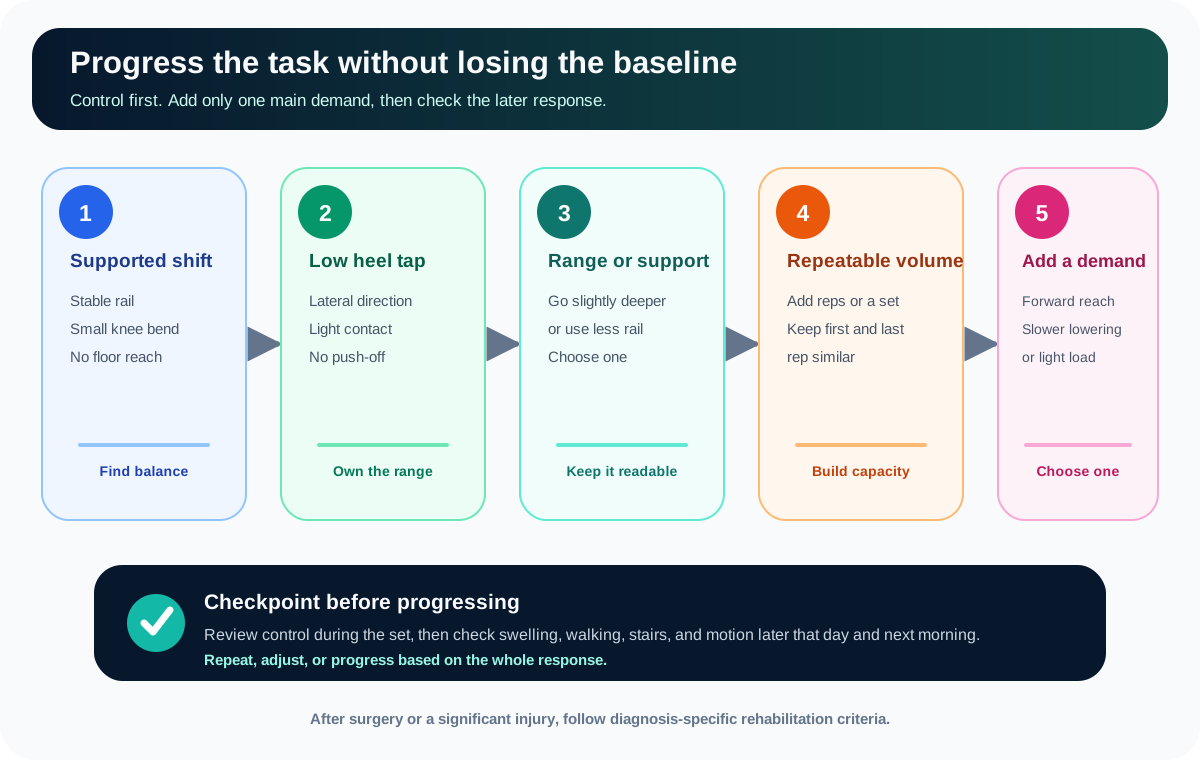
- Supported weight shift: hold a rail, stand on one leg, and practice a small knee bend without trying to reach the floor.
- Low lateral heel tap: use a shallow range and enough support to keep the tap quiet and the return smooth.
- More range or less support: choose one. Do not remove the rail and raise the step in the same session.
- Build repeatable volume: add repetitions while the first and last rep still look similar.
- Add direction, tempo, or load: try a forward step-down, slower lowering, or light external resistance according to the actual goal.
There is no universal requirement to reach an eight-inch box or complete a fixed number of repetitions. Box height changed visual scores in an ACL reconstruction study, but that small, specific sample cannot prescribe a height for everyone.
How Much Discomfort Is Acceptable?
Pain rules need context. Mild discomfort that stays stable, does not change the movement, and returns to the usual baseline may be acceptable within a clinician-led plan. Sharp pain, rapidly increasing pain, a protective drop, or a limp afterward is not a useful training response. If the exercise is new, begin below the maximum range even when the first repetitions feel easy.
Check the knee later that day and the next morning. Note swelling, walking, ordinary stairs, and whether the usual range of motion has changed. A delayed flare is still information about the dose. Reduce the newest variable rather than abandoning every strengthening exercise. If exercise-related soreness is the broader issue, compare the pattern with the knee pain after exercise guide.
Patellofemoral pain commonly reacts to loaded bending tasks such as squats and stairs. Current best-practice guidance supports education with knee-targeted exercise, often combined with hip-targeted exercise, rather than one corrective drill. A small 2025 trial in college-aged adults with patellofemoral pain found greater improvements from a functional program that combined strength and movement-control training than from its comparison strength program. That result supports an individualized program, not the claim that step-downs alone cure kneecap pain. The patellofemoral pain guide explains the broader condition.
Where Step Downs Fit in a Strength Plan
Use the exercise for a reason. A runner may want controlled single-leg knee bend. Someone rebuilding stair confidence may need a supported lowering task. A field-sport athlete may eventually use it before faster deceleration work. Pair it with other suitable knee and hip exercises instead of making one visible movement fault the center of the entire plan. The knee exercise guide gives broader starting options.
After surgery, a significant injury, or a period of restricted weight bearing, do not use an online progression to override rehabilitation criteria. Range limits, graft or tissue healing, swelling, quadriceps recovery, and return-to-sport testing may all change the correct starting point. A lateral step-down can be an assessment tool in rehabilitation, but a visually tidy rep does not provide clearance by itself.
When to Get Medical Help
Arrange an assessment when pain keeps returning, limits ordinary stairs or walking, or comes with recurrent swelling, catching, locking, giving way, or reduced motion. Seek prompt care after a forceful injury, when you cannot bear weight, when the knee is badly swollen or deformed, or when it is physically locked. A hot red swollen knee with fever or feeling unwell needs urgent medical guidance.
The Bottom Line
A step-down is useful because it is adjustable. Start low, add stable support, choose lateral or forward direction deliberately, and make the free-foot contact a light tap. Watch the whole movement rather than blaming one muscle or demanding perfect alignment.
Progress height, range, support, tempo, repetitions, and load separately. The best version is not the deepest one. It is the one that stays controlled, serves the training goal, and leaves the knee ready for the next sensible step.
Frequently Asked Questions
What muscles does the step-down exercise work?
The stance-side quadriceps help control and reverse the lowering motion, while the hip muscles, calf, and foot contribute to balance and leg position. The trunk also helps keep the body organized over the stance foot. A wobble cannot identify one weak muscle by itself because strength, mobility, balance, pain, confidence, and familiarity can all change the movement.
What is the difference between a lateral step-down and a forward step-down?
In a lateral step-down, the free leg lowers beside the step. In a forward step-down, it reaches toward the floor in front. A laboratory study in healthy adults found that the forward version used more knee flexion and ankle dorsiflexion and produced more observed movement faults. That does not make it bad, but it may be a later or different progression.
Is a heel tap exercise the same as a step-down?
Heel tap is a common cue for a shallow step-down. The free heel touches the floor lightly to mark depth, but it should not take body weight or push you back up. Names vary between gyms and clinics, so confirm the direction, step height, touch point, and intended range instead of relying on the exercise name alone.
How high should the box be for step downs?
Use the lowest height that allows a slow, repeatable lowering without dropping, pushing off the free foot, or producing an unacceptable symptom response. Research after ACL reconstruction found poorer observed movement quality on a six-inch box than a four-inch box. That small study does not create universal heights, but it supports treating height as a meaningful load dial.
Should my knee stay behind my toes during a step-down?
No universal rule requires the knee to stay behind the toes. Some forward travel is normal when the knee bends and the ankle allows it. Keep the heel supported and let the knee travel in the same general direction as the middle toes without forcing a rigid path. Reduce height or range if the heel lifts, control is lost, or symptoms rise.
What if step downs hurt my knee?
Stop repeatedly testing the painful depth. Reduce the step height, range, repetitions, or external load, and use stable hand support. Review how the knee feels later that day and the next morning. Persistent pain, recurrent swelling, locking, giving way, a recent injury, or difficulty with ordinary walking deserves a clinician's assessment rather than more unsupervised progression.