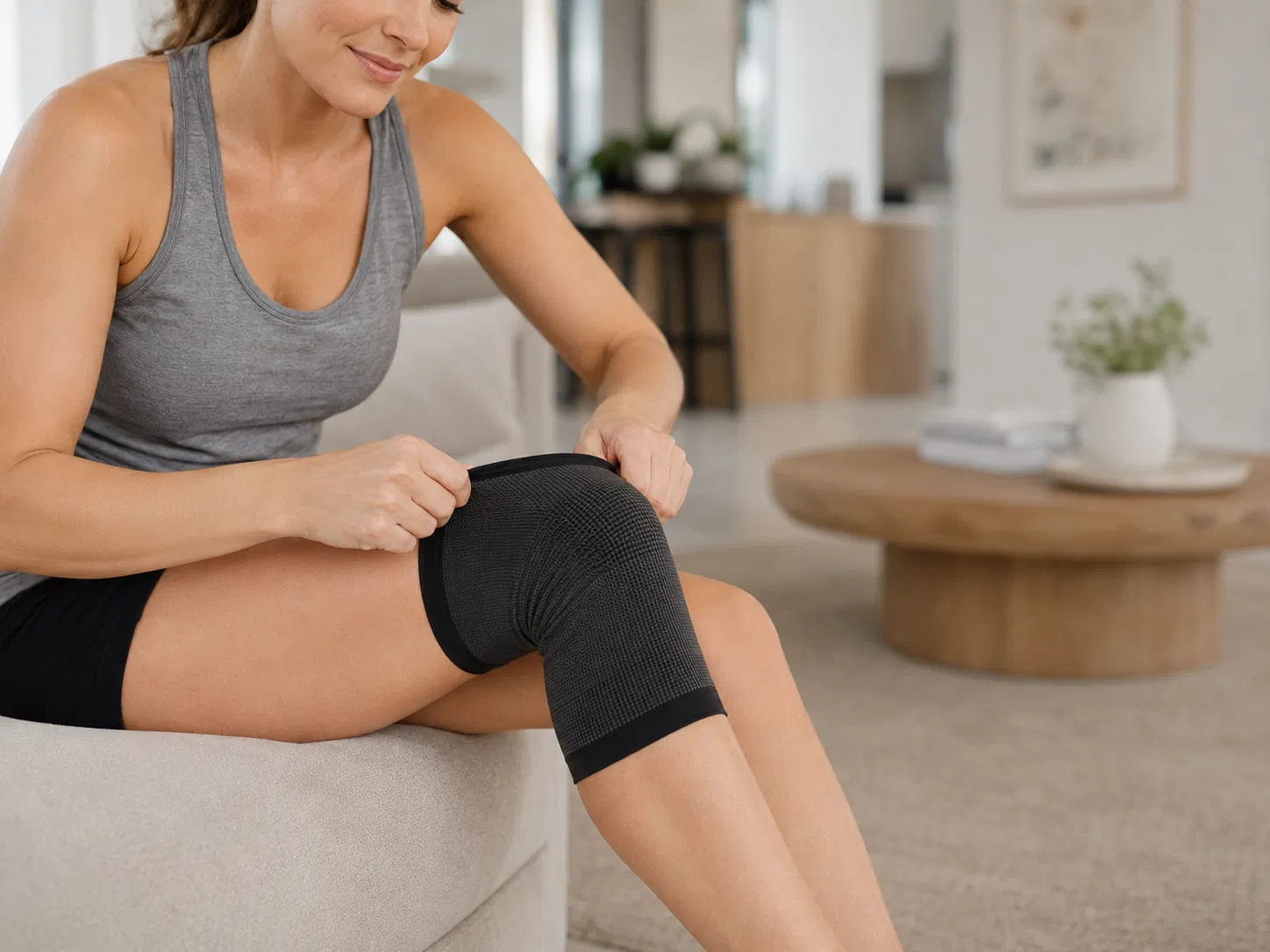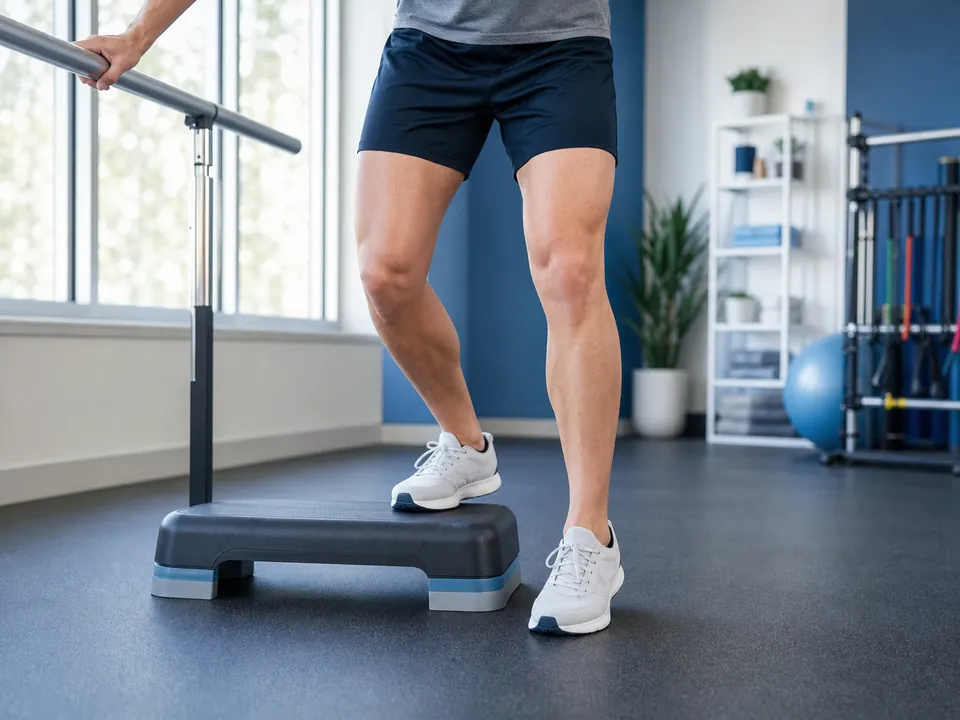
TKE stands for terminal knee extension. In exercise language, terminal means the final portion of the movement toward a straight knee. The band does not lift the leg through a full seated knee extension. Instead, it creates resistance while the foot remains on the floor and the knee moves through a short arc. That narrow purpose is why the exercise appears in programs for quadriceps control, patellofemoral pain, and return after some knee injuries.
Searches for terminal knee extension exercises often mix several movements: a towel-supported quad set, a short-arc extension while lying down, a cable TKE, and the standing version with a band. This guide covers the standing banded terminal knee extension. For a broader routine that combines several muscle groups and movement patterns, use the knee pain exercises guide. The TKE page stays focused on one drill, its setup, and sensible progression.
What a Banded Terminal Knee Extension Trains
The quadriceps straighten the knee. During a TKE, they work against a band that becomes more stretched as the knee reaches the end of the movement. This is variable resistance: the external pull usually increases across the short range. The standing foot also supplies sensory information, while the calf, hip, and trunk keep the body organized over that foot.
The exercise is sometimes promoted as a way to isolate the teardrop-shaped vastus medialis obliquus, or VMO. That promise is too specific. The quadriceps portions share the work of knee extension, and electromyography studies have not shown that common open- or closed-chain knee extension tasks selectively train one vastus portion in isolation. A better goal is a smooth contraction across the front of the thigh with steady whole-leg control.
Clinical research rarely tests a banded TKE as a stand-alone treatment. One multicenter patellofemoral pain trial included TheraBand terminal knee extensions inside a six-week knee-focused program that also progressed squats, lunges, wall squats, and step-downs. Participants improved, but the study cannot tell us that TKE alone caused the result. Think of it as an accessible piece of a program rather than the centerpiece of every recovery plan.
How to Set Up a Terminal Knee Extension With a Band

Use a long loop band or a resistance band tied into a secure loop. The anchor must be fixed, smooth enough not to cut the band, and able to tolerate more force than you plan to use. A closed rack post can work in a gym. At home, use equipment designed as an exercise anchor rather than a loose table leg, door handle, radiator, or object that can slide toward you.
- Set the anchor near knee height. The band should pull the working knee forward into a slight bend, not drag the leg sharply downward.
- Step through and position the loop. Place the band across the back of the working knee. Fabric or clothing can reduce pinching.
- Create light starting tension. Face the anchor and step back until the band is taut while the knee remains softly bent.
- Build a stable stance. Keep the working foot flat and point it in a comfortable forward direction. The other foot may stay slightly behind for balance.
- Straighten with the thigh. Tighten the quadriceps and move the knee backward until the leg reaches its comfortable straight position.
- Pause, then return slowly. Hold for one or two seconds without bouncing. Let the band guide the knee forward under control.
The movement is small. The kneecap may glide slightly as the quadriceps contract, but the body should not lurch backward. If you need a large hip thrust to move the band, use less resistance. If the loop rolls into a thin cord or causes numbness, stop and change the setup.
Form Cues That Make the Drill Clearer
| Checkpoint | Useful cue | Common compensation | Simple correction |
|---|---|---|---|
| Foot | Keep the heel and forefoot grounded | Rising onto the toes | Reduce tension and shorten the stance |
| Knee | Move from soft bend to comfortable straight | Snapping or forcing hyperextension | Pause just before the joint is pushed backward |
| Thigh | Feel broad quadriceps tension | Trying to squeeze only the inner quad | Use whole-thigh effort and normal breathing |
| Hips | Keep the pelvis quiet over the feet | Thrusting the hips backward | Lighten the band and use fingertip support |
| Tempo | Straighten, pause, return smoothly | Fast pumping through tiny repetitions | Count one up, one hold, and two back |
Knee tracking does not need to look identical in every person. Avoid an obvious uncontrolled collapse or twist, but do not chase a perfectly vertical line at the expense of comfort. Foot shape, hip anatomy, and stance width differ. A mirror can help you notice large shifts; it cannot diagnose why pain occurs.
How Much Resistance and How Many Repetitions?
Begin with a band that lets you complete every repetition without a hip thrust, heel lift, or abrupt lockout. Two or three sets of 8 to 15 repetitions with a one- or two-second pause is a reasonable technique range for many healthy adults. Rest long enough that the next set looks like the first. The final repetitions may feel effortful in the thigh, but the setup should remain controlled.
Band color is not a universal dose because manufacturers use different materials, widths, and color systems. Distance from the anchor also changes tension. Record the band, how far you stood from the anchor, repetitions, and perceived effort. That makes progression more reliable than simply changing from one color to another.

First make the movement repeatable. Next add a few repetitions within the chosen range. Then increase band tension slightly or step farther from the anchor. A narrower stance or less hand support can add a balance demand, but balance should not prevent the quadriceps from doing clear work. The last step is not an extreme TKE. It is combining the gained control with larger tasks such as sit-to-stand, squats, step-downs, running drills, or sport work when appropriate.
Exercise guidelines for patellofemoral pain support combined hip- and knee-targeted exercise rather than dependence on one isolated drill. If stairs, squats, or running remain the problem, the program needs to prepare those tasks. The knee pain when squatting guide helps separate depth, load, and symptom location instead of using endless TKE repetitions as a workaround.
Where TKEs Fit in a Strength Session
A banded TKE can appear near the beginning of a session when the goal is to practice a clear quadriceps contraction before larger movements. It can also sit between more demanding exercises as low-complexity work, or near the end as extra volume when technique remains clean. Its position should match the purpose. Performing dozens of fatiguing repetitions before a squat or running session may reduce control rather than improve it.
A simple sequence might begin with a few minutes of comfortable walking or cycling, followed by one light practice set. Complete two working sets, then move to the larger task selected for the program, such as a sit-to-stand, supported split squat, or step exercise. Finish by noting whether the knee reaches its usual straight position and whether walking feels normal. This is only an example for an otherwise stable knee, not a postoperative protocol.
Avoid changing band strength, repetitions, and the rest of the leg workout on the same day. If symptoms increase, you will not know which change mattered. Keep the first few sessions consistent and review three time points: discomfort during the TKE, ordinary movement later that day, and walking or stairs the next morning. A stable response supports a small progression. Pain that appears earlier in every set, increasing swelling, or a loss of extension supports stepping back and getting advice.
TKEs can be performed on both legs, but that does not mean both sides require identical resistance. After injury, surgery, or a long period of pain, strength and confidence may differ. Use the band that preserves the intended movement on each side rather than forcing symmetry through compensation. A clinician may also measure quadriceps strength and choose a more loadable exercise when a light band no longer creates enough challenge.
TKE vs. Quad Set, Leg Extension, and Step-Down
A quad set is performed without standing resistance and may be useful when simply tightening the thigh or regaining extension is the current goal. A seated leg extension trains a much larger arc and can be loaded more precisely with a machine or ankle weight. A step-down asks the leg to control body weight through more knee and hip motion. The banded TKE sits between these ideas: short range, standing, and easy to scale, but limited in how much total strength and task capacity it can build.
Another band-supported option is the Spanish squat, which holds or moves through substantially more knee bend and creates a different quadriceps and patellar tendon demand. The two exercises are not interchangeable. Choose from them because their load and range match the current goal, not because both use a band.
When to Get Medical Help
Do not use a TKE to push through a newly injured knee, rapidly increasing swelling, a physically locked joint, repeated giving way, or an inability to bear weight. A new inability to fully straighten the knee after trauma needs assessment. After surgery, follow the permitted range and timing from the surgeon or physical therapist. A generic online repetition target should not replace that diagnosis-specific plan. Mild thigh effort is expected, but sharp joint-line pain, catching, increasing kneecap pain, band-related numbness, or symptoms that worsen later that day or the next morning are reasons to reduce the dose and reconsider the exercise. The guide to knee pain after exercise explains why the delayed response matters.
The Bottom Line
A banded terminal knee extension is a small, practical quadriceps-control drill. Set the anchor near knee height, place the band behind the knee, keep the foot flat, and move from a soft bend to a comfortable straight position without snapping the joint or driving the hips. Progress tension only after the motion is steady. Most importantly, place TKEs inside a program that eventually prepares the real activity you want to regain.
Frequently Asked Questions
What is a banded TKE exercise?
A banded TKE is a standing terminal knee extension exercise. A resistance band sits behind the knee and pulls it toward a small bend. The quadriceps straighten the knee against that pull through the final part of extension. It is commonly used as one component of rehabilitation or strength programming, not as a test that identifies a particular injury.
Where should the band sit for terminal knee extensions?
The band normally rests across the back of the working knee, rather than around the kneecap, calf, or ankle. The anchor is usually close to knee height so the pull encourages a small bend. Use a broad comfortable band, keep it away from bare skin if it pinches, and confirm that the anchor cannot move.
What muscles does a banded TKE work?
The movement trains the quadriceps as a group while the foot, calf, hip, and trunk help maintain a steady standing position. It should not be advertised as a reliable way to isolate the vastus medialis obliquus. Research comparing quadriceps portions does not support the idea that one common knee-extension drill can selectively train only that small region.
How many banded TKE repetitions should I do?
A practical starting range is two or three sets of 8 to 15 slow repetitions with light resistance and a brief pause at straightening. That is an example, not a prescription for every knee. Increase band tension, repetitions, or standing challenge only when form and the later-day response remain comfortable. Postoperative dosage should come from the treating clinician.
Should I lock my knee during a TKE?
Actively straighten the knee to a comfortable end position, but do not ram or bounce it backward. People with natural hyperextension may need a clinician to define their stopping point. The useful part is controlled quadriceps tension and a smooth pause, not forcing the joint farther than its normal range.
Why do I feel banded TKEs in my calf or hip instead of my quadriceps?
The band may be too strong, the anchor may be too low, or you may be shifting the hips and rising onto the toes to finish the movement. Reduce tension, keep the working foot heavy through the floor, and make the motion smaller. Persistent pain, weakness, or an inability to straighten the knee deserves assessment rather than more resistance.