Start with the reason you want support
Two people packing for the same ski holiday may need completely different advice. One wants a comfortable layer around an otherwise stable knee. Another has a reconstructed ligament and a return-to-sport plan. A third has new swelling after a fall. A shopping comparison that calls one product the best ski knee brace skips the most important distinction: what problem is the equipment supposed to address?
Write that reason in ordinary language before looking at products. Examples include wanting fabric that stays comfortable during bending, following an existing brace prescription, or asking whether episodes of giving way need assessment. Those are different tasks. New instability belongs in a clinical conversation, not a search for the strongest-looking straps. A brace can have a defined role without becoming a solution to every knee symptom.
This guide compares categories, evidence and practical fit. It does not prescribe a brace or certify that a knee is ready for skiing. For pain that has already developed after a trip, use our post-ski knee pain guide. Keep equipment selection separate from diagnosing the reason a knee hurts.
Compression sleeves and mechanical braces do different jobs
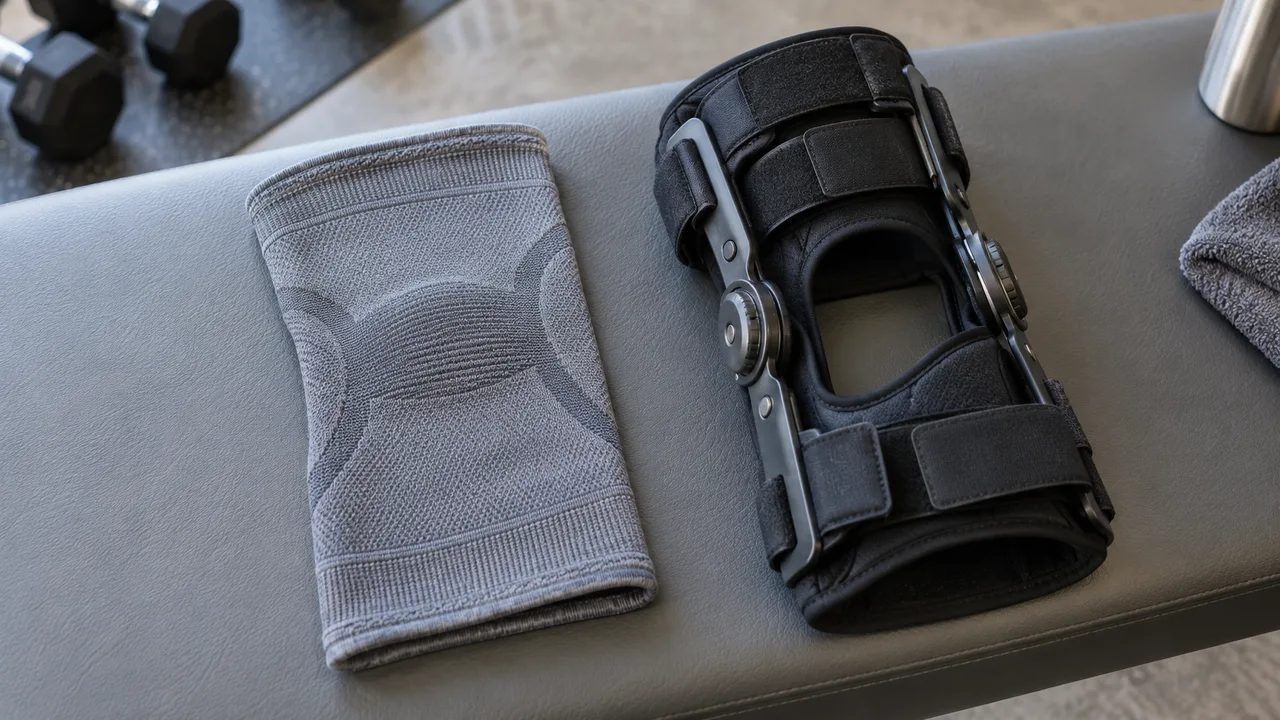
| Category | What to understand | What not to assume |
|---|---|---|
| Fabric compression sleeve | A close-fitting layer whose comfort depends on size, fabric and movement | That compression stabilizes an injured ligament like a prescribed functional brace |
| Functional ligament brace | A structured device selected and fitted for a particular clinical or activity context | That buying one makes an unstable knee safe to ski |
| Postoperative or range-limited brace | Equipment used according to a rehabilitation prescription and specific settings | That its hinges or adjustable stops make it a recreational ski brace |
| Osteoarthritis unloading brace | A different design intended for a particular joint-loading problem | That it can be chosen solely from a general knee-pain label |
A hinge is a construction feature, not a complete description of treatment. Products with superficially similar sidebars can differ in geometry, straps, sizing and intended use. Likewise, the word support on a fabric sleeve does not identify a clinically meaningful level of ligament restraint. Read the intended use and instructions rather than treating the product name as the evidence.
If a clinician has prescribed a particular category, ask before substituting another. A slimmer sleeve may look easier to fit under trousers, but convenience is not proof that it performs the prescribed role. Conversely, someone seeking a comfortable fabric layer should not assume that more hardware is automatically better. Extra components introduce their own fit and pressure considerations.
What does the skiing research actually show?
One often-cited study followed ski-resort employees who had undergone ACL reconstruction at least two years earlier. It reported fewer subsequent knee injuries among the skiers who chose functional bracing. That is relevant evidence for discussing a particular population, but it was not a randomized trial assigning otherwise identical people to a brace or no brace. Self-selection and differences between groups can influence the findings.
The participants also were not a sample of every beginner on a one-week holiday. Their work and skiing exposure, previous surgery and equipment context matter. The study cannot show that an inexpensive compression sleeve prevents ACL injuries, nor can it establish that every uninjured skier should buy a functional brace. The product category and the population must match the claim being made.
Broader guidance adds another important limit. The AAOS guideline does not recommend routine functional bracing after isolated primary ACL reconstruction because routine use has not shown clinical benefit. This does not mean an individual skier should discard a prescribed brace. It means the decision needs a specific rationale instead of a blanket rule that every reconstructed knee requires the same equipment.
A useful question for your clinician is therefore not simply whether braces work. Ask what a brace is intended to achieve in your case, what evidence applies to that purpose, what its limits are, and how you will judge fit and tolerance. That conversation is more informative than a numerical protection score on a retailer's comparison chart.
Previous injury changes the decision
If you have recurrent giving way, a recent ligament injury or ongoing rehabilitation, arrange advice before booking an equipment fitting at the last minute. Explain the skiing you expect to do, your previous experience and what ordinary activities currently feel like. The intended terrain and the demands of getting on and off lifts belong in the conversation alongside turning on snow.
Return-to-sport decisions involve more than a date or the ability to wear a brace comfortably. A treating team may consider strength, movement, symptoms, rehabilitation progress and sport demands. Buying equipment should follow that discussion, not serve as a shortcut around it. A supportive feeling on the shop floor does not reproduce a sudden change of direction or an unexpected fall.
If the recommendation is to postpone skiing, upgrading the brace is not an equivalent alternative. You can still discuss different holiday activities and how to stay involved socially without negotiating away the restriction. This is particularly important when the emotional pressure of a prepaid trip makes a reassuring product description unusually persuasive.
Check fit with the whole clothing and boot system
A brace fitting is not finished when its circumference falls inside a size chart. Follow the manufacturer's measurement locations and the fitter's instructions, including any differences between right and left versions. Record the intended strap sequence so that you can reproduce the setup rather than improvising on the first morning in the resort.
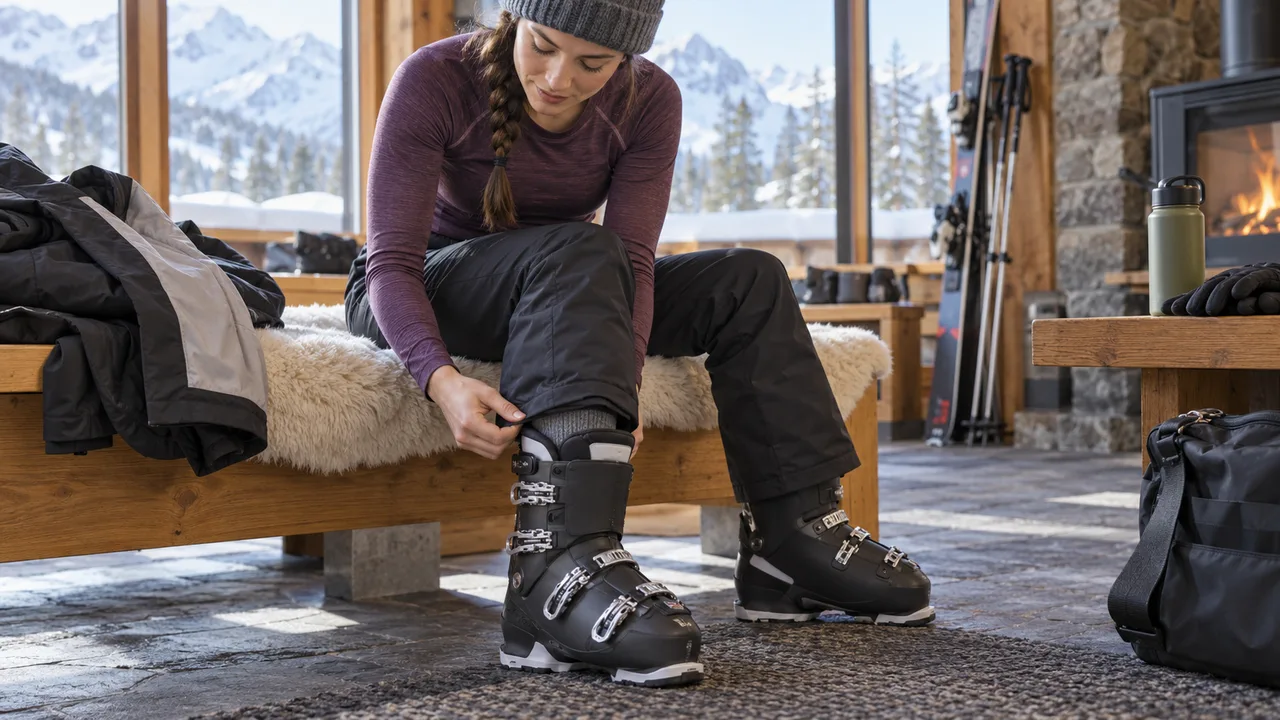
Bring the thermal layer, ski trousers and boots you expect to use. The approved arrangement may depend on the particular brace, so do not follow a universal internet rule about always wearing it over or under clothing. Fabric folds, thick seams and a tight trouser leg can alter pressure or make a previously comfortable setup difficult to manage.
Check where the lower brace ends relative to the boot cuff, especially during the movements your fitter asks you to try. Contact between components, rubbing or a restricted position deserves attention before you ski. Do not cut, bend or alter a frame to make it fit. Ask whether a different size, configuration or product is appropriate.
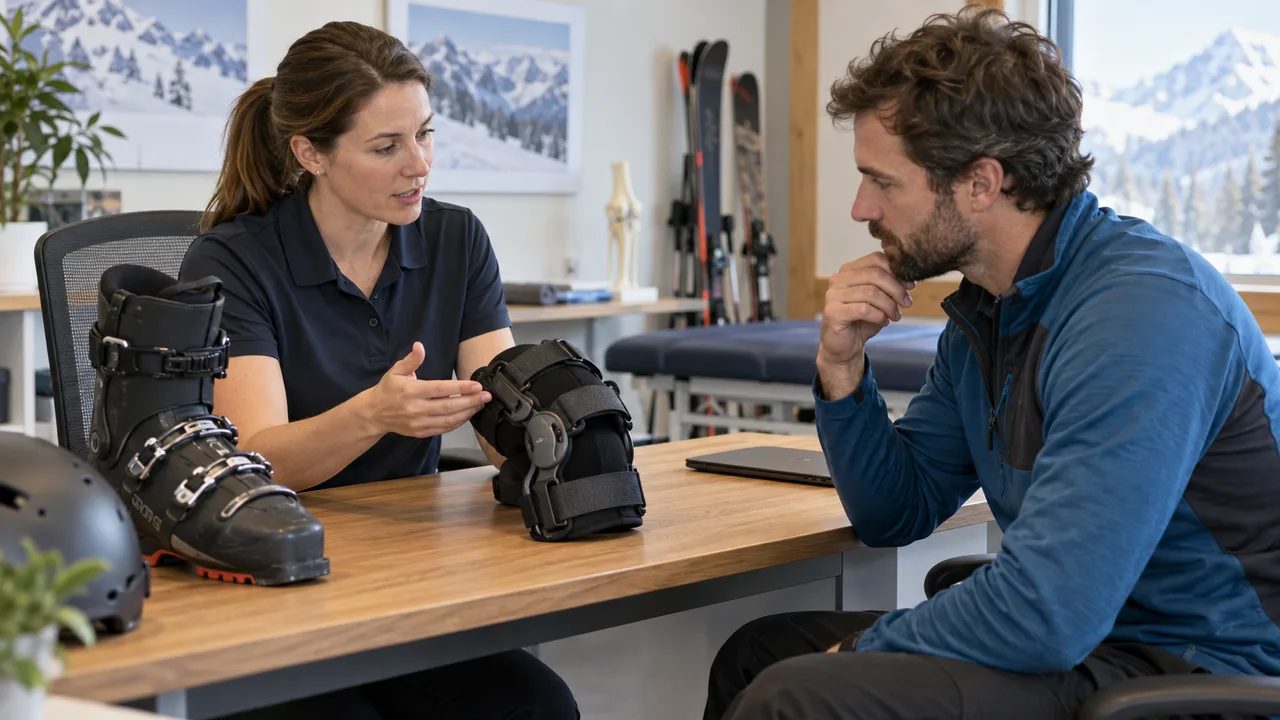
Practice putting the equipment on while you have time, good lighting and access to help. Can you reach the straps, identify their order and notice when a section has folded? Can you use the toilet and change layers without losing the setup? These ordinary tasks are part of usability, especially for someone with limited hand strength or movement.
Allow an opportunity to discuss problems with the fitter before departure. A short trial in an approved setting may reveal slippage or rubbing that was not obvious during a standing measurement. Follow clinical restrictions during any trial; a home fitting check is not an invitation to test the knee with jumps or aggressive twisting.
Slipping, pressure and skin changes are feedback
| Observation | Check | Avoid |
|---|---|---|
| Support migrates downward | Size, strap order, approved clothing arrangement and fitting advice | Repeatedly tightening until the leg feels compressed or numb |
| Fabric bunches behind the knee | Length, folds, layering and the product's suitability for repeated bending | Ignoring rubbing because the front looks aligned |
| Frame contacts the boot | Clearance during approved movements and professional adjustment options | Reshaping or cutting the brace yourself |
| New tingling, numbness or color change | Stop use and seek appropriate advice, urgently if symptoms persist or are severe | Treating altered sensation as proof of strong support |
For a prescribed brace, follow the team's instructions about skin inspection, wear time and what to do if symptoms appear. Those instructions may differ from the care directions for an ordinary sports sleeve. Keep the relevant contact information accessible while travelling instead of relying on a retailer's general question-and-answer section when a problem arises.
Comfort also changes over a day. Layers can become damp, a strap may shift and a pressure point may appear after repeated bending. Build in opportunities to notice those changes. A device that was comfortable during breakfast should not be assumed to remain correctly fitted simply because taking off ski trousers is inconvenient.
A sleeve can be a comfort choice, not a safety certificate
If you are considering an ordinary compression sleeve, assess its sizing, seams, fabric care and comfort through the movements you have been cleared to perform. It should not create numbness, excessive pressure or a persistent fold behind the knee. Use our compression sleeve sizing guide for measurement considerations, not as a replacement for a brace fitting.
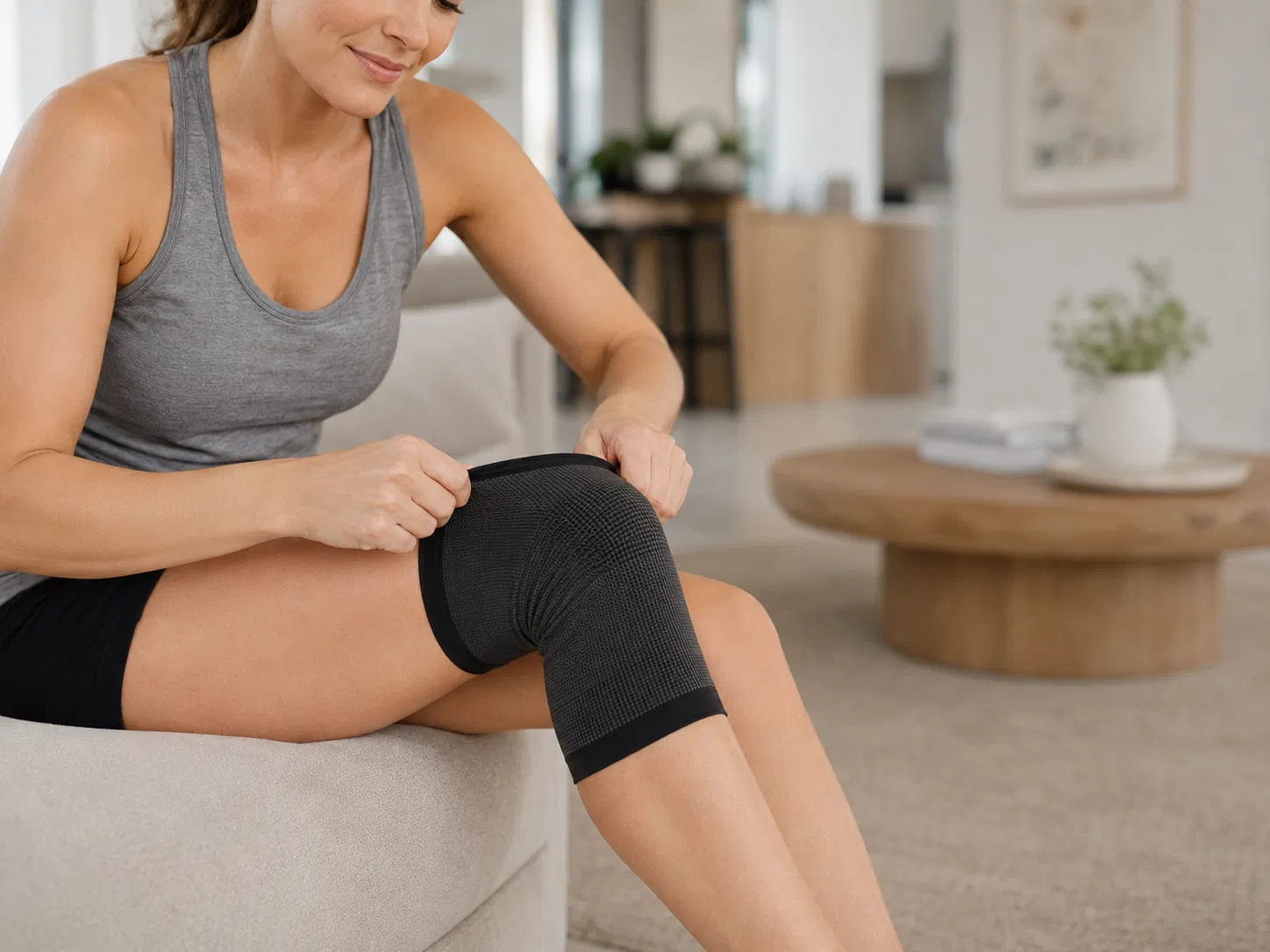
The sleeve shown with this guide is a fabric product. It is not presented as a functional ACL brace, a postoperative brace or protection against a ski injury. If that distinction makes it unsuitable for your purpose, do not try to make it serve that purpose by selecting a smaller size. A purchase that does not match the need is not an upgrade.
Warmth from clothing is also different from applying a powered heating device to a knee. Neither should be used to hide worsening symptoms so that you can continue skiing. For questions about when heat or cold may be appropriate away from the slopes, read the separate heat and ice guide and follow any individual treatment advice.
The rest of the ski day still matters
A brace does not choose a suitable slope, maintain your equipment or decide when fatigue has made another run unwise. Discuss bindings and equipment with a qualified ski technician, and use instruction appropriate to your ability. Do not change binding settings yourself to compensate for knee anxiety or assume that a brace allows you to ignore equipment advice.
Plan the first day around your current capacity rather than the distance you covered years ago. Lift queues, carrying equipment, walking in boots and getting back to accommodation add demands outside the runs themselves. A manageable plan leaves room for those tasks instead of allocating all available energy to the final descent.
Agree with companions that changing the plan is acceptable. Separate meeting points and a realistic return route can make it easier to stop without feeling responsible for ending everyone's day. That practical arrangement can be more useful than buying progressively more elaborate support while keeping an unrealistic itinerary unchanged.
Do not interpret a lack of pain during one run as proof that every later run is appropriate. Conditions and fatigue change. Conversely, a brace that makes you feel more aware of the knee is not necessarily evidence that the underlying injury has improved. Keep the equipment experience separate from the clinical assessment of the knee.
Know when support is not the next step
After an injury, severe pain, inability to bear weight or move the knee, major swelling, deformity or a hot red knee with fever needs prompt medical assessment. A ski-patrol or local medical evaluation is more appropriate than trying a different support and repeating the run. Follow local emergency arrangements when symptoms are severe.
For less urgent but persistent pain, repeated giving way or swelling that returns with activity, arrange a clinical review before the next session. Record what happened, the terrain and the symptoms rather than only the brand of brace you wore. That information helps distinguish a fitting problem from a knee problem that equipment alone cannot resolve.
The most useful choice is a clearly defined one: a fabric sleeve for an appropriate comfort purpose, a professionally selected brace for a specific clinical reason, or no purchase while you clarify what the knee needs. More support is not automatically more safety. A good decision explains both what the equipment is for and what it cannot do.
Pack the instructions, not just the equipment
Save the correct fitting and care instructions where you can access them without depending on resort internet. Keep any prescribed settings and the fitter's contact details with the travel information. Check which parts can be cleaned or replaced and what to do if a strap or fastening fails. A damaged device should not be repaired with improvised tape and treated as equivalent to its intended condition.
If the support is important to an agreed activity plan, discuss a backup plan before travelling. That may mean changing the activity rather than buying an unfamiliar brace at the resort. Knowing the limits in advance makes it easier to respond sensibly when equipment, weather or symptoms change.
Frequently Asked Questions
Will a knee brace prevent a skiing injury?
No brace guarantees prevention. Research in selected injured or reconstructed knees cannot establish protection for every recreational skier. Technique, conditions, fatigue, equipment and individual readiness remain important.
Is a compression sleeve the same as an ACL brace?
No. A fabric compression sleeve and a functional ligament brace differ in construction and intended use. Do not substitute a sleeve for a brace prescribed for a specific injury.
Should everyone wear a brace after ACL reconstruction?
No universal rule applies. AAOS guidance does not recommend routine functional bracing after isolated primary ACL reconstruction. A clinician may discuss individual sport circumstances; the brace alone never clears a return to skiing.
Can I wear a ski knee brace over thermals?
Follow the specific brace instructions and your fitter's advice. Clothing can change fit, friction and pressure. Test the approved arrangement with your ski trousers and boots before the trip.
Why does my knee brace slip while skiing?
Incorrect sizing, strap setup, clothing layers or changes in fit can contribute. Stop and check the instructions. Persistent migration needs a fitting review rather than progressively tighter straps.
Can I ski through knee pain if I wear support?
A brace should not be used to override worsening pain, swelling or instability. Stop the activity and obtain assessment when symptoms suggest an injury or interfere with normal movement.