One simple count, several contributing abilities
The 30-second chair stand test asks how many repeated stands you can complete in a fixed period under a defined protocol. The movement involves lower-body effort, but it also requires balance, coordination, confidence, and enough comfortable motion. Calling it a pure measurement of knee strength overlooks those other contributors.
Clinicians use functional tests because ordinary tasks can reveal limitations that a description alone misses. Someone may report difficulty with chairs but walk comfortably along a corridor. Observing repeated standing can help organize the next assessment or exercise plan. The count is useful information, not the complete explanation of the difficulty.
This article explains the test rather than prescribing a chair workout. For a gradual exercise routine, use our seated knee exercise guide. For pain specifically when rising, the after-sitting knee pain guide addresses symptoms rather than scoring performance.
Who the standard version is designed to help assess
The test was developed and studied in community-dwelling older adults and is used in settings including falls assessment and rehabilitation. Reference values belong to particular populations and procedures. A number from an older-adult screening tool should not be applied automatically to a young athlete, a person immediately after surgery, or someone using a modified technique.
The original validation study examined reliability and relationships with other measures of lower-body strength. Later work has studied the test in people with knee osteoarthritis and other groups. These studies support its usefulness while also showing why measurement consistency and the clinical setting matter.
Before testing, ask what question the result is meant to answer. Screening for a possible functional limitation, following rehabilitation progress, and comparing with age-related reference data are different purposes. A test chosen for one question may not be the best tool for another.
Safety comes before the stopwatch
A person who is dizzy, acutely unwell, newly injured, or unable to stand safely should not attempt a timed challenge alone. Knee pain that is severe or changing rapidly deserves assessment first. The test is not a way to prove that a swollen knee can tolerate exercise.
Arrange appropriate supervision, especially when balance is uncertain. The observer needs room to stand nearby and should know when to stop the test. A phone balanced across the room is not a substitute for a person who can respond if the participant becomes unstable.
Clear the area and secure the chair appropriately, commonly against a wall so it cannot slide backward. Use suitable footwear and a level surface. If the environment cannot be made safe, postpone the test or use another assessment selected by a clinician. A score is not worth an avoidable fall.
The chair and starting position affect the result
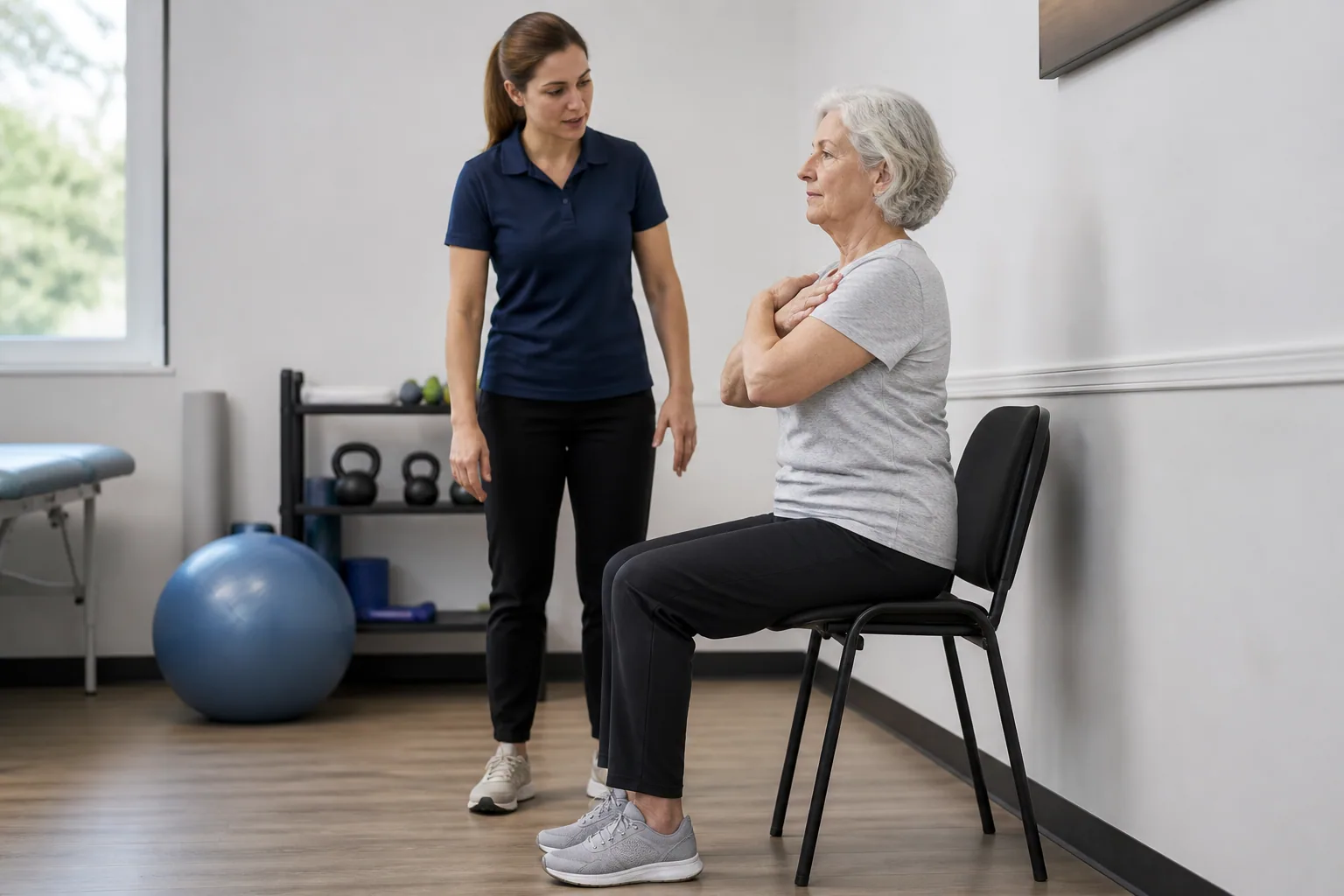
The CDC STEADI version specifies a straight-backed chair without armrests, with a seat height of 17 inches. The participant begins seated with feet on the floor and arms crossed at the chest. These details standardize the task; a soft sofa or a much higher dining chair does not create the same test.
Seat height changes how far you move and the effort needed to rise. Cushion compression changes the effective starting height too. Record the equipment when comparing results over time. If the chair changes, describe that openly rather than interpreting every extra repetition as a physical improvement.
The observer should demonstrate the intended movement and make sure the participant understands the task before timing. Confusion about whether to sit fully or stand all the way can distort a result. Familiarization should clarify the procedure without turning into an exhausting practice session.
How the timed count works
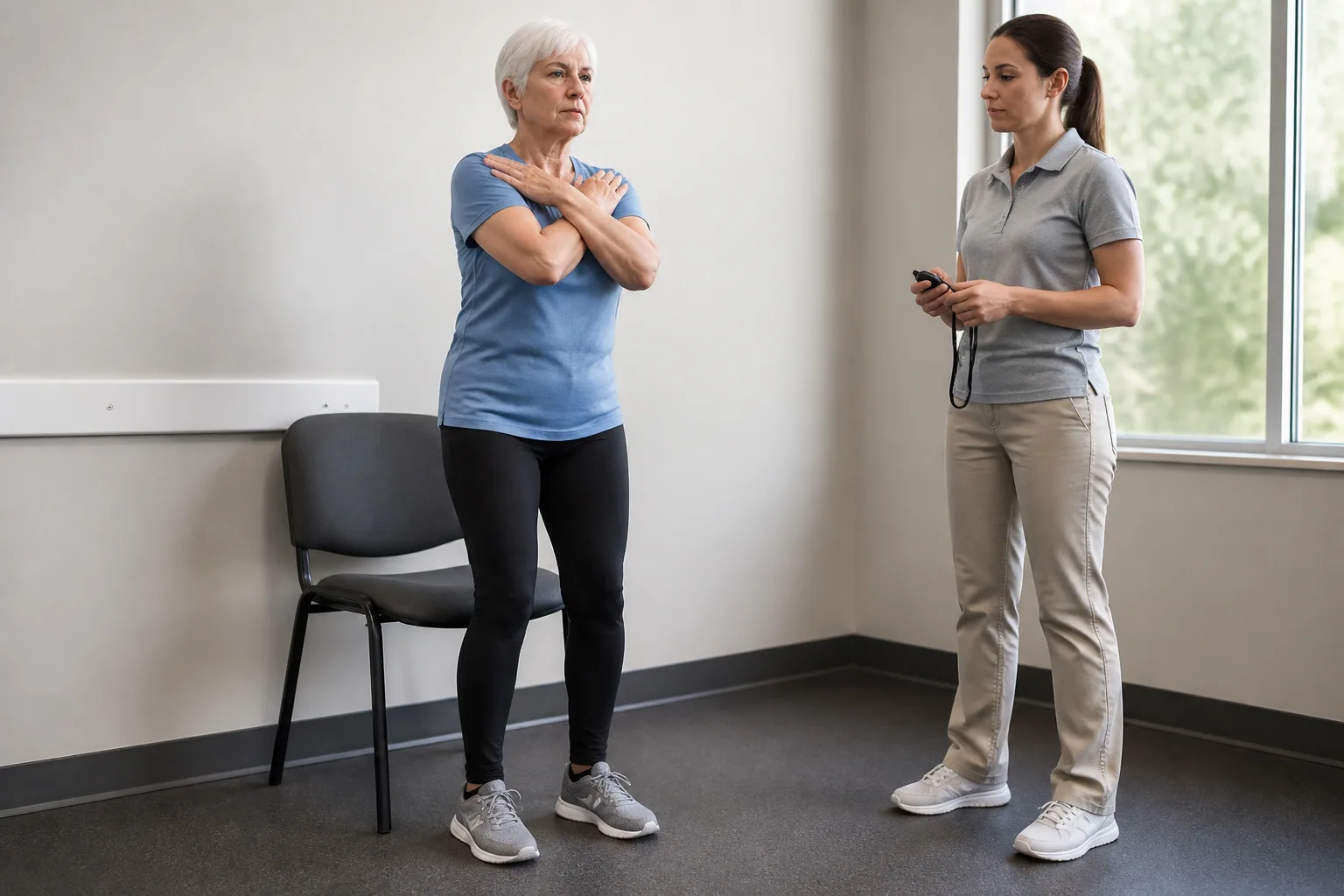
During the timed period, the participant repeatedly stands fully and returns to sitting according to the standardized instructions. The observer counts the completed stands and watches the movement. In the CDC protocol, a person more than halfway into the final stand when time ends receives credit for that stand.
Using the hands changes the protocol. If the participant must push with the arms in the standard CDC assessment, the test is stopped and recorded as zero for that version. This does not mean the person has no strength or no useful ability. It means they could not complete the defined arms-crossed task.
Do not encourage a person to ignore pain or instability to obtain a count. Stop when safety requires it and document why. A stopped test can provide important clinical information even without a number suitable for a reference table. The response to the task matters alongside the final score.
CDC below-average reference cutoffs
The following figures are the CDC STEADI chart's below-average cutoffs for its older-adult assessment. They are not minimum exercise targets, diagnostic thresholds for arthritis, or a prediction that a particular person will fall. Use the correct age band and the original protocol when discussing the result with a professional.
| Age in years | Men: below average | Women: below average |
|---|---|---|
| 60–64 | Fewer than 14 stands | Fewer than 12 stands |
| 65–69 | Fewer than 12 | Fewer than 11 |
| 70–74 | Fewer than 12 | Fewer than 10 |
| 75–79 | Fewer than 11 | Fewer than 10 |
| 80–84 | Fewer than 10 | Fewer than 9 |
| 85–89 | Fewer than 8 | Fewer than 8 |
| 90–94 | Fewer than 7 | Fewer than 4 |
These categories reflect the source chart's grouping. They do not capture every difference in body size, medical history, activity, or identity. Where the available reference groups do not adequately fit a person, interpretation should be individualized rather than forcing a simple pass-or-fail label.
A score below the reference cutoff is a prompt to consider function and falls risk more broadly. A score above it does not rule out balance problems, medication effects, vision difficulties, or a recent fall. The most useful response is a relevant assessment and plan, not reassurance or alarm from the table alone.
How knee pain changes interpretation
A painful knee may limit repeated standing even when the muscles could generate more force under different conditions. Pain can also change speed, confidence, and the way weight is shared between the legs. A lower count during a flare should not automatically be described as permanent strength loss.
Observe the pattern without turning it into a self-diagnosis. Does the person hesitate before rising, shift heavily to one side, or have difficulty controlling the descent? A clinician can use those observations to decide what else to examine. The test alone cannot distinguish arthritis, a tendon problem, or another cause of pain.
If an adapted chair height or arm support is necessary for safety, record the adaptation and follow an appropriate modified measure. Do not compare that result directly with the standard table as though nothing changed. Adaptation can be clinically useful precisely because it makes a task possible, but it changes what the number means.
Thirty seconds is not the same as five repetitions
The five-times sit-to-stand test usually measures the time required to complete five repetitions under its own instructions. The 30-second test fixes the time and counts repetitions. Both involve chairs, but their scoring, pace, and reference values differ. A time of twelve seconds cannot be translated into a standard thirty-second count by simple multiplication.
Other assessments, such as the Timed Up and Go, include walking and turning in addition to a chair transfer. Those added tasks answer different functional questions. A clinician may combine measures when a single count does not explain a person's difficulty with everyday mobility.
When reading a result online, check the exact test name, chair height, arm rule, and population. Many social-media comparisons omit these details. Without them, a dramatic claim about your fitness age or expected lifespan may rest on numbers that were never intended for that purpose.
How much change is meaningful?
Every measurement contains some variation. Sleep, symptoms, instructions, learning, effort, and the chair setup can influence repeated tests. Research in early knee osteoarthritis has examined reliability and detectable change, but a single threshold should not be borrowed for every population and testing situation.
A clinician should interpret a change alongside the measurement method and real-life function. One extra stand may be encouraging without proving a major physiological change. Conversely, a stable count does not erase improvements in pain, confidence, walking, or how easily you manage ordinary transfers.
Do not test at maximum effort every day to chase a better number. Planned reassessment after a suitable interval is usually easier to interpret than frequent attempts under inconsistent conditions. Keep the exercise programme and the assessment distinct so the test does not become the whole purpose of training.
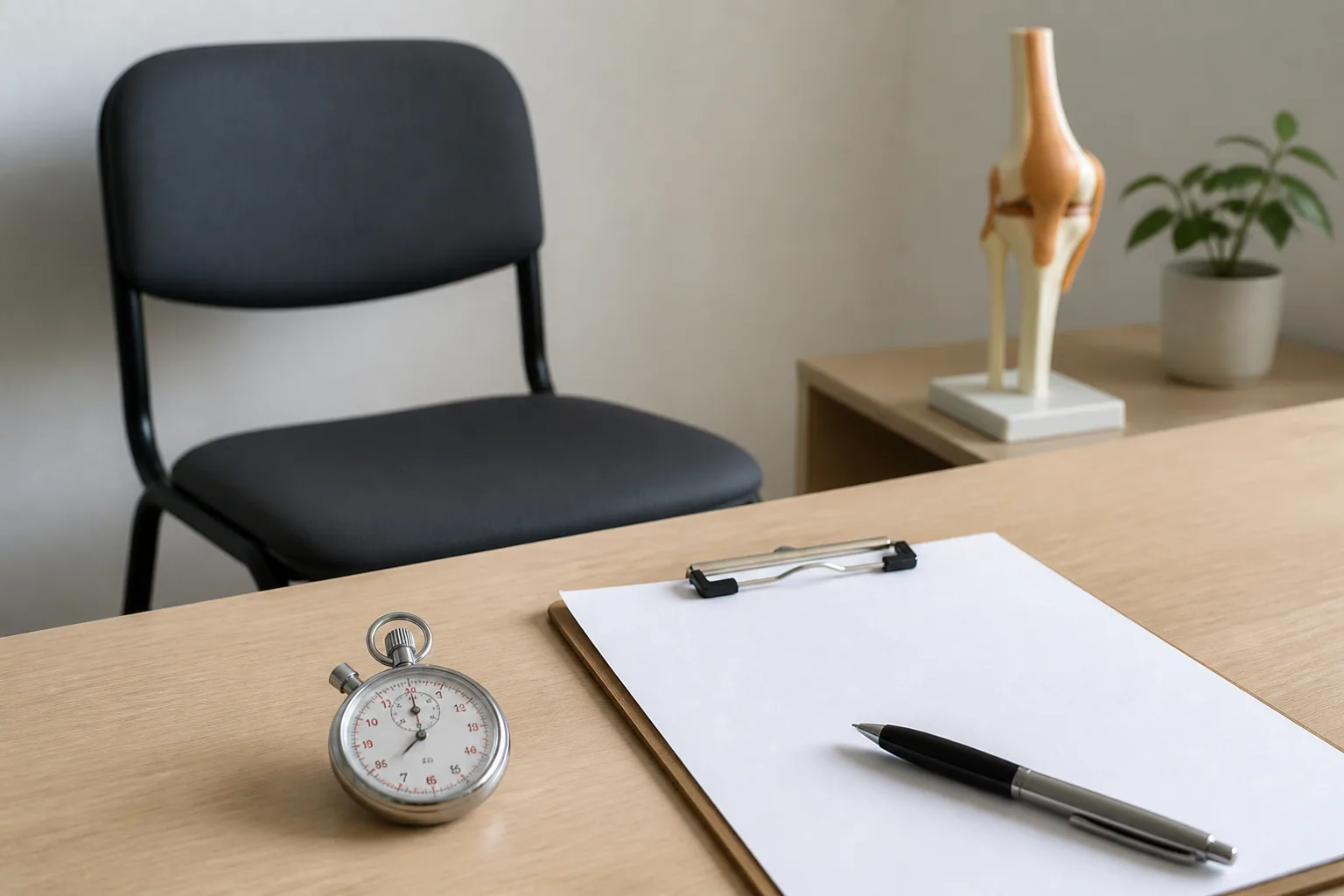
A useful record for repeat testing
| Record | Why it helps |
|---|---|
| Chair height and type | A different starting height changes the movement demand. |
| Footwear and surface | Grip and stability influence performance. |
| Arm position or adaptation | Modified results need to be identified clearly. |
| Symptoms before and during | Pain or dizziness may explain a change or stopped test. |
| Count and counting method | Consistency matters at the final partial repetition. |
| Observer and instructions | Different demonstrations can change understanding and pace. |
| Relevant recent changes | Illness, surgery, exercise, or medication may affect interpretation. |
The record can be brief. A few clear notes are more useful than a complicated spreadsheet that nobody reviews. If testing is part of therapy, ask the clinician to explain how the result relates to your goals and when they intend to repeat it.
For remote assessment, follow the supervising service's setup instructions. Camera position should allow observation without requiring you to hold a device while standing. A helper may be needed for safety and counting. Do not assume a telehealth version is automatically suitable for unsupervised self-testing.
Turn the result into an everyday goal
Choose a practical task you want to improve: standing from a usual chair, getting out of a car, or managing a short outing. A rehabilitation programme can then address the relevant strength, balance, and motion. The chair-stand count may help follow progress, but the daily task gives the effort a meaningful purpose.
If floor transfers are your concern, discuss them separately. Our floor-transfer guide explains why that task involves different positions and support needs. A good chair score does not establish that an unsupported floor rise is safe.
Support products should not be used to disguise a testing limitation. A sleeve may change comfort, but it does not validate an altered protocol or diagnose the knee. Record meaningful changes in equipment, and prioritize a suitable exercise and assessment plan over purchasing something to improve the score.
Questions to ask after the test
Ask which reference group is being used and whether the setup matched it. Then ask what the observer noticed beyond the count. Movement quality, pain, and balance may explain why the next step is a particular exercise, a medical review, or another assessment rather than simply more repetitions.
Also ask what would make the next test comparable. Using the same chair and clear instructions is often easier than trying to recreate every detail from memory. If symptoms change substantially before the planned reassessment, report that rather than waiting just to obtain another number.
A stopped test still deserves a useful explanation
If pain, arm use, or instability stops the standard assessment, ask what will be assessed instead. The next step may be observing an ordinary transfer, using an adapted measure, or reviewing the symptom that interrupted the task. Recording the reason is more informative than leaving a blank score or treating the result as a personal failure.
Caregivers should avoid turning the number into pressure to perform faster next time. Encourage the agreed exercise plan and safe everyday movement. The assessment is there to support care, not to rank family members or judge how hard someone is trying.
When to Get Medical Help
Stop testing for chest pain, faintness, unusual breathing difficulty, new weakness, severe knee pain, or instability, and seek appropriate medical help. A hot red swollen knee, inability to bear weight, or a significant new injury requires assessment. Repeated falls or increasing difficulty rising from everyday chairs also deserves a professional review.
Use the count as a conversation starter
A standardized chair stand can make function easier to discuss and follow over time. It cannot summarize your health, diagnose a painful knee, or predict your future by itself. Keep the setup consistent, put safety first, and connect the result to the activities you actually want to do more comfortably.
Frequently Asked Questions
What does the 30-second chair stand test measure?
It is a functional performance measure involving lower-body strength and endurance. Balance, pain, coordination, and the setup can also influence the count.
Can I use my arms?
Not in the standard arms-crossed protocol. If arms are required, the CDC assessment stops and records zero for that protocol. An adapted test should be labeled separately.
What chair height is used?
The CDC version specifies a 17-inch straight-backed chair without armrests. A different height changes the task and may limit comparison with its reference cutoffs.
Does a low score mean I will fall?
No single score predicts an individual's fall. A low result is a reason for broader assessment, especially alongside falls history, balance, medications, and symptoms.
Is this the five-times sit-to-stand test?
No. One counts stands within 30 seconds; the other times five repetitions. Their procedures and reference values are not interchangeable.
Should I do the test every day?
Repeated maximal testing is usually less useful than a planned reassessment under consistent conditions. Discuss an appropriate interval and exercise plan.
Can I test myself with painful knees?
Do not force a painful or unsafe test. A clinician can decide whether testing, adaptation, or another measure is appropriate.
Do the older-adult norms apply to younger people?
Do not automatically apply age-specific older-adult cutoffs to a younger person or another clinical population. Use suitable reference data.