Somewhere between one in five and one in four adults has what would be described as flat feet, and the overwhelming majority of them walk around perfectly comfortably for a lifetime. That is the first thing worth saying clearly, because searching this topic can quickly leave you convinced that your feet are a structural emergency. They almost certainly are not.
The reason flat feet come up in knee conversations at all is that the leg works as a chain. Everything the knee does is influenced by what the hip above it and the foot below it are doing, and the foot is the part that actually meets the ground. If the foundation moves differently, the structure above adapts. Sometimes that adaptation is silent for decades. Sometimes it shows up as an ache at the front of the knee after a long day.
What Flat Feet Actually Are
The medical term is pes planus, and people also call it fallen arches. It simply means the arch on the inner side of the foot sits lower than average, so more of the sole makes contact with the ground when you stand. There are two versions that behave very differently.
Flexible flat feet are by far the most common. The arch appears when the foot is unloaded, for example when you sit with the foot in the air or stand on tiptoes, and disappears when you put weight through it. Most people have had them since childhood, and they often run in families. Rigid flat feet have no visible arch in any position. They are less common, more likely to be painful, and more likely to need proper assessment.
There is also a third pattern that matters more than the other two: an arch that was normal for most of adult life and then gradually flattens, usually on one side, often with pain and swelling along the inner ankle. That presentation deserves a clinician rather than an insole, and we come back to it at the end.
Do You Actually Have Flat Feet? The Wet Test
Before spending money on anything, it is worth knowing what you are dealing with. The wet footprint test is crude but genuinely useful, and it takes about a minute.
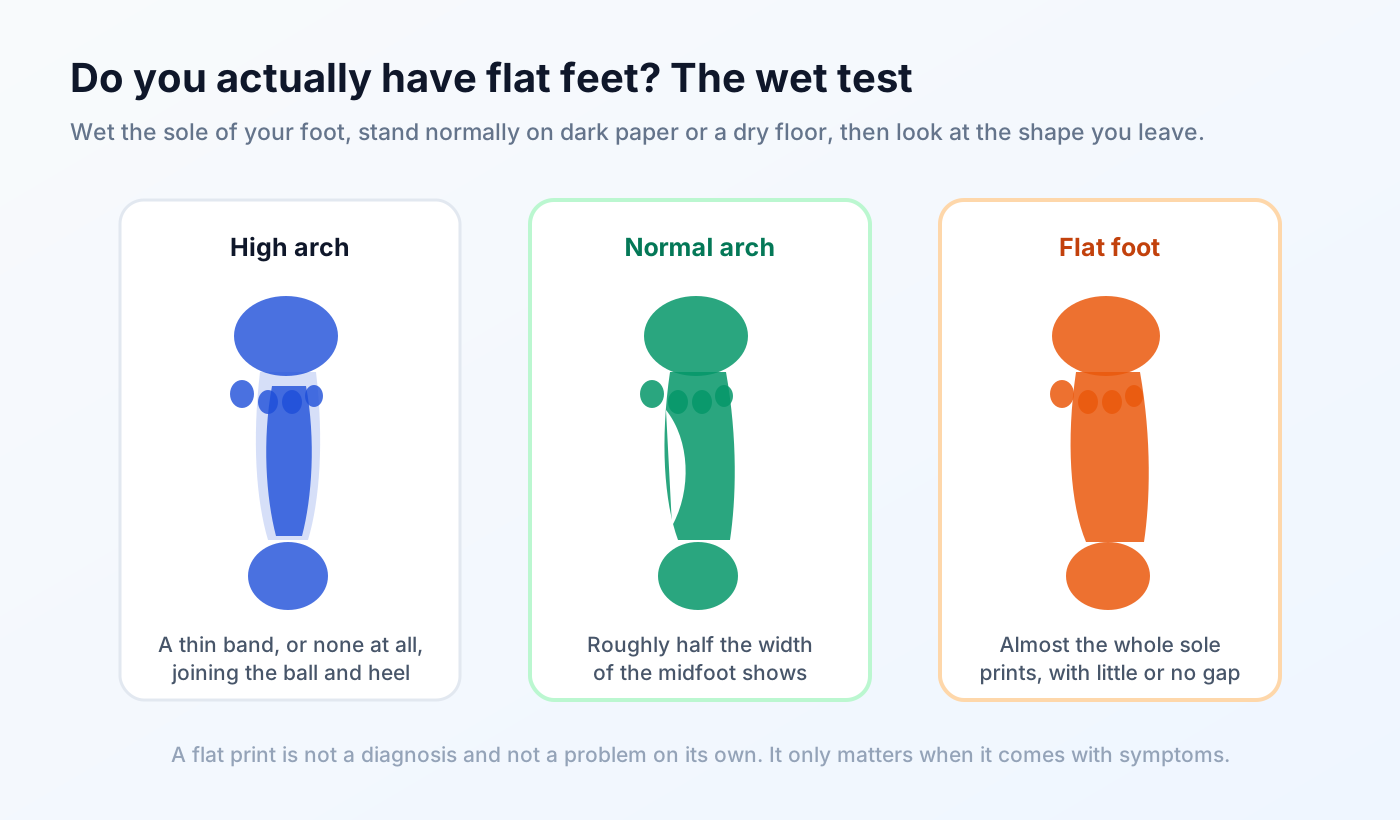
Wet the bottom of one foot, stand normally on dark paper, a dry patio slab or a concrete floor, then step away and look. A high arch leaves a thin strip, or sometimes no connection at all, between the ball of the foot and the heel. A normal arch leaves a band roughly half the width of the midfoot. A flat foot prints almost the entire sole with little or no inward curve.
A second check is even more informative. Stand relaxed and look at the back of your ankles in a mirror, or have someone photograph them. If the Achilles tendons angle inward rather than running straight down, and you can see the outer toes peeking out beyond the ankle from behind, the foot is rolling inward under load. That is pronation, and it tells you more than the footprint does.
Flat Feet and Overpronation Are Not the Same Thing
This distinction is where most online advice goes wrong, so it is worth being precise. Flat feet describe a shape. They are about how your arch looks when you stand still. Overpronation describes a movement. Pronation itself is normal and necessary: the foot is supposed to roll slightly inward on landing to absorb shock. Overpronation simply means it rolls further, or faster, or for longer than it should before pushing off.
The two often travel together but not always. Plenty of people with visibly flat feet control their motion perfectly well and have no symptoms anywhere. Some people with textbook arches overpronate significantly under load. This is why buying a shoe purely because your footprint looks flat is a coin flip, and why what happens when you move matters more than what a static print shows.
How the Foot to Knee Chain Works
Here is the mechanism, in plain terms. As the arch flattens under body weight, the heel bone tilts and the whole foot rolls inward. The shin bone is attached to the ankle, so it follows, rotating inward as well. That inward rotation of the shin changes the angle at which the thigh muscles pull on the kneecap, which is often described as an increase in the Q angle.
The practical result is that the kneecap no longer tracks cleanly in its groove. It is dragged very slightly toward the inside with each step, and pressure concentrates on one side of the joint surface instead of being spread evenly. Nobody notices a single step. Around seven thousand steps a day is a different matter, and that is where front of knee ache, inner knee soreness after long walks, and stairs discomfort start to appear. Our guide on pain behind the kneecap covers what that pattern feels like from the knee's side of the story, and knee pain going down stairs explains why descending is usually the first thing to suffer.
The chain works upward too. Inward rotation at the shin encourages the knee to drift toward the midline, which is the position sometimes described as knock knees. Weak hip muscles allow exactly the same drift from above. When both ends contribute, the knee is being squeezed from two directions at once, which is why programmes that only address the foot sometimes disappoint.
Reading Your Own Symptom Pattern
Feet are not always the culprit, so it helps to match what you are feeling against what the foot chain usually produces before you start buying things.
| What you notice | How likely the feet are involved | Sensible first move |
|---|---|---|
| Front or inner knee ache after long walking or standing | Reasonably likely, especially with visible inward ankle roll | Check shoe support and age, then trial arch support for two to three weeks |
| Inner edges of your shoes wear out faster than the outer | Strong clue that load is travelling through the inside of the foot | Move to a stability shoe category and replace worn pairs |
| Heel pain in the first steps of the morning | Classic plantar fascia pattern, often shares the same mechanics | Support plus calf work, since a tight calf worsens both |
| Aching along the inner shin after running or walking | Commonly associated with excessive pronation and load spikes | Reduce volume, check footwear, build back gradually |
| Outer knee pain that sharpens the longer you go | Less about the arch, more about hip control and training load | Look at the IT band and hip strength before the feet |
| Knee swelling, locking, or giving way | Unlikely to be a foot problem at all | Get the knee assessed rather than experimenting with insoles |
If your discomfort sits on the outer side, the foot is probably not the main story and the IT band guide is the better starting point. If you are not sure where your pain actually sits, our visual guide to knee pain locations is designed for exactly that question.
Worth trying early
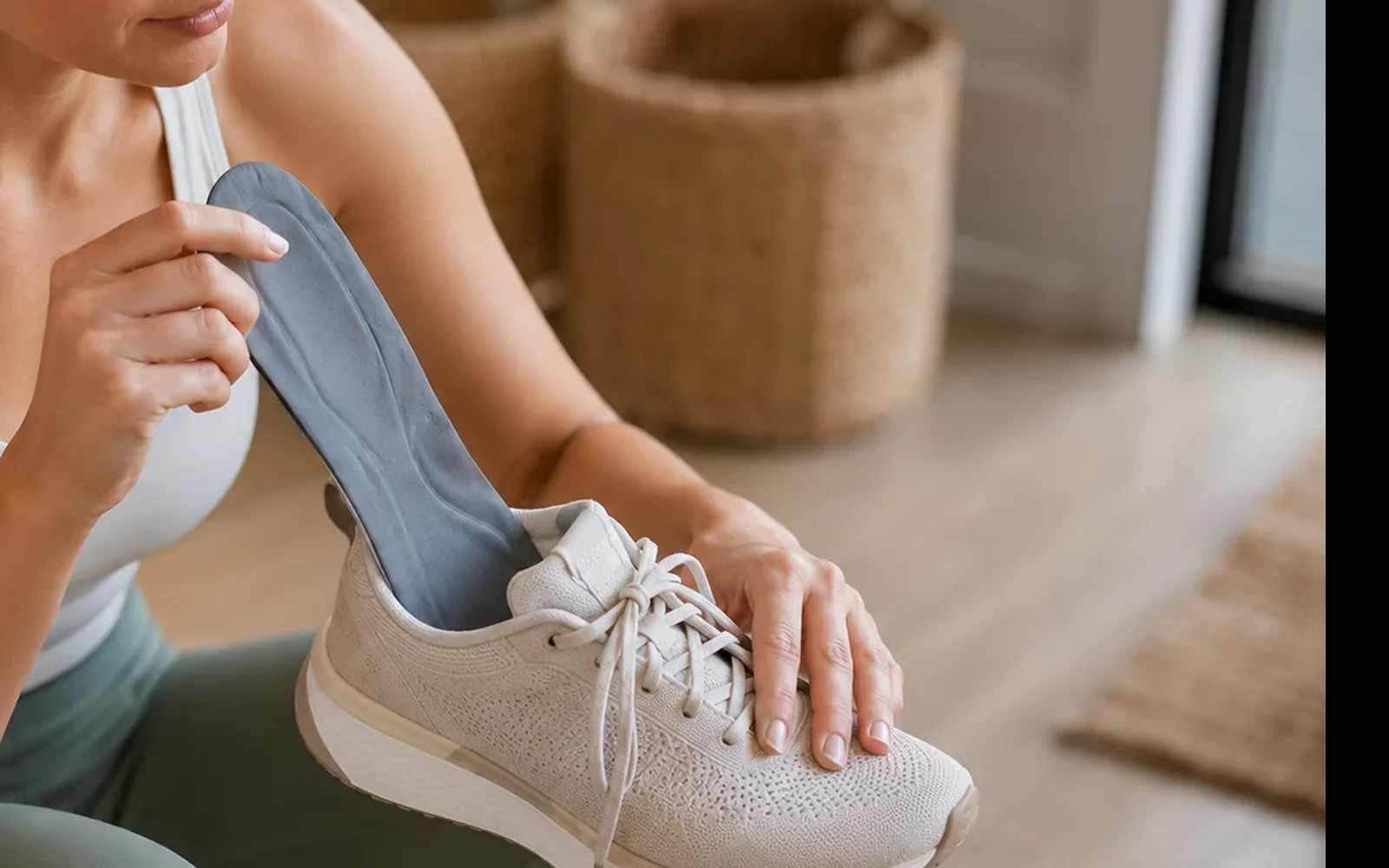
Arch support is the cheapest, fastest and most reversible experiment in this whole article, which is why it sits before strengthening and long before anything clinical. Our FlexiKnee Sport Orthopedic Insoles are structured, shock absorbing and trim to fit, which makes them a reasonable way to find out whether changing what happens under your foot changes what your knee feels. Give any insole two to three weeks before you judge it, and read our insole buying guide first if you want to compare types rather than buy blind.
Can Flat Feet Be Fixed?
The honest answer, and the one that saves people the most money, is no, not in adults, not in the way the question is usually meant. Once skeletal growth is complete, no exercise programme, insole, shoe or device rebuilds a permanent arch. Claims to the contrary are marketing.
What can change, and change meaningfully, is function. The muscles that support the arch from underneath and the hip muscles that control the leg from above both respond to training. Footwear changes how much the foot is allowed to collapse. Load management determines whether the tissues have time to adapt. Together these can substantially reduce the strain reaching your knee, without altering the shape of anything.
Surgery exists for flat feet but is reserved for a small group, typically people with rigid, painful, deformed feet or a failed tendon, and it is not a treatment for a knee that aches on stairs. If a website is suggesting an operation for garden variety flexible flat feet, close the tab.
What Actually Helps, in Order
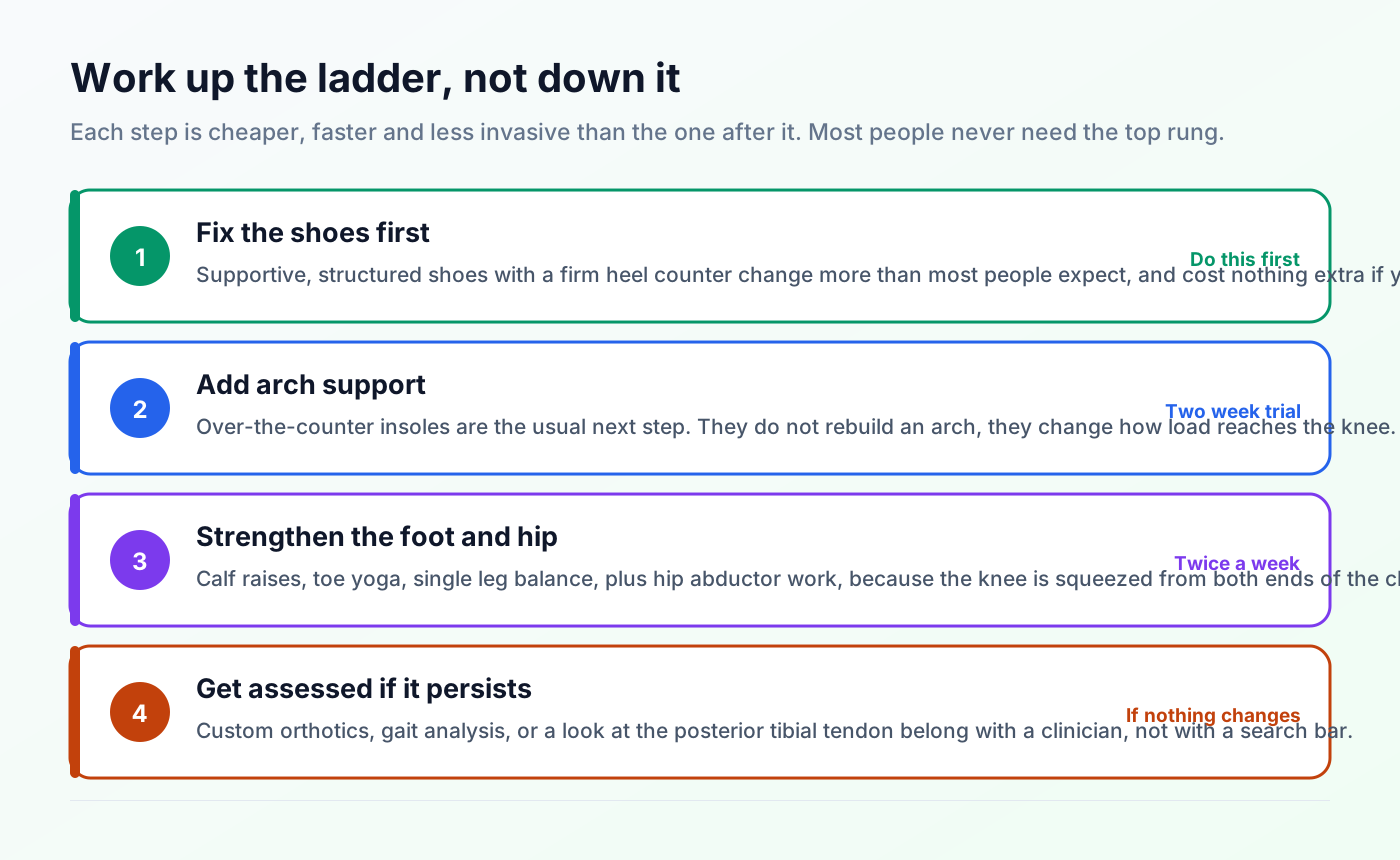
Start with your shoes. This is unglamorous and it is where the biggest free win usually hides. Pick a shoe up and test it: pinch the heel counter, which should resist rather than collapse; wring the shoe like a towel, and it should resist twisting; try to fold it in half, and it should bend at the ball of the foot rather than in the middle. Worn out cushioning is the single most common hidden factor, because midsoles die long before uppers look old. Our guide to running shoes and knee pain covers the same principles for anyone covering distance.
Then add arch support. Over the counter insoles are the standard next step and they are enough for most people. They do not correct anything structurally, they simply change how force travels up the leg. Custom orthotics have their place but belong further along the path, after simpler options have genuinely been tried.
Then strengthen both ends of the chain. For the foot, slow calf raises through a full range, short foot exercises where you draw the ball of the foot gently toward the heel without curling the toes, and single leg balance work. For the hip, side lying leg raises and band walks, because hip weakness lets the knee drift inward regardless of what your foot is doing. Two sessions a week is enough, and our knee strengthening guide shows how these fit into a wider routine.
One more thing deserves a mention because it is so frequently missed. A tight calf increases the demand on the arch, since the foot has to find range somewhere when the ankle will not bend far enough. If your calves are stiff as well, working on them makes everything else more effective, and our guide on tight calves and knee pain explains why the two problems so often arrive together.
Give Any Change Time to Show Itself
Tissues adapt on their own schedule. New insoles usually feel odd for the first few days and should be worn in gradually, an hour or two on day one and building over a week, rather than straight into an eight hour shift. Judge them after two to three weeks of consistent use, not after one uncomfortable afternoon.
Expect improvement rather than resolution. A realistic outcome is that stairs feel less pointed, long days hurt less by the evening, and you stop noticing your knee during ordinary walking. If nothing at all has shifted after a month of supportive shoes, arch support and sensible loading, that is genuinely useful information: the feet were probably not the main driver, and it is time to look at the knee itself, at training load, or at the hip.
On flare days, warmth around the joint helps many people stay comfortable enough to keep moving, which matters more than any single exercise. Our heat versus ice guide covers when each one is appropriate, and the daily knee care routine shows how to keep the habit small enough to actually do.
When to Get It Looked At
Most flat feet need nothing more than sensible shoes. A few situations do warrant an appointment rather than an experiment.
See a clinician if an arch has flattened during adulthood when it used to be normal, particularly on one side and with pain or swelling along the inner ankle, because that pattern can point to a posterior tibial tendon problem that responds much better to early treatment than late. Get assessed for a foot that is rigid and painful rather than flexible, for symptoms in one foot only without an obvious reason, and for numbness, tingling or weakness. And if the knee itself is swelling, locking or giving way, that is a knee problem to investigate directly rather than a foot problem to accommodate.
The Bottom Line
Flat feet are a common variation, not a defect, and they cause no trouble at all for most of the people who have them. When knee pain does travel up from the foot, the mechanism is straightforward: the arch collapses, the shin rotates inward, and the kneecap is pulled slightly off its track thousands of times a day. That is worth addressing, and it is usually addressable without anything dramatic.
Check your arches with the wet test, look at your ankles from behind, and pay attention to how your shoes wear. Fix the footwear first because it is free if you were replacing them anyway, trial arch support for two to three weeks, and build strength at both the foot and the hip so the knee is not squeezed from either end. Adjust your expectations to management rather than correction, since adult arches do not come back. And keep the small list of red flags in mind, because the version of flat feet that genuinely needs a clinician announces itself clearly, usually in one foot, usually with inner ankle pain, and usually in someone whose arches were fine until recently.
Frequently Asked Questions
Can flat feet cause knee pain?
They can contribute to it, though they are rarely the only cause. When an arch collapses under load the shin bone rotates inward, which increases the angle the kneecap is pulled at and shifts pressure toward the inner knee and the front of the joint. Many people with flat feet never develop knee pain at all. The feet become relevant when knee symptoms appear alongside inward rolling ankles, uneven shoe wear, or foot and shin discomfort.
How do I know if I have flat feet?
The wet footprint test takes a minute. Wet the sole of one foot, stand normally on dark paper or a dry floor, and look at the shape. A normal arch leaves roughly half the width of the midfoot. A flat foot prints almost the entire sole with little or no gap on the inner edge. It also helps to look at your feet from behind in a mirror while standing: if the ankles angle inward and you can see extra toes on the outer side, that suggests pronation.
Are flat feet and overpronation the same thing?
No, and confusing them is the most common mistake in this topic. Flat feet describe the shape of the arch when you are standing still. Overpronation describes movement, specifically how far and how fast the foot rolls inward as you walk or run. Plenty of people with flat looking feet have perfectly controlled motion, and some people with normal arches overpronate significantly. Movement matters more than shape.
Can adult flat feet be fixed?
Not in the sense of rebuilding a permanent arch. In adults the bones and ligaments have finished developing, and no exercise, insole or shoe restores an arch that has flattened. What can genuinely change is function: how well the foot muscles control that motion, how supportive your footwear is, and how much strain reaches the knee. That is why the goal in adults is management and comfort rather than correction.
Do insoles help knee pain from flat feet?
For many people they help, and they are a reasonable early experiment because they are inexpensive and reversible. Insoles do not rebuild the arch. They change how load travels up the chain, which can reduce the inward rotation reaching the knee. Give a pair two to three weeks of consistent wear before judging them, and expect improvement in comfort rather than a complete resolution.
What shoes are best for flat feet?
Look at the shoe rather than the marketing. A supportive shoe has a firm heel counter that does not squash when you pinch it, resists twisting when you wring it like a towel, and does not fold in half at the middle. Stability or motion control categories are designed for exactly this. Worn out cushioning is a common hidden culprit, so check the age of your shoes before buying anything else.
Are flat feet linked to plantar fasciitis and shin splints?
Both are associated with excessive pronation, which is why these complaints often appear together. The plantar fascia under the foot and the muscles along the shin work harder when the arch gives way, and the same mechanics that irritate them can affect the knee. If you have two or three of these at once, addressing the foot may improve all of them at the same time.
When should flat feet be checked by a doctor?
See a clinician if an arch flattens noticeably in adulthood having previously been normal, especially with pain and swelling along the inner ankle, because that pattern can indicate a tendon problem that responds better to early treatment. Also seek advice for a foot that is rigid and painful rather than flexible, for pain in one foot only, or for symptoms that have not improved after a few months of supportive shoes and sensible loading.