Searches for tib raises, wall tib raises, and tibialis anterior exercises have made this small movement feel like a missing piece in every knee program. The exercise is not useless, but the most dramatic promises run ahead of the evidence. A tib raise trains muscles at the ankle. Any knee benefit depends on why you are doing it, what else is in the program, and whether the lower leg is actually a limiting part of the task.
This guide explains technique and programming. It cannot identify the cause of pain from a screen. If your main symptom is in the knee during loaded bending, first use the guide to knee pain when squatting. If discomfort is centered in the front of the shin or follows running, do not assume more tib raises are automatically the solution.
What Is a Tibialis Raise?
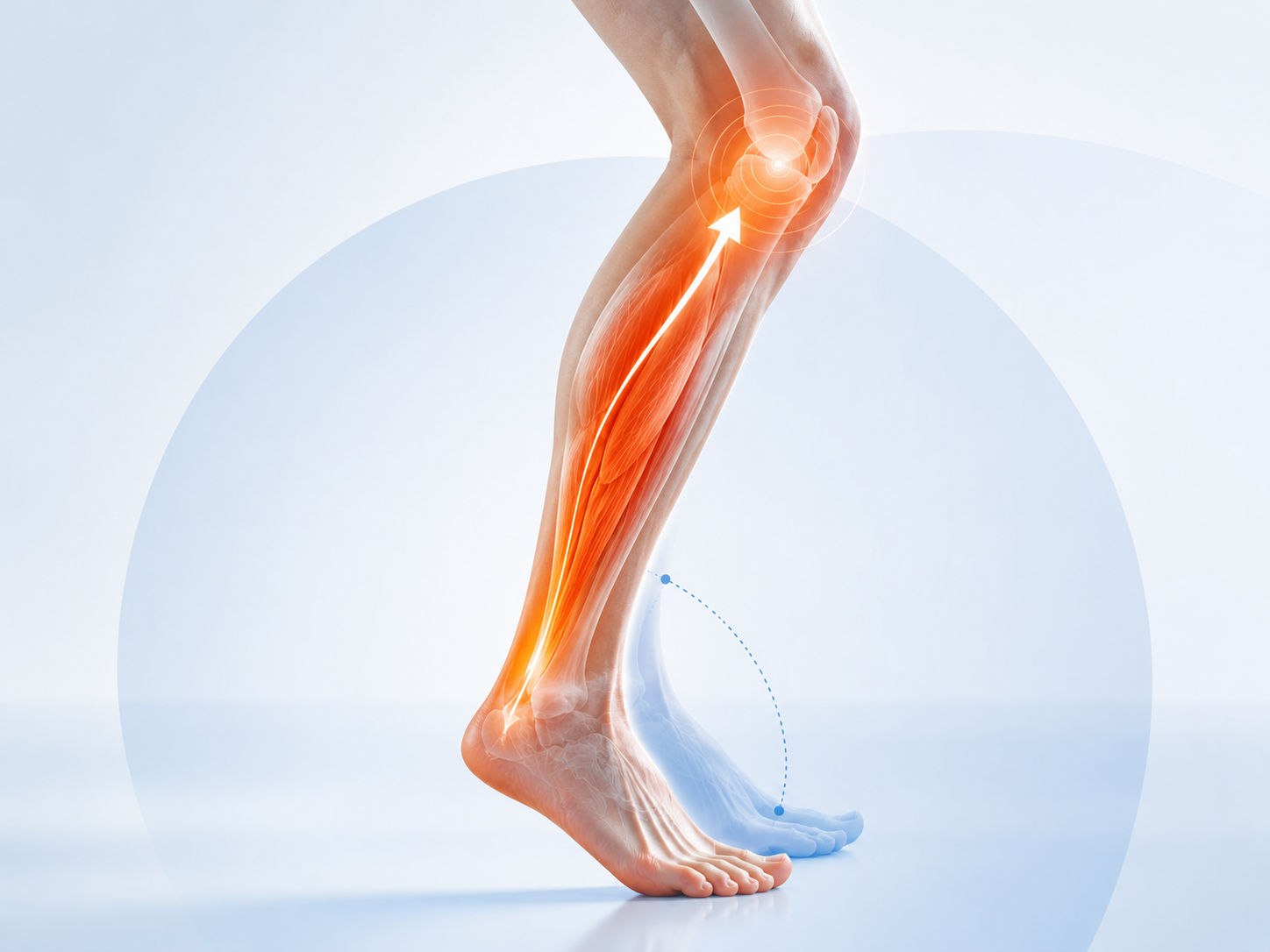
A tibialis raise is resisted ankle dorsiflexion. The heel stays planted while the forefoot and toes move toward the shin. The bodyweight wall version uses your lean as resistance. A seated version reduces the balance demand, while a band, cable, or tib bar can provide more measurable resistance.
The tibialis anterior is the largest muscle in the front compartment of the lower leg and is the main target. Other dorsiflexors assist. During walking, this muscle helps lift the foot for toe clearance in swing and controls the foot as it lowers after contact. A small laboratory study using ultrasound and motion analysis in 12 healthy adults documented both roles. That describes normal function, not proof that one exercise prevents knee injury.
What Tib Raises Actually Train
Active ankle dorsiflexion
Pulling the forefoot upward against gravity or resistance builds the specific action of dorsiflexion. AAOS includes banded ankle dorsiflexion in its foot and ankle conditioning program and lists the anterior tibialis among the main muscles worked. This is a clearer claim than saying the exercise “strengthens the knee,” because the movement occurs at the ankle.
Local strength and fatigue resistance
Repeated controlled contractions can train the front of the shin. A small study of 20 young healthy women found improvements in ankle dorsiflexion and plantar-flexion strength after four weeks of either open-chain or closed-chain ankle exercise. It did not test wall tib raises as a knee treatment, and results from a small healthy sample should not be turned into a pain guarantee.
Control of the lowering phase
The return is part of the repetition. Letting the toes slap down skips the controlled lengthening that helps manage the forefoot. A slow, quiet lower is also an easy way to keep the exercise honest without adding equipment.
Do Tibialis Raises Improve Knee Strength?
Indirectly, perhaps in a narrow supporting role. Directly, no. The tibialis anterior does not extend the knee like the quadriceps. A person may benefit from better ankle capacity during walking, incline work, step-downs, or squats, but that is different from demonstrating that tib raises reduce knee pain or prevent injury.
The best-practice guide for patellofemoral pain supports knee-targeted exercise, with hip-targeted exercise and other interventions tailored to the individual. It does not identify tib raises as a stand-alone treatment. A complete program still needs exercises that match the painful or important task. Use the knee strengthening guide to build that foundation, then add tib raises when lower-leg capacity has a clear reason to be there.
Strength Is Not the Same as Ankle Mobility
A common claim says strengthening the tibialis anterior automatically improves ankle dorsiflexion range. That mixes active force with available joint motion. You can become better at pulling the toes upward without meaningfully changing how far the shin travels over a planted foot. Calf flexibility, joint structure, pain, prior injury, and the testing position can all limit range.
Experiments show that altering available ankle dorsiflexion changes squat mechanics. A 2026 review also found that heel elevation changed ankle and knee range during squats in healthy adults. Those findings show that setup and range matter; they do not show that wall tib raises correct every mobility restriction. If the calves feel like the main limit, compare strength with the separate guide to tight calves and ankle dorsiflexion.
How to Do Wall Tib Raises
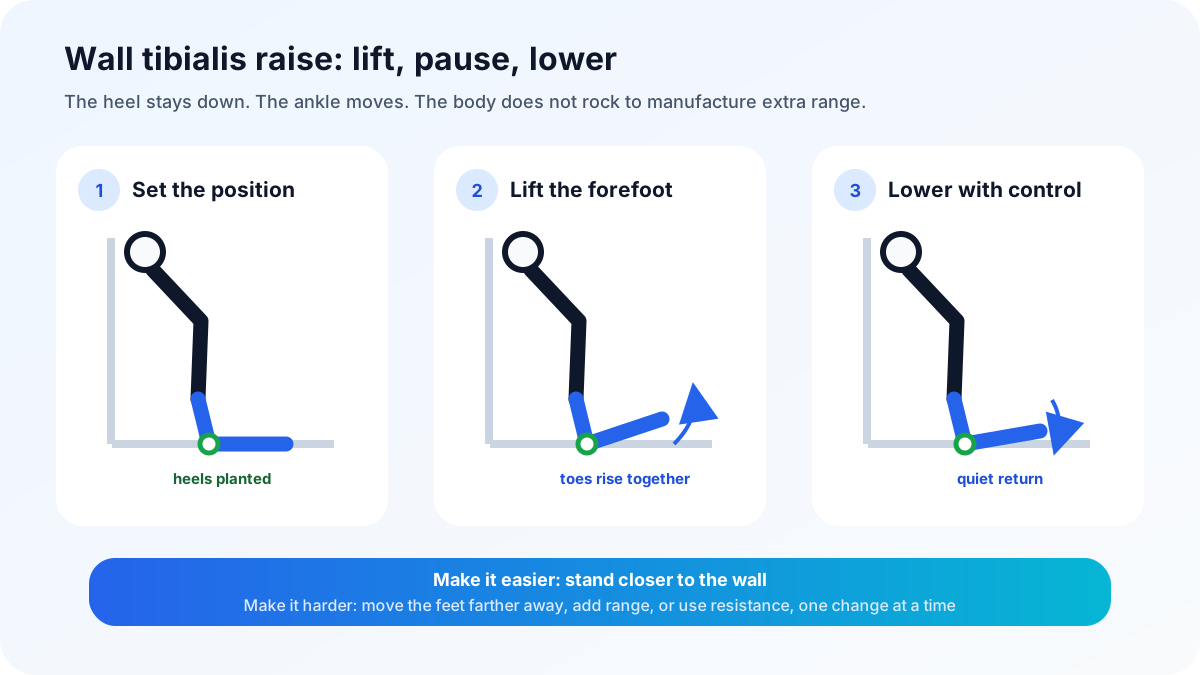
- Choose a stable wall. Rest the hips or upper back lightly against it and place both feet flat, roughly hip-width apart.
- Set the difficulty. Keep the feet closer to the wall for an easier version. Move them farther away only when balance and heel contact remain easy.
- Keep both heels planted. Lift the forefeet and toes toward the shins without bending backward at the waist.
- Pause briefly. Use the highest range you can reach without rolling to the outer edge of the foot or clawing the toes.
- Lower quietly. Take one or two seconds to return instead of dropping the toes to the floor.
Technique Errors That Change the Exercise
- Rocking the whole body. Momentum makes a larger movement but gives the dorsiflexors less controlled work.
- Lifting the heels. The repetition becomes a body sway rather than a clean forefoot lift.
- Rolling to the outside edge. Keep pressure through the heel and let the forefoot rise evenly.
- Chasing a hard burn with fast partial reps. Fatigue is not a quality score. Stop before range and control collapse.
- Training one painful side harder to “catch up.” A new large difference, weakness, or altered walking pattern deserves assessment rather than an improvised overload test.
Four Ways to Scale the Exercise
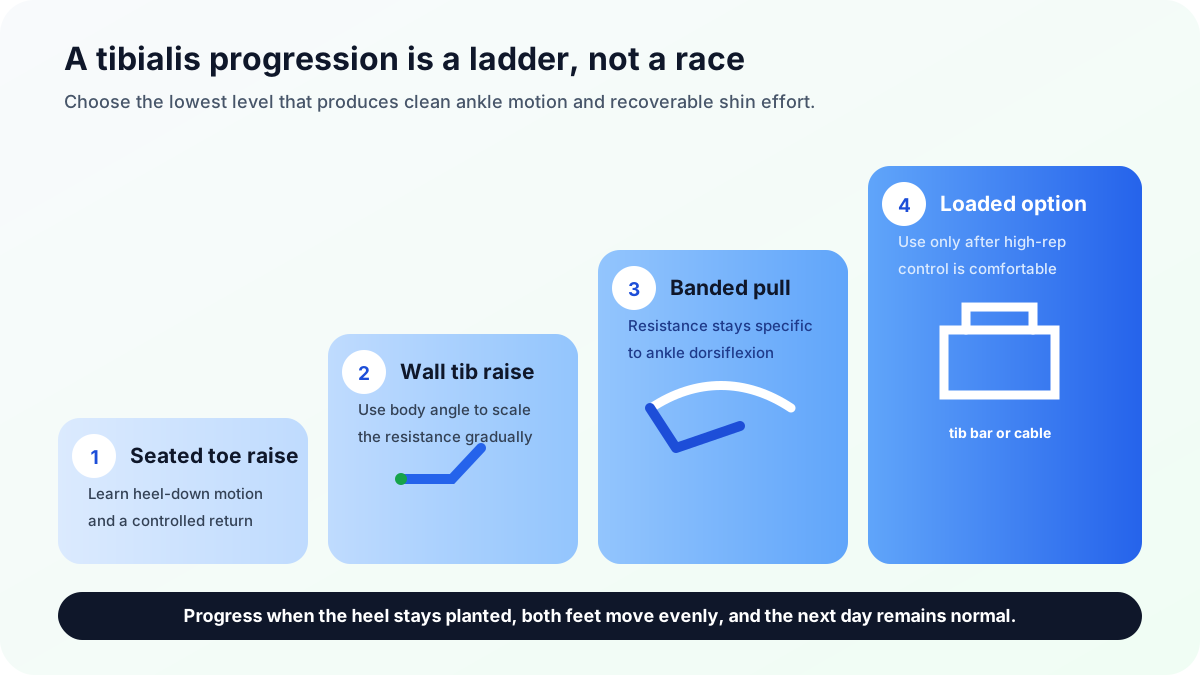
1. Seated toe raise
Sit with the heels planted and lift both forefeet. This removes most balance demand and works well for learning the motion or comparing sides. It may become too easy quickly, but that is a reason to progress rather than accelerate the repetitions.
2. Wall tib raise
The wall version makes resistance easy to adjust with foot distance. Start close enough that the final repetition looks like the first. Freestanding raises can be performed while holding a counter if contact with a wall is uncomfortable.
3. Banded dorsiflexion
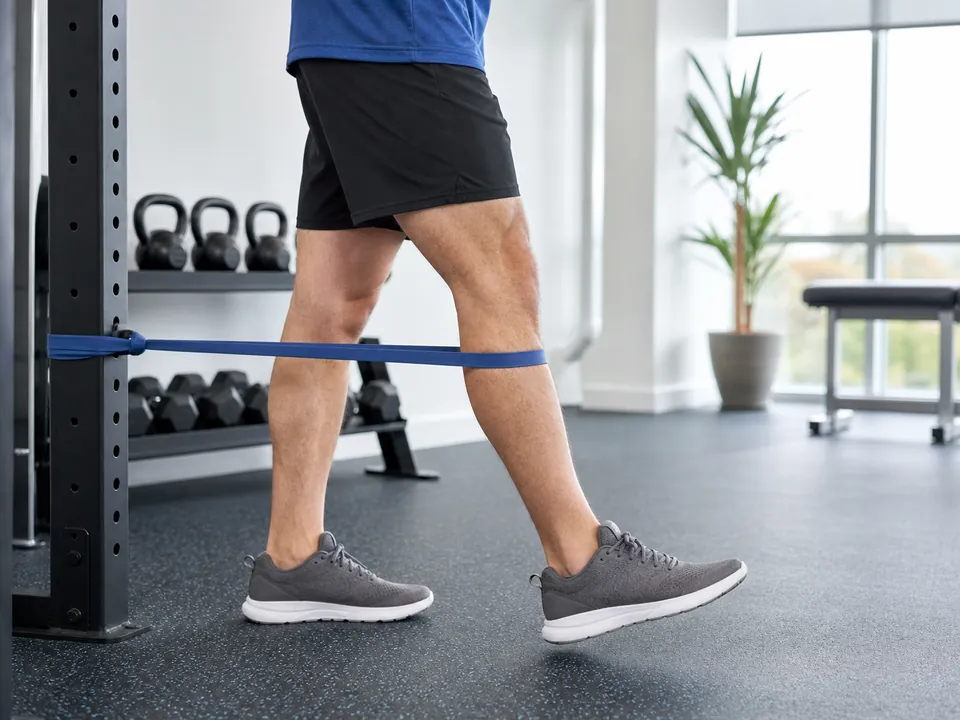
Sit with the heel supported, anchor a band in front, loop it around the forefoot, and pull the toes toward you. Confirm that the anchor is secure and that the band does not slip. This variation can train one side at a time and follows the action described in the AAOS conditioning program.
4. Tib bar, cable, or other loaded version
Added weight is optional. Use it only after bodyweight or banded repetitions remain smooth through a useful range. Heavy loading does not become more “knee specific.” It simply increases dorsiflexor resistance and may require more recovery.
How Many Tib Raises Should You Do?
No research establishes one ideal wall-tib-raise prescription for knee health. A practical beginner can try one or two sets of 8 to 15 controlled repetitions, two or three days per week. Some people will easily tolerate more bodyweight repetitions, while a banded version may become challenging sooner. Stop the set when the heel lifts, the foot rolls, or the lowering phase can no longer stay quiet.
Progress only one variable: add a few repetitions, move the feet slightly farther from the wall, increase band tension, add a set, or add a weekly session. Do not change all five. Judge the result by walking comfort and the next morning, not only by how strong the burn felt during the set.
Where Tib Raises May Fit
Walking and hills
The tibialis anterior contributes to foot clearance and contact control during walking. A small incline-walking study found different lower-leg activation patterns in people with limited ankle dorsiflexion, especially on steeper grades. That does not mean tib raises prevent hill-related knee pain. It does explain why incline work can expose a lower leg that tires earlier. The incline walking knee pain guide covers grade and session load.
Squats and step-downs
Dorsiflexor strength may support active ankle control, but squat technique depends on the entire chain. Hip strength, quadriceps capacity, calf mobility, balance, footwear, and proportions all contribute. The companion guide on whether knees over toes are bad explains why forward shin travel is a load choice rather than a pass-fail test.
Running preparation
Tib raises may be one accessory for a runner, but running tolerance still depends on impact exposure, calf and thigh capacity, pace, hills, and weekly volume. If shin pain grows with running or jumping, adding more dorsiflexion work can aggravate rather than solve the issue. Use the broader running knee pain guide when the symptom is tied to training load.
What the Evidence Does Not Show
There is no strong direct trial showing that ordinary wall tib raises alone reduce knee pain, rebuild cartilage, prevent every shin splint, or “bulletproof” the knees. A randomized trial in 30 female athletes with restricted weight-bearing dorsiflexion found improvements after a comprehensive corrective program, but that program combined mobility, stretching, and strengthening. Its result cannot be assigned to one tibialis exercise.
This is an important distinction. An exercise can be sensible without needing a cure claim. Tib raises earn a place when the goal is to train ankle dorsiflexion, when the dose is recoverable, and when the rest of the program addresses the person's actual knee or sport demands.
When to Get Medical Help
A broad muscular burn during a set and mild next-day soreness can follow a new exercise. Reduce the dose when soreness changes walking, lasts longer than expected, or grows with each session. Arrange an assessment for sharp focal shin-bone pain, swelling, pain at rest or with impact, numbness, tingling, or new difficulty lifting the foot or toes. New foot drop can reflect a nerve problem rather than ordinary fatigue; the guide to peroneal nerve symptoms near the knee explains the different pathway.
A Balanced Lower-Leg and Knee Session
Pair one tibialis variation with a calf raise, a supported squat or step-up, and a hip-dominant bridge or hinge. Add balance or walking when it matches the goal. This covers more lower-limb demands than hundreds of isolated toe lifts. Keep the first dose easy enough that next-day shin soreness does not change how the foot lands.
The Bottom Line
Tibialis raises are a straightforward way to train ankle dorsiflexion and the front of the shin. They may support walking control and provide a useful accessory for a complete lower-limb program, but their knee benefit is indirect and should not be oversold. Keep the heels planted, lift and lower through a controlled range, progress one variable at a time, and pair the exercise with knee, hip, calf, and task-specific training. Stop treating it as an experiment when pain is sharp, focal, neurological, or progressively worse.
Frequently Asked Questions
Do tibialis raises strengthen the knees?
They strengthen ankle dorsiflexion rather than the knee joint itself. A stronger, more fatigue-resistant front of the shin may support lower-leg control and walking tasks, but the exercise does not directly replace knee-targeted quadriceps work, hip strengthening, calf training, or gradual exposure to stairs, squats, running, or sport.
What muscles do tib raises work?
The tibialis anterior is the main target, with the other ankle dorsiflexors assisting. These muscles lift the forefoot toward the shin and help control the foot after contact during walking. If the heel lifts, the body rocks, or the foot rolls outward, the exercise is no longer isolating that action as cleanly.
How many tib raises should I do?
There is no universal magic repetition target. Begin with one to three sets that you can perform through a controlled range, stopping before you swing or lose heel contact. High repetitions often suit bodyweight versions, while banded or loaded versions may need fewer. Increase only one of range, repetitions, resistance, or frequency at a time.
Are wall tib raises better than banded dorsiflexion?
Neither is universally better. Wall tib raises are quick and easy to scale by changing foot distance. Banded dorsiflexion provides a clearer external resistance and may be easier to perform one side at a time. Use the version that gives smooth ankle motion without sharp pain, compensation, or a poor next-day response.
Should tib raises make the shins burn?
A temporary muscular burn or fatigue across the front of the shin is common during a set. Sharp focal pain on the shin bone, pain that worsens with impact, marked swelling, numbness, or new difficulty lifting the foot is different and should not be trained through. Reduce the dose and seek assessment when those symptoms persist.
Can tib raises improve ankle dorsiflexion?
They train active dorsiflexion strength, but strength and joint range are not the same quality. If calf flexibility, joint structure, pain, or another restriction limits how far the shin can move over the foot, tib raises alone may not change that limit. Test mobility separately and use a broader plan when range is the main problem.