Why a smooth machine can still bother your knee
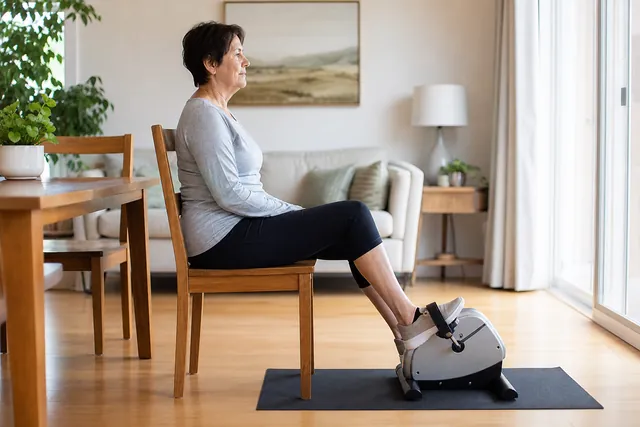
This guide concerns a standing elliptical trainer or cross-trainer, including a home elliptical machine. A mini elliptical used while seated under a desk is a different task, with a separate chair-to-pedal relationship and different balance demands. Do not transfer standing-machine advice directly to a seated device. For that general setup issue, the seated pedal-exerciser guide explains the chair and floor checks.
The elliptical removes the repeated landing associated with running, but your legs still have to support you and move the pedals. Your knee bends and straightens against an external resistance. That distinction explains why a machine can be described as low impact and still feel demanding around the kneecap or inside the joint. Smoothness is one part of the movement, not a measurement of its total load.
Your feet also follow the machine's geometry. On a walk, you can make small changes to stride and foot placement with every step. An elliptical gives you less freedom to do that. A fixed stride may feel easy for one person and awkward for another, even when both people use the same resistance setting. That is a reason to investigate fit, not proof that the machine has injured you.
A laboratory comparison involving 12 healthy men found greater knee torque on the tested elliptical than on the stationary bicycle, with speed affecting the measurements. It was not a treatment trial in people with knee pain and cannot predict your individual response. Its useful message is narrower: equipment choice and pedaling speed change the mechanical task. See the bike and elliptical study.
Start with the pattern, not a diagnosis
Before adjusting anything, describe what actually happens. Does discomfort begin immediately, build after several minutes, or appear later that evening? Is it present on every machine or only the cross-trainer at one gym? Did the session include a new interval program? A repeatable pattern gives you a useful starting point, whereas simply recording that the elliptical is bad for your knees hides the important differences.
Note the location without using it as a diagnosis. Front-of-knee discomfort may be sensitive to bending and effort, but inner, outer, or back-of-knee symptoms can have several explanations. Pain that now occurs during ordinary walking, stairs, or rest deserves a broader assessment. Our guide to pain behind the kneecap explains why location and activity have to be considered together.
| Pattern you notice | Useful first check | What it cannot establish |
|---|---|---|
| Only one elliptical feels uncomfortable | Compare stride, pedal spacing, and ramp position | That all elliptical exercise is unsuitable |
| Pain rises during hard intervals | Check resistance, speed, and interval duration | Which tissue is causing symptoms |
| Discomfort near the end of the stride | Look for reaching, rocking, or forced knee bending | A universal ideal stride length |
| The knee is worse the next morning | Review total session dose and other activity that day | That the machine alone caused the flare |
| Swelling, locking, or giving way | Stop experimenting and seek assessment | A safe setting that overrides the warning |
Find a stride that does not make you reach
Begin with the feeling of the whole movement. You should not have to stretch forward to catch the front of the pedal path or snap the knee straight at the back. Watch for your hips shifting side to side, your trunk leaning to compensate, or your heel lifting because you cannot comfortably follow the machine. These are practical observations to discuss with a trainer or physiotherapist, not measurements of joint damage.
On an adjustable-stride machine, try a small change at low effort. Keep the comparison short and do not simultaneously change the ramp and resistance. If the stride is fixed, another model may feel more natural. Manufacturer height charts can narrow your options, but leg proportions and available motion vary. No clinical evidence establishes one stride length in inches as the best choice for every painful knee.
Pedal spacing is another difference between models. A study of 21 college students found that a modified converging footpath changed knee movement compared with a standard elliptical. That study measured movement during brief laboratory exercise, not long-term pain relief. It supports the idea that machines differ, not a rule that everyone should seek the narrowest or widest pedals. The equipment-design study is useful in that limited context.
Foot position: supported, comfortable, and repeatable
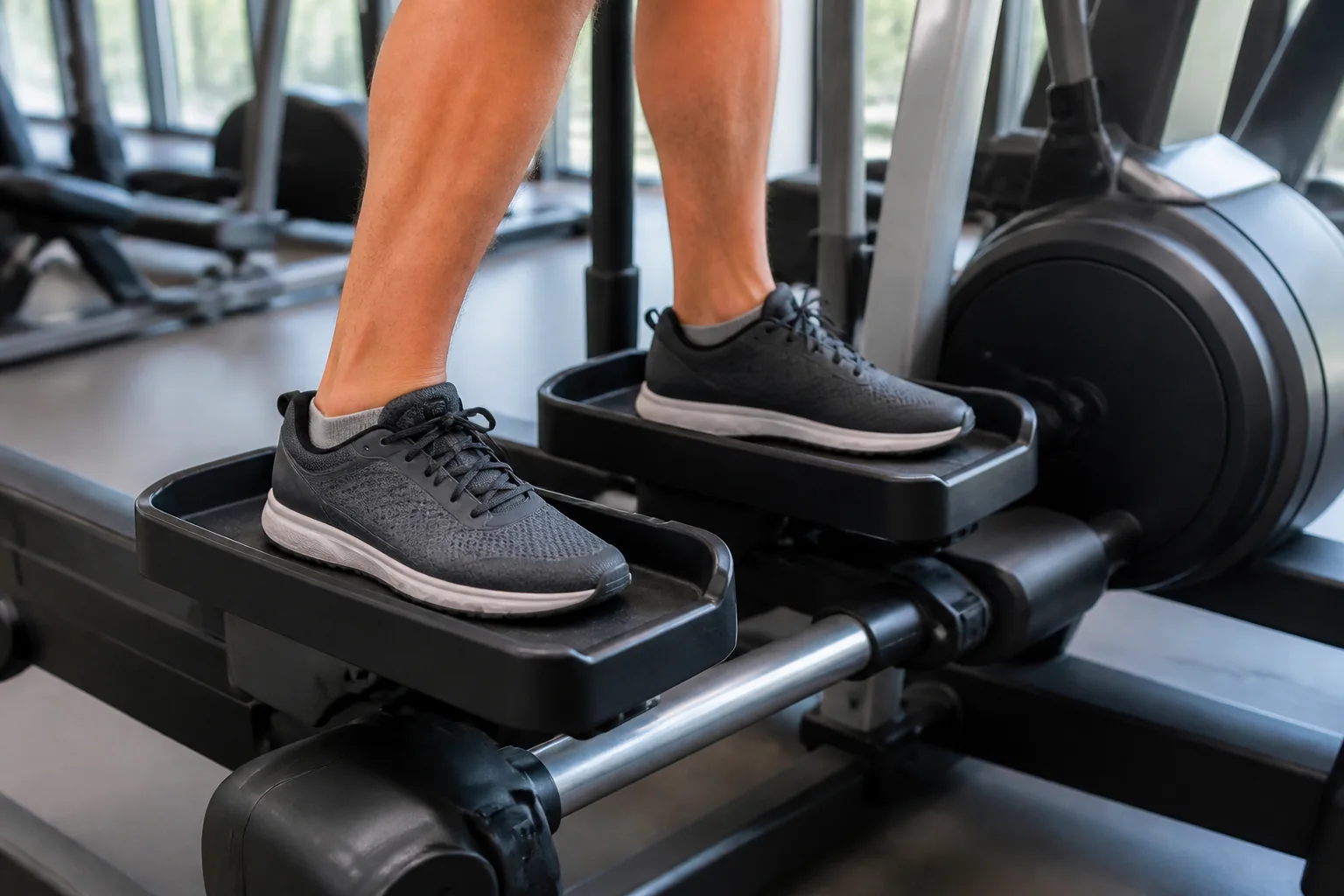
Use ordinary secure exercise shoes and place each foot fully on its platform. Check that nothing catches the edge and that your toes are not pressed into the front lip. You do not need to glue the heel down throughout the entire movement, but avoid deliberately staying on tiptoe to make an unsuitable stride possible. The goal is a controlled movement you can repeat without gripping or bracing unnecessarily.
Let your knees follow a comfortable direction rather than squeezing them together or pushing them outward to imitate an online demonstration. If the fixed pedals make the legs feel twisted, pause and reconsider the machine. Do not improvise wedges or reposition parts of the equipment. A persistent alignment concern is better reviewed in person, where someone can watch the complete movement and hear what you feel.
Keep footwear consistent while investigating the elliptical. A new pair of shoes, different insoles, and a new machine create several simultaneous changes. If your usual shoes are secure and in good condition, they are a sensible comparison baseline. If the problem started with new footwear, use the separate shoe-change checklist without assuming that findings about running transfer directly to elliptical exercise.
Resistance, incline, and speed are separate controls
Resistance changes how much effort it takes to keep the pedals moving. Start low enough that the motion remains smooth and you do not have to drive hard through one leg. A low number is not always a light workload across brands, so use your actual effort and control. If the pedals almost stall with each step, lowering resistance may be more useful than trying to force a faster cadence.
Incline changes the pedal path rather than merely making the same task harder. Depending on the design, it may change how deeply the knee bends and how your hips move. A higher ramp is not automatically protective, and a perfectly flat setting is not universally comfortable. Find a reasonable baseline first, then test a small ramp change only if you can keep the other variables similar.
Speed adds another variable. Fast pedaling may feel fluid, but the laboratory comparison above found changes in peak joint torque at higher frequencies. There is no reason to chase a universal revolutions-per-minute target while sorting out pain. Choose a controlled conversational effort, and avoid interpreting the absence of pounding as permission to sprint. Console calorie estimates are not a knee-safety gauge.
| Control | Conservative experiment | Keep steady for comparison |
|---|---|---|
| Resistance | Reduce it until each revolution feels smooth | Machine, ramp, and approximate session length |
| Incline or ramp | Try one small adjustment from an easy baseline | Resistance and comfortable speed |
| Stride length | Use an adjustment that removes reaching or crowding | Low effort and short exposure |
| Speed | Slow to a pace you can control without bouncing | Resistance and foot placement |
| Duration | Finish before the previous symptom-building point | The already comfortable setup |
Hands and posture should make the session manageable
Use the fixed support handles if moving handles make balance or coordination difficult. Keep your trunk comfortably upright rather than hanging your body weight from your arms or leaning heavily onto the console. This is a practical way to make the task more consistent, not a claim that one posture eliminates knee pressure. If you need a strong pull on the handles to complete each step, reassess effort and fit.
Mounting and dismounting deserve their own attention. Follow the machine instructions, use the stable handholds, and wait for the pedals to stop before stepping off. Do not adjust moving parts while balancing on the equipment. If getting on requires a painful step or leaves you uncertain of your balance, ask gym staff for help or choose an exercise option with easier access.
Use a short comparison session
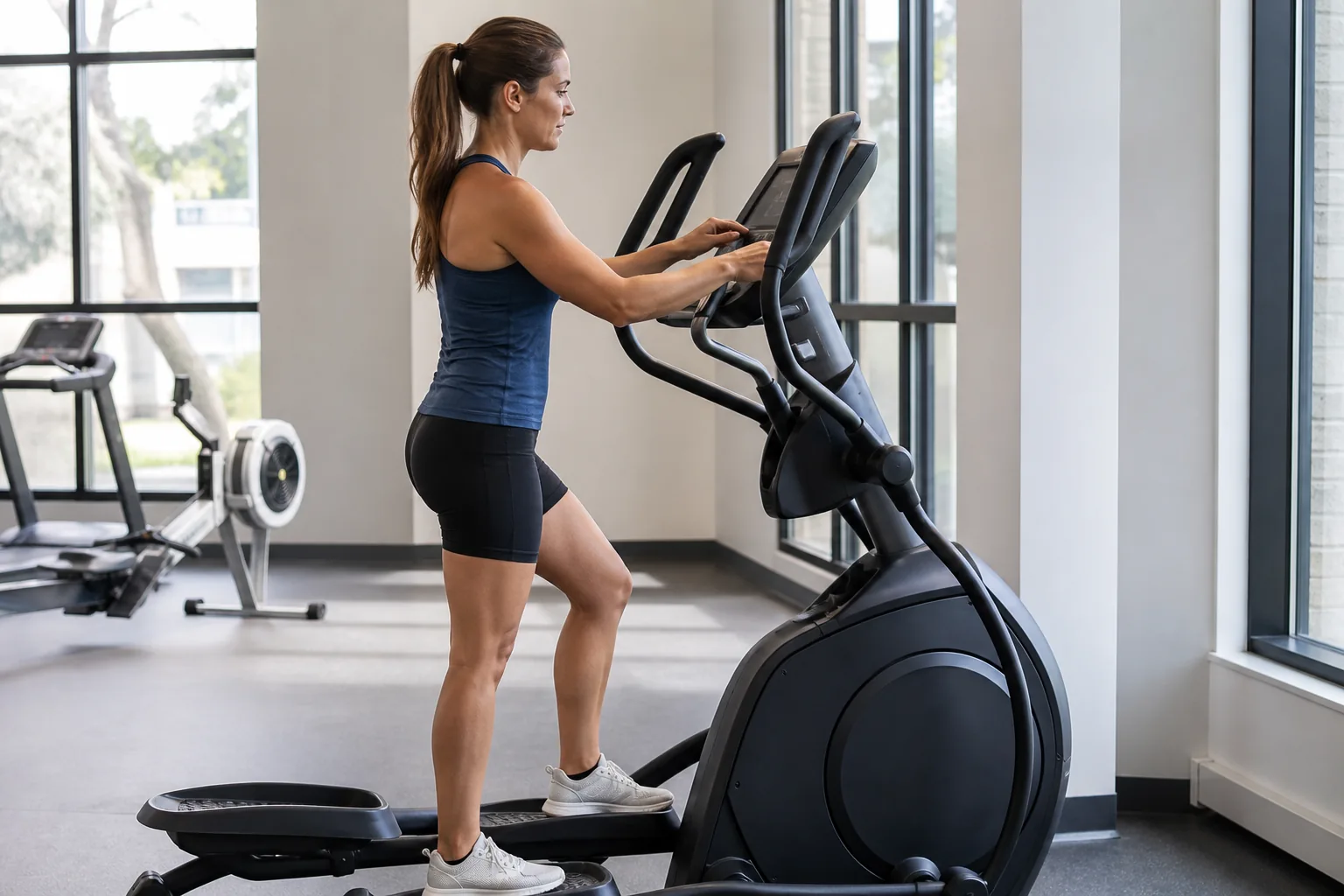
Make the first test deliberately unremarkable. Choose a day when the knee is near its usual baseline, not immediately after a difficult hike or leg workout. Use the familiar shoes, a comfortable stride, and easy resistance. A few minutes may be enough to discover an obvious mismatch. You are collecting information about tolerance, not completing a fitness challenge or proving that you can ignore discomfort.
Record the machine, settings, approximate duration, and symptom location. Also note ordinary activities later that day. A knee that feels acceptable while exercising but becomes swollen or makes stairs harder afterward did not necessarily tolerate the dose well. The next morning gives another useful checkpoint. A symptom diary can show whether the same workload is repeatably comfortable or whether you are gradually accumulating a problem.
If the test is comfortable during and afterward, repeat that dose before increasing it. Then change one thing, usually a little more time before a harder setting. There is no universal weekly percentage that guarantees safety. Keep the increase small enough that you can identify what changed, and return to the previous comfortable dose if the response deteriorates. Do not increase duration, speed, and resistance together.
What if pain appears only after the session?
Delayed symptoms can make the machine seem innocent because you felt fine during exercise. Review the whole day: walking to the gym, standing at work, strength training, stairs, and the elliptical all contribute to what you asked of your knee. An easy-feeling session can still be a large increase if you have not used that movement recently. A wearable's training score does not capture all of those details.
Reduce the next exposure instead of testing the same long session repeatedly. If the knee is still clearly worse than baseline, postpone the experiment and use comfortable everyday movement as appropriate. New swelling needs attention, especially when it recurs. See knee pain after exercise for the distinction between session timing and the broader recovery pattern.
When another machine is the better choice
When comparing two ellipticals, avoid comparing a hard session on one with a brief easy test on the other. Use similar comfortable effort and stop points, and note any difference in the range your knees travel through. You do not need perfectly matched laboratory conditions, but you do need enough consistency to avoid mistaking a shorter session for a superior machine design. That also helps distinguish a geometry issue from a session that simply lasted too long.
A helpful description is specific: this model feels crowded at the front of the stride, or symptoms begin when the automatic ramp program changes. Show gym staff the setting that concerns you while the machine is safely stopped. Ask whether the stride or ramp can be adjusted and whether a simpler manual program is available. If a basic setup cannot be made comfortable, choosing another activity is a reasonable outcome, not a failed workout.
There is no requirement to make an elliptical work. A stationary bicycle may offer a seated option with different adjustment possibilities; an accessible walking route may allow freer steps; a supervised exercise program may provide more individualized choices. Compare access, comfort, balance, and your actual goals. Choose the activity you can do consistently, not the one with the strongest claim to being joint friendly.
Do not transfer settings between activities. The saddle and pedal relationship on a bicycle differs from the standing footpath of an elliptical. If cycling is your alternative, the bike-fit guide is the appropriate place to review it. Likewise, a mini pedal exerciser in front of a chair requires a separate setup rather than a miniature version of elliptical posture.
| Current obstacle | Reasonable next step | Boundary |
|---|---|---|
| The fixed stride remains uncomfortable | Try another machine design or a different activity | Do not force a repeated painful path |
| Standing balance is uncertain | Discuss a seated or supervised option | Support handles do not replace a balance assessment |
| Easy sessions are tolerated | Repeat and build one variable gradually | Comfort today does not justify a large jump tomorrow |
| Pain affects daily activities too | Seek a clinical assessment and a tailored plan | Do not keep narrowing the explanation to equipment |
Where elliptical exercise fits in knee care
For osteoarthritis, NICE recommends therapeutic exercise tailored to the person, including strengthening and aerobic activity. That recommendation does not nominate one gym machine as treatment. Your useful routine may combine several types of movement and a plan for progression. An elliptical can fill an aerobic role when tolerated, but it does not automatically replace strength work, balance practice, or rehabilitation exercises prescribed for a particular problem.
A small study of a custom robotic off-axis elliptical reported improvements in people with patellofemoral pain. Its specialized moving footplates, supervision, and training design differ from a commercial cross-trainer. It should not be used to promise that a standard gym machine will reproduce the result. Similarly, laboratory comparisons with treadmill running describe movement differences, not proof that one option is best for every injured runner.
The practical question is whether the activity helps you stay active without a worsening symptom pattern. Keep the target specific: a comfortable short session, more consistent activity, or a gradual return to a familiar routine. That makes success easier to recognize than searching for a machine that supposedly protects all knees. A physiotherapist can help when several reasonable adjustments have failed.
When to Get Medical Help
Seek urgent care for a very painful or badly swollen knee, inability to bear weight or move it, deformity, locking, or a hot red knee with fever or feeling unwell. Stop exercise after a significant injury. Arrange an assessment for persistent or worsening symptoms, repeated giving way, or pain that changes ordinary walking. After surgery, use only the activities cleared by your rehabilitation team.
For a milder repeatable equipment-related pattern, bring your notes to the appointment: which machine, which setting, when symptoms start, and how long they last. That information is more useful than a photograph of a console alone. The aim is a sustainable movement plan and an explanation of the symptoms, not endless adjustments to a machine that continues to be uncomfortable.
Frequently Asked Questions
Is an elliptical good for knee pain?
It can be a useful exercise option when its movement and effort are comfortable, but it is not automatically right for every knee. Machine geometry, exercise dose, and your underlying condition matter. A brief easy trial is more informative than a low-impact label.
Why do my knees hurt on the elliptical but not when walking?
An elliptical guides your feet along a fixed path and may require a different amount of knee bending and muscle effort from walking. Its stride, ramp, pedal spacing, resistance, or duration may not suit you. This pattern does not identify a specific injury.
Can elliptical resistance cause knee pain?
More resistance requires greater effort to move the pedals and can exceed your current tolerance. Reduce resistance while keeping other settings similar, but do not keep testing through sharp or worsening symptoms.
What is the best elliptical stride length for bad knees?
There is no proven universal stride length for knee pain. Look for a smooth movement without reaching, pelvic rocking, forced knee position, or discomfort at either end of the pedal path. Trying the machine matters more than choosing from height alone.
Is a higher incline better for knee pain?
Not necessarily. A ramp change can alter knee bending and muscle demand. Begin with a comfortable low setting and compare small adjustments separately. Different machines use different ramp geometry, so their level numbers are not interchangeable.
Should I pedal backward if the elliptical hurts my knee?
Backward pedaling changes the task but is not an established treatment for an undiagnosed painful knee. Only use a direction permitted by the machine instructions, and stop if it increases symptoms or makes balance difficult.
Is an exercise bike easier on the knees than an elliptical?
Some people prefer the seated position and adjustable fit of a bike. A small laboratory study found higher knee forces and torque on an elliptical than on a stationary bike under the tested conditions, but it did not establish which machine prevents pain for everyone.
How long should I use an elliptical with knee pain?
There is no universal session duration. Start well below the amount that previously provoked symptoms, keep effort easy, and check your response later and the following morning. Build duration gradually only when the current dose is repeatably comfortable.
Can I use an elliptical after knee surgery?
Follow your surgeon and physiotherapist's specific rehabilitation plan. Permission depends on the procedure, healing stage, strength, range of motion, and ability to mount and dismount safely. General gym advice is not a postoperative clearance.