Leg extensions load the knee, but loading is not automatically damage
A leg-extension machine asks the quadriceps to straighten the knee against resistance applied near the lower shin. Your foot is not planted on the ground, so this is usually described as an open-chain exercise. That label describes the movement. It does not mean the exercise is inherently unsafe, nor does it guarantee that every painful knee will tolerate it.
The useful question is why this particular version hurts now. A new machine may have a different resistance profile, the seat may not suit your proportions, or the selected load may be much harder than the same number on another stack. A sensitive knee can also react to the movement even when the equipment is set up reasonably.
Separate a broad quadriceps effort from pain centered in or around the joint. A muscle working hard is not the same sensation as a sharp catch, a focal tendon pain, or a painful stop near straightening. You do not need to diagnose the structure yourself. You do need to notice whether the symptom changes your movement or continues after the set.
Start with the machine's instructions, not another person's settings
Find the equipment placard and identify which adjustment controls the backrest, starting position, and shin roller. Some machines combine adjustments; others have independent levers. A machine that looks familiar may work differently from the one you used last week. Ask gym staff if a lever's purpose is unclear, and do not release a loaded adjustment unexpectedly.
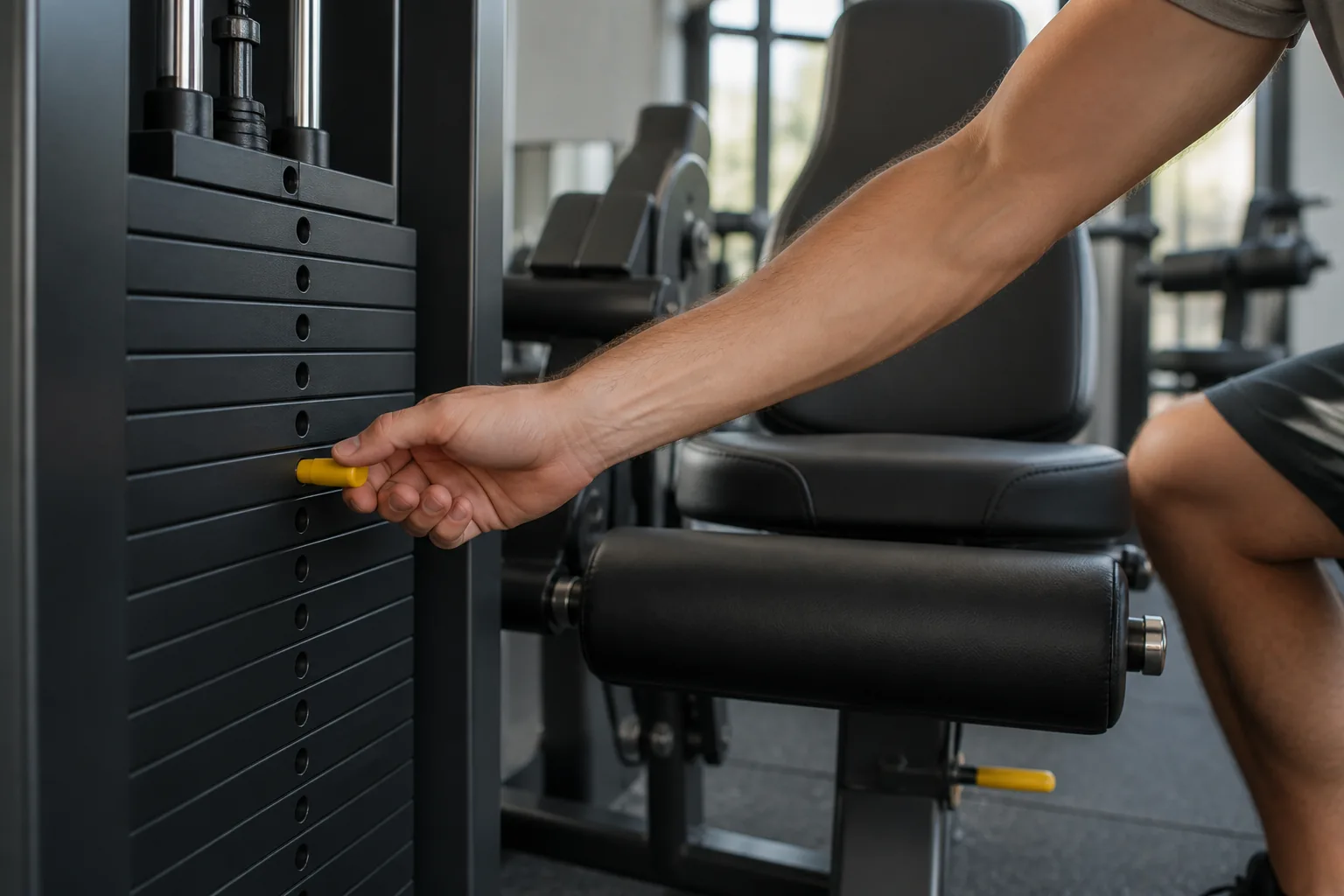
Set the machine while the weight stack is resting. Choose a light starting resistance, confirm the selector pin is fully seated, and keep hands clear of moving parts. If the cable catches, the seat shifts, or the roller mechanism feels loose, stop and report the equipment. A mechanical fault should not be worked around by changing your posture.
Record the settings only after they fit you. Copying a taller training partner's seat number can put the knee in a different relationship to the lever. The numbers are repeatability tools for one machine, not anatomical measurements and not a universal setup prescription across brands.
Align the knee with the pivot as the manufacturer intends
On many seated machines, the backrest adjusts your position so that the side of the knee is near the machine's rotation marker or pivot. Manufacturer guidance for Life Fitness equipment explicitly describes adjusting the back pad to align the user with the pivot. Use the marker and instructions on the actual machine, because the visible hardware is not identical on every model.
Sit with your pelvis and back supported, then check the relationship before moving the load. The seat should support the thighs without forcing the backs of the knees against a hard edge. If you must slide forward, perch on the front, or lift your hips to reach the roller, the setup may not fit. Ask for help rather than compensating under a heavy load.
The knee is not a perfectly fixed mechanical hinge, so a photograph cannot establish millimeter-perfect alignment throughout the movement. The practical aim is comfortable, controlled motion within the machine's intended setup. Do not turn a small visual mismatch into a claim that you have damaged cartilage or created a specific amount of shear force.
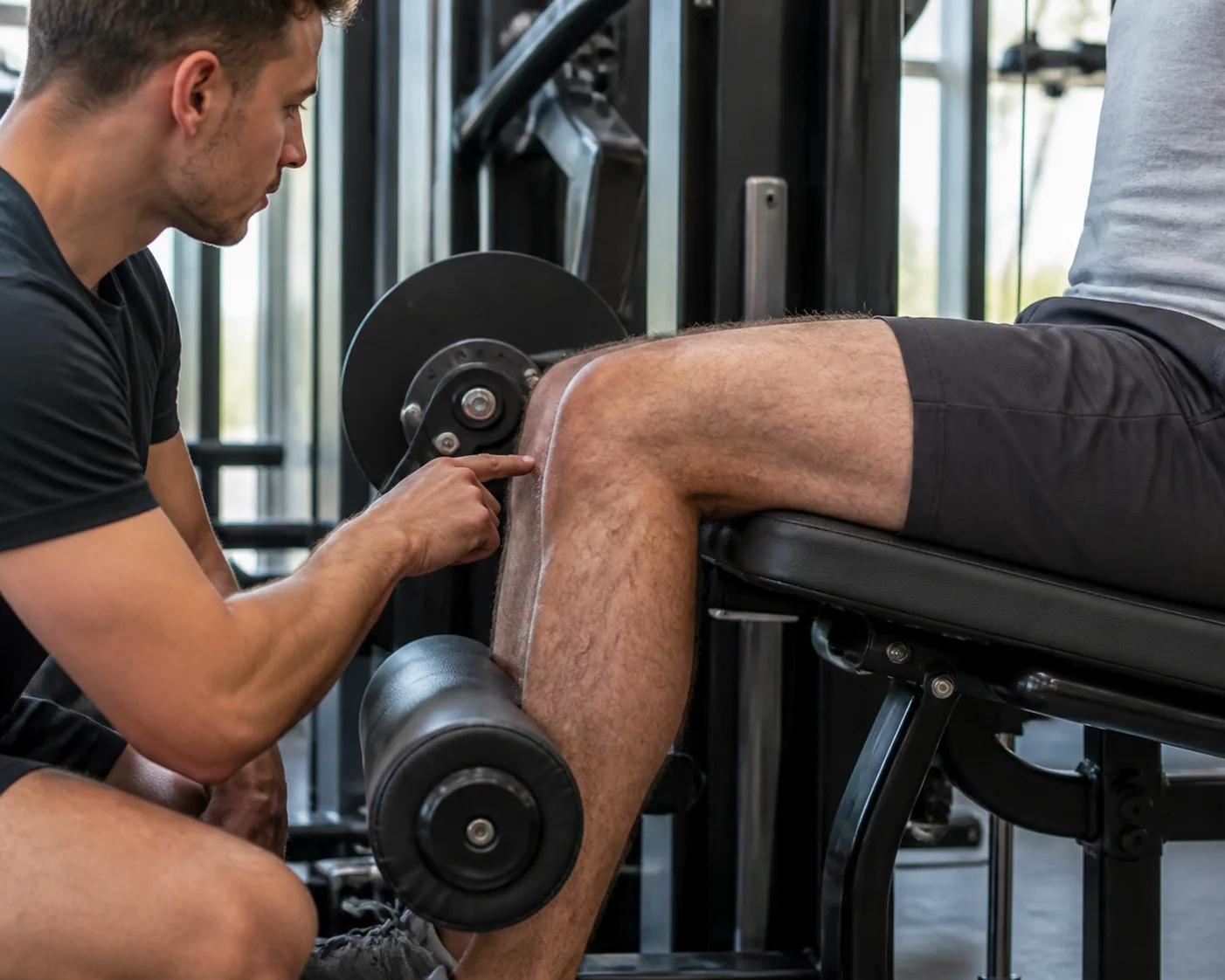
| Setup point | Useful check | Reason to stop and review |
|---|---|---|
| Seat and backrest | Pelvis and back supported without sliding | You must perch or lift your hips |
| Knee and pivot | Follow the machine's alignment marker | You cannot fit the intended position |
| Shin roller | Comfortable contact above the ankle | Pressure on the joint or exposed hard padding |
| Starting position | Light load and comfortable initial bend | Painful block or forced deep flexion |
Place the roller on the lower shin, not across the foot
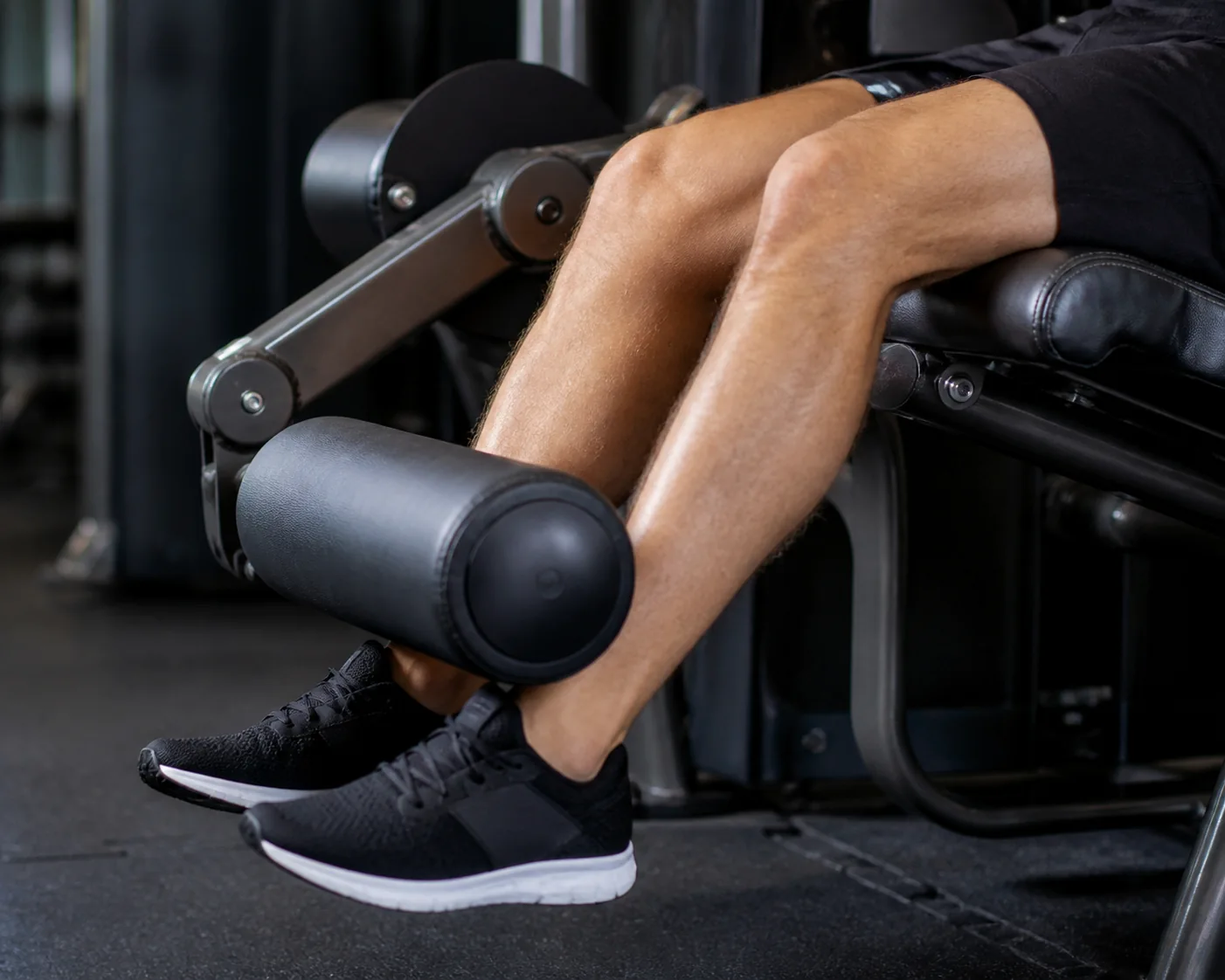
The padded roller generally contacts the front of the lower leg above the ankle, as directed by the machine instructions. It should not press on the kneecap or require the toes to hook underneath it. Adjust the roller position for your lower-leg length rather than reaching for it by moving your whole body out of the seat.
During a light repetition, notice whether the roller maintains comfortable contact or drags excessively up the shin. A small amount of relative movement can occur, but repeated scraping, pressure on the ankle joint, or a need to point the foot hard to keep contact deserves a setup review. Stop if the padding is damaged or a hard edge is exposed.
Moving the pad closer to the knee may make the same stack weight feel easier because the external lever arm changes. That does not make arbitrary pad placement a reliable pain treatment. Use the intended adjustment range, then choose the load independently. The goal is a repeatable exercise, not manipulating the lever to preserve a number in your training log.
Range of motion changes the exercise
In exercise descriptions, zero degrees of knee flexion means a straight knee, while ninety degrees describes a right-angle bend. Remember that convention when reading a rehabilitation plan. “Avoid the last part of extension” and “avoid deep bending” are different instructions and should not be confused.
Biomechanical studies comparing squats and knee extensions show that knee angle and the way resistance is applied influence estimated patellofemoral loading. In the 2014 study by Powers and colleagues, the relative loading pattern differed across the tested ranges and exercise versions. These findings help clinicians choose exercises, but they do not define one universally safe angle or prove that a higher modeled stress causes injury.
If pain is confined to one part of the repetition, a clinician may use a lighter load or a temporary comfortable range while the problem is assessed. Do not force through a painful endpoint simply because full range is your usual training goal. Equally, do not permanently avoid straightening a healthy knee because a social-media post calls all terminal extension dangerous.
Use the machine's range adjustment only as instructed. If there is no comfortable controlled range even with very light resistance, stop that exercise for the session. A painful block, locking sensation, or sudden loss of motion is not an invitation to push harder until the joint “releases.”
Why the same stack number can feel different
Two leg-extension machines can use different cams, lever lengths, seat angles, cables, and starting positions. Those features change the resistance you experience during the repetition. A plate-loaded machine, a cable-stack machine, and an ankle weight are not mechanically identical even though all ask the knee to extend.
For that reason, do not transfer your old working weight automatically to a new machine. Start with a light familiarization set and judge control and knee response. A gym log is more useful when it names the machine and settings, rather than recording only kilograms or pounds. The display is a reference within that setup, not a direct measure of force inside the knee.
Older laboratory work by Escamilla and colleagues also found different patterns of muscle activity and estimated knee forces across squat, leg press, and knee extension. It supports exercise-specific decisions, not a ranking that makes one movement safe and the others harmful. Study participants, loads, and modeling assumptions limit how directly the results apply to an individual painful knee.
| Equipment difference | What changes | How to compare |
|---|---|---|
| Different cam or cable path | Where resistance feels hardest | Use a fresh light trial |
| Different roller distance | External leverage at the shin | Follow setup guidance before selecting weight |
| Different seat angle | Hip position and overall fit | Record the full machine setup |
| Ankle weight versus machine | How resistance changes through range | Do not assume equal load from equal kilograms |
Control the start, the finish, and the return
Begin each repetition smoothly instead of kicking the roller upward to overcome the first difficult part. Keep your pelvis on the seat and use the handles for steady support, not to wrench yourself into position. If the load requires a sudden torso movement or hip lift, reduce it before trying to refine smaller details.
At the top, straighten only as far as the planned comfortable range allows. Do not slam into the machine stop or snap the knee backward. On the way down, maintain control rather than dropping the stack and catching it at the bottom. A controlled return makes it easier to notice when pain appears and avoids disguising a difficult range with momentum.
There is no magic repetition tempo that guarantees a pain-free knee. Slower movement can make the same weight feel more demanding, so changing tempo may require less load. Keep the first troubleshooting set well short of fatigue. If you simultaneously slow every repetition and add extra sets, you have increased the challenge even if the stack number stays the same.
Distinguish pad pressure, muscle effort, and joint symptoms
Pressure exactly where the roller touches the shin points you first toward padding and setup. A broad working sensation through the front of the thigh may simply reflect quadriceps effort. Pain around the kneecap, at a focal tendon area, or deep in the joint calls for a different discussion, particularly if it also occurs during ordinary stairs or walking.
These categories can overlap, and they are not a self-diagnosis checklist. Patellofemoral pain can involve the front of the knee, but not every front-knee symptom is patellofemoral pain. For context, see our guide to pain behind the kneecap. Note the location and provoking range without repeatedly pressing or loading the area to prove a theory.
Painless clicking alone does not automatically require abandoning the movement. Painful clicking with swelling, catching, or instability is more concerning. Likewise, delayed thigh soreness after a new exercise is different from a knee that becomes swollen or makes walking difficult the following morning. Record function as well as the intensity of the sensation.
A practical troubleshooting session
Begin only when your ordinary baseline is comfortable enough to assess a light exercise and there are no warning signs. Review the seat, pivot marker, and roller position with the stack resting. Choose a much easier load than the one that provoked symptoms. Try a few controlled repetitions within a comfortable range, without trying to complete your usual workout at the same time.
If a clear setup correction removes the problem, repeat cautiously before increasing anything. If lowering the load helps but the symptom returns as you fatigue, the current set length or overall dose may still be too much. If the same pain occurs immediately despite careful setup and very light resistance, stop and consider a clinical assessment.
| Observation during a light trial | Reasonable response | Avoid |
|---|---|---|
| Pain disappears after setup correction | Repeat the easy setup before progressing | Returning immediately to maximum effort |
| Only a short range is comfortable | Discuss temporary range modification | Forcing the painful endpoint |
| Pain grows with fatigue | Reduce the set or total exercise dose | Using momentum to finish |
| Pain persists despite easy conditions | Stop and arrange assessment | Testing heavier loads to locate the problem |
Check the knee later that day and the next morning before calling the session successful. A short comfortable set is useful information, but it does not prove that several hard sets will be tolerated. Keep your other leg training reasonably stable while troubleshooting. Our guide to knee ache after leg workouts addresses the broader session when multiple exercises are involved.
Choose alternatives by tolerance and purpose
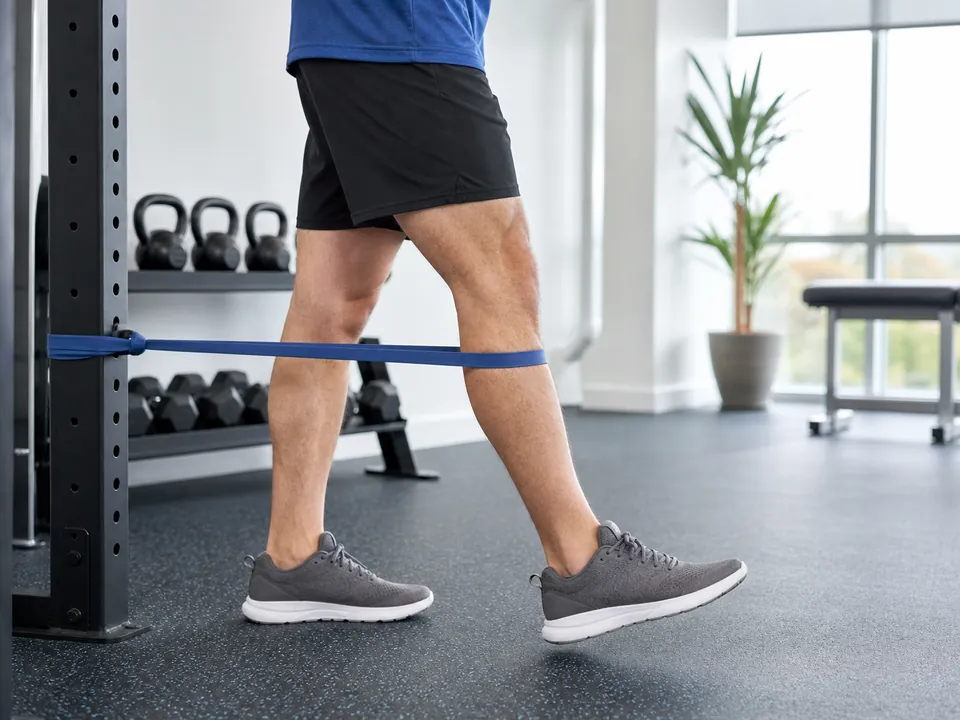
If the machine remains uncomfortable, an alternative should still serve the intended goal. A clinician may choose another quadriceps exercise, a different range, an isometric hold, or a combined hip-and-knee program. Research on patellofemoral pain supports considering more than one muscle group, but no single exercise is a universal replacement.
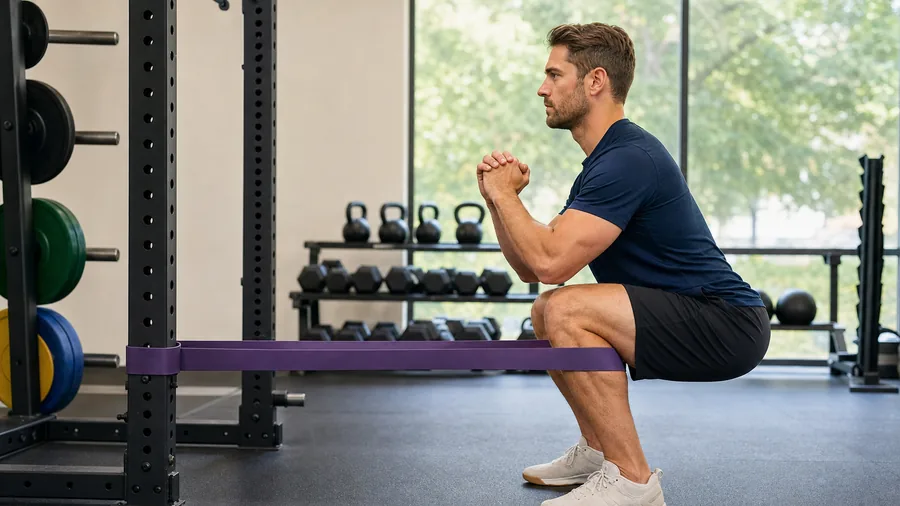
A shallow sit-to-stand may feel different from a knee extension because the foot is supported and several joints share the movement. A squat or leg press can also become demanding as depth and load increase, so “closed chain” is not a promise of comfort. Test the alternative at an easy level rather than transferring the entire planned training dose into it.
The Spanish squat guide explains one specific loading option and its limits. It is not a reason to diagnose patellar tendinopathy from a painful machine repetition. Our knee-strengthening guide offers a broader framework when you need a manageable routine instead of one replacement exercise.
Recent surgery and known ligament injuries need a separate plan
After ACL reconstruction, tendon repair, joint replacement, or another operation, the permitted range and resistance may depend on the procedure and stage of recovery. Generic gym advice cannot override that plan. Ask the treating team specifically about seated knee extension, the machine available, and how they want you to progress.
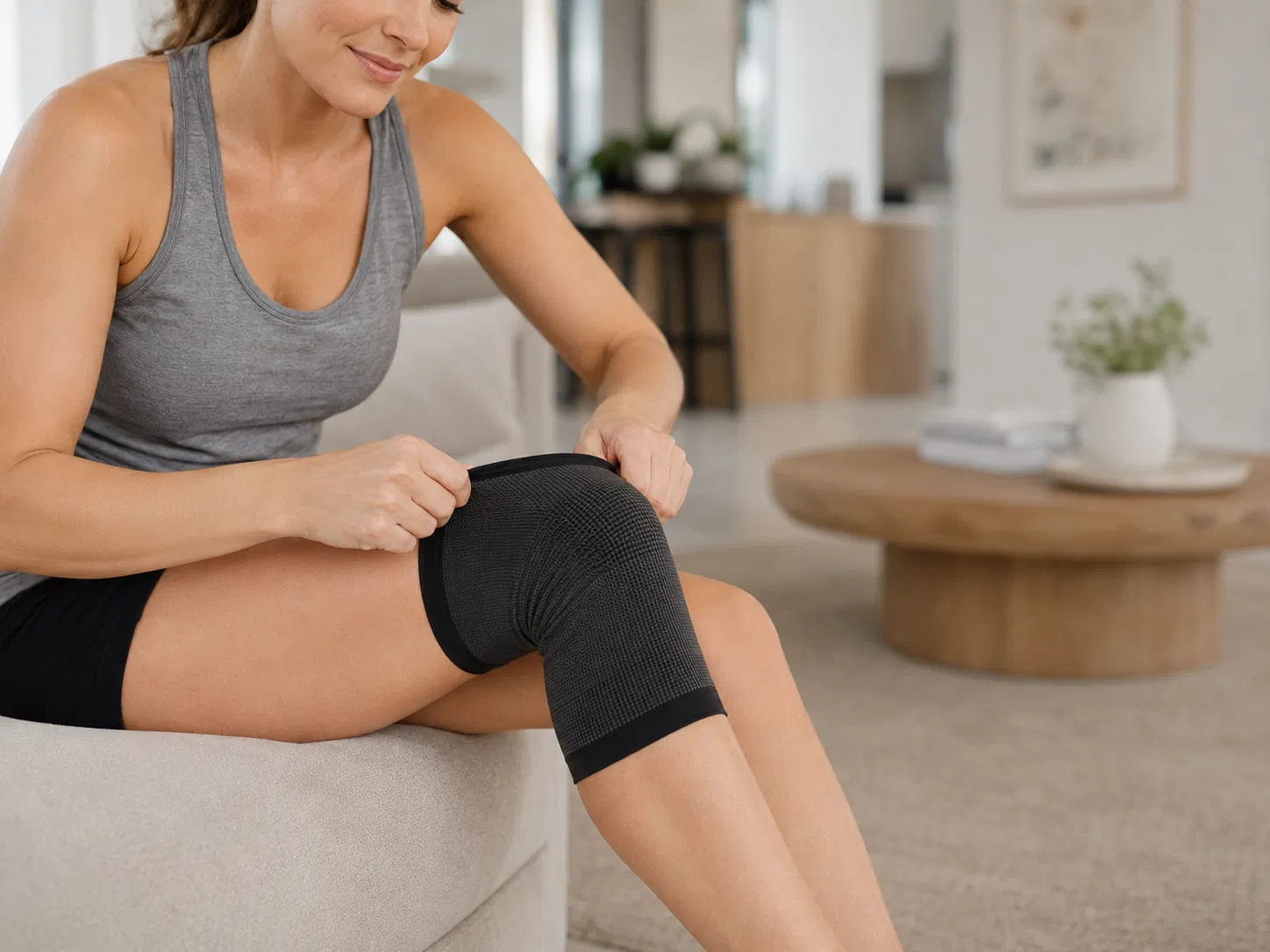
A sleeve can add a sense of warmth or support for some users, but it does not change a rehabilitation restriction or correct a poor seat fit. It should not create numbness, pressure, or a reason to ignore pain. If you are comparing support options, our brace versus compression sleeve guide explains their different roles without treating either as a cure.
When to Get Medical Help
Seek prompt assessment for a sudden injury, major swelling, locking, giving way, inability to bear weight, or a hot red knee with fever. Arrange a review if pain persists with light exercise, changes your walking, or repeatedly returns despite reasonable setup and load changes. Follow your treating team's advice after surgery.
The bottom line
Leg-extension troubleshooting starts with the actual machine: supported seat position, intended pivot alignment, comfortable shin-pad contact, manageable resistance, and controlled movement. Range and load can be adjusted, but persistent pain should not become a technical puzzle you keep solving under heavier weight. A useful exercise is one that fits your goal and your current knee capacity.
Frequently Asked Questions
Are leg extensions bad for your knees?
Not inherently. They load the quadriceps and knee differently from a squat, and tolerance depends on the person, machine, resistance, and range. Pain is a reason to review those factors, not proof that the exercise damages every knee.
Where should my knee line up on the machine?
Use the equipment's pivot marker and instructions. Many machines adjust the backrest to place the side of the knee near the rotation point. Ask gym staff if you cannot achieve a supported, comfortable fit.
Where should the leg-extension pad sit?
Usually on the front of the lower shin above the ankle, according to the machine instructions. It should not press on the kneecap or require the foot to hook under it. Review setup if it scrapes or creates focal pressure.
Why does the last part of a leg extension hurt?
The resistance and joint-loading pattern change through the movement, and some knees are sensitive near the endpoint. Reduce load and avoid forcing the painful range while seeking guidance. The location alone does not identify the cause.
Should I lock my knees on leg extensions?
Do not snap into hyperextension or slam against the machine stop. Use a controlled endpoint within your planned comfortable range. A healthy knee does not need a blanket ban on straightening, but painful or postoperative knees may have specific restrictions.
Can I use partial leg extensions?
A temporary comfortable range may be useful when selected for an individual problem. It is not a universal safe-angle rule. If no light range is comfortable, stop and obtain an assessment.
Why does a new leg-extension machine feel much harder?
Cam shape, lever length, cables, seat angle, and starting position can differ. The same stack number is not directly comparable between machines. Begin with a light familiarization set.
Can I do leg extensions after ACL surgery?
Follow your surgeon or physiotherapist's plan. Allowed resistance and range can depend on the procedure and recovery stage. General online advice cannot replace those instructions.
What can I do instead if leg extensions hurt?
A clinician may choose another quadriceps exercise, a tolerable isometric, or a combined hip-and-knee routine. Test alternatives lightly rather than assuming squats or leg press are always more comfortable.