A patellar tendon strap may also be called a patellar band, patella strap, knee band, or jumper's knee strap. These names usually describe the same narrow piece of equipment. Its placement and intended use differ from a full knee sleeve or hinged brace.
This guide is about the equipment decision. It does not repeat the loading instructions in our Spanish squat guide for patellar tendon pain, and it does not treat a narrow band as a substitute for the broader comparison in our knee brace versus compression sleeve guide.
What a Patellar Tendon Strap Is
The patellar tendon connects the bottom of the kneecap to the top of the shin bone. A patellar strap wraps around the upper shin and places a narrow pad or band across that tendon. It is also called an infrapatellar strap because it sits below the patella.
The proposed idea is that local pressure changes how strain or force is distributed through the tendon and may alter sensory input during movement. Laboratory work has shown reduced estimated tendon strain during a landing task in some participants. That is a mechanical observation, not proof that the strap repairs tendon tissue or prevents injury.
A strap also creates a clear tactile cue. The feeling of support, expectation, and confidence can affect pain during activity. In a randomized trial of athletes with patellar tendinopathy, both a patellar strap and sports tape reduced short-term pain compared with control conditions, while placebo taping also produced benefit. The practical message is balanced: a real short-term response is possible, but the mechanism and size of that response vary.
Patellar Tendon Strap Placement
- Find the lower edge of the kneecap. Sit with the knee relaxed and gently feel the firm bottom border of the patella.
- Locate the tendon below it. The patellar tendon is the firm band between the kneecap and the bony bump at the top of the shin.
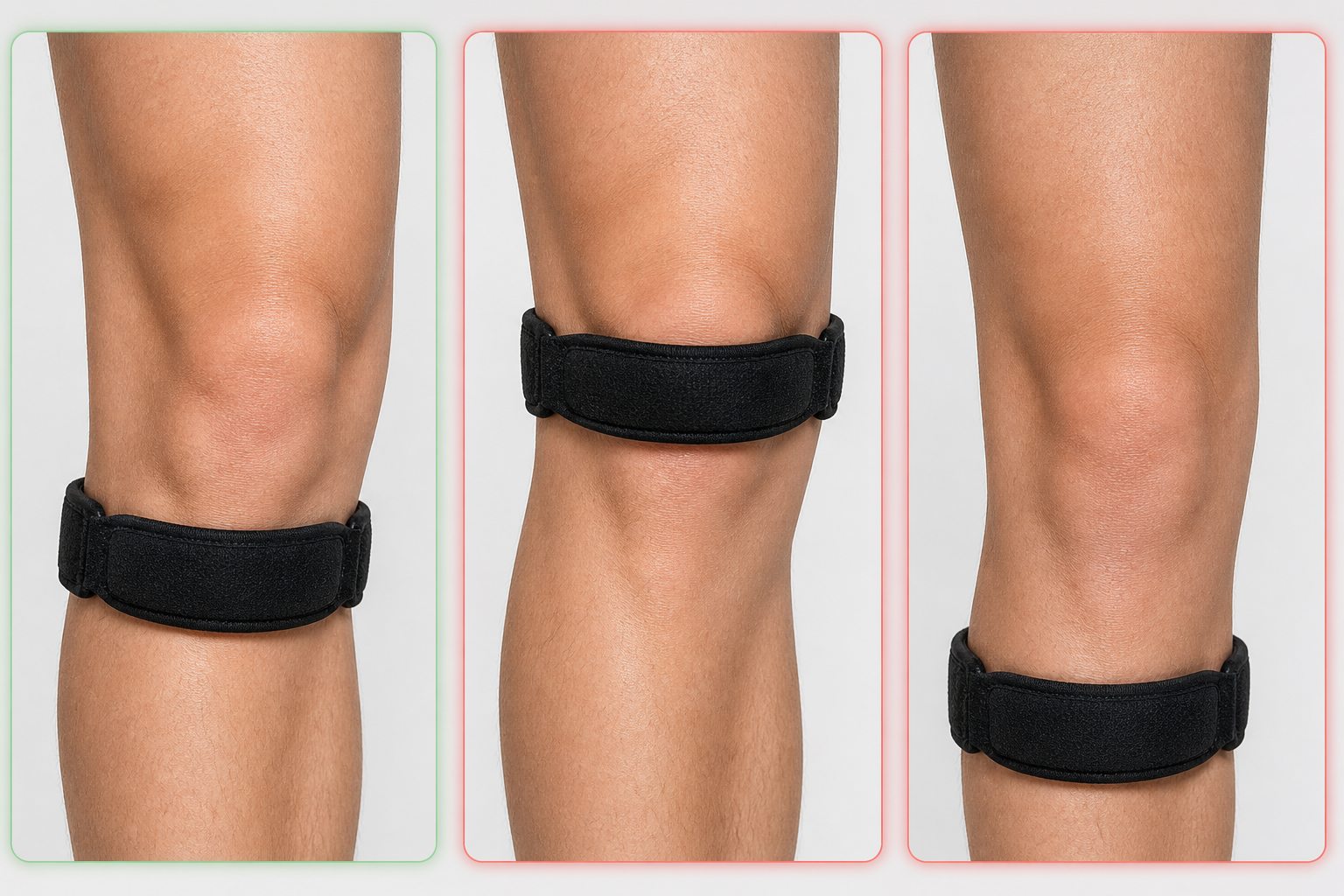
- Center the pad across the tendon. Place it close below the kneecap, not on the kneecap and not down on the tibial tubercle.
- Fasten it while the leg is relaxed. Tighten only enough to keep the pad from sliding.
- Bend and straighten the knee. The strap should remain flat without pinching the back or sides of the knee.
- Test the target movement. Repeat one controlled squat, step, jog, or sport drill that normally produces a familiar symptom.
- Recheck the skin and foot. Remove or loosen the band if sensation, color, temperature, or swelling changes.
Bodies and products differ, so there is no reliable instruction based on a fixed number of centimeters. Use the anatomical landmark and the instructions supplied with the exact strap. If pressure directly on the tender spot sharply worsens pain, do not keep tightening in search of relief.
How Tight Should a Patellar Strap Feel?
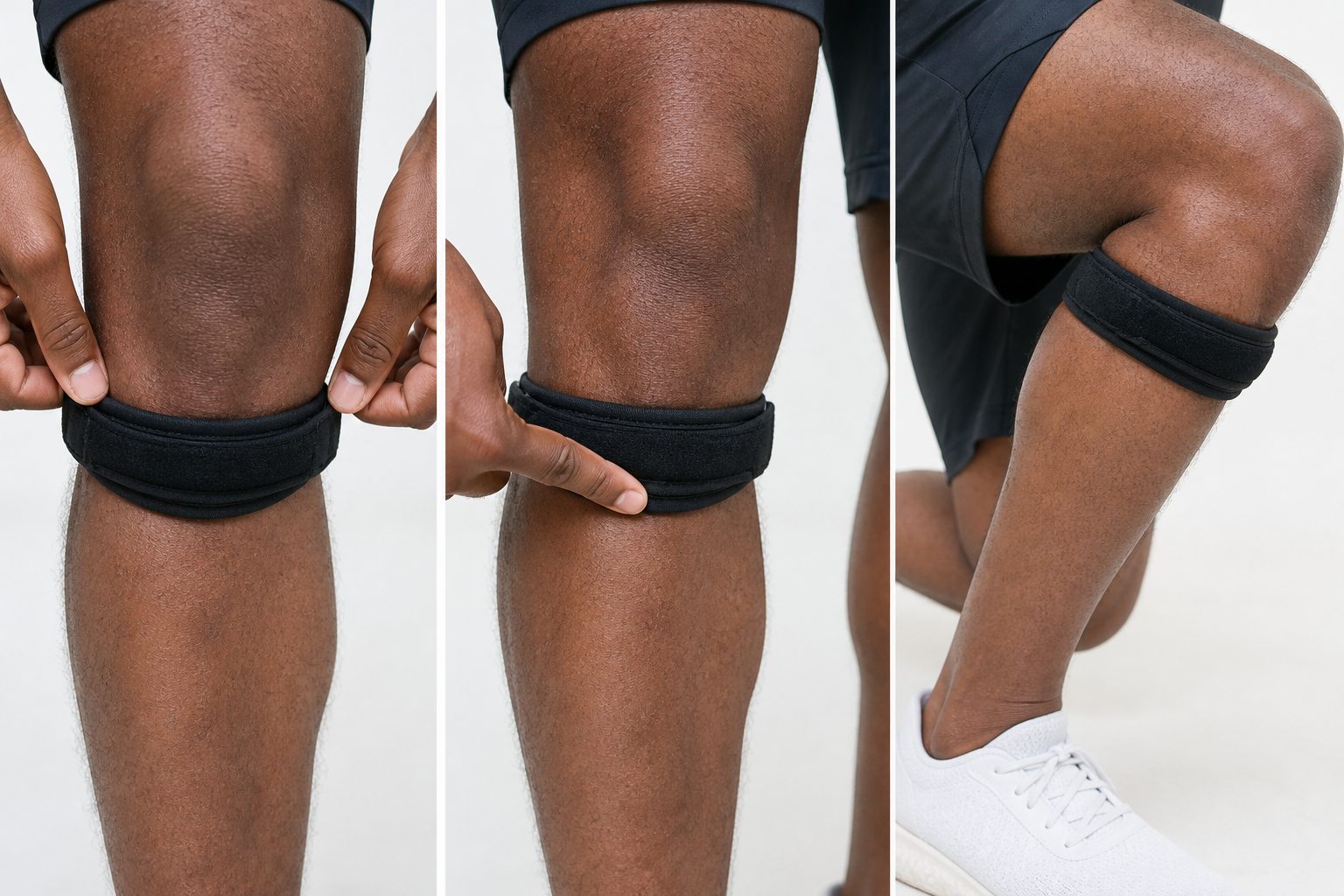
Aim for secure rather than maximal. The band should not slide during the chosen activity, yet you should be able to move normally and the lower leg should look and feel unchanged. A fingertip check can be a rough prompt, but it is not a medical standard because strap width, padding, limb shape, and material tension differ.
| Fit clue | What it suggests | What to do |
|---|---|---|
| Band stays flat | Placement and tension may be workable | Test one familiar movement |
| Band slides down | It may be too loose, misplaced, or the wrong shape | Reset it; do not simply overtighten |
| Pinching or deep pressure mark | Pressure is concentrated or excessive | Loosen, reposition, or remove it |
| Numbness, tingling, color change | Possible nerve or circulation compression | Remove it immediately |
| Pain is unchanged | This strap may add no useful benefit | Do not wear it by default |
Sweat, repeated jumping, and fabric stretch can change tension during a session. Recheck after the warm-up and again when you finish. Wash and dry the product according to its label, and do not place it over broken, irritated, or infected skin.
Who May Benefit From a Patellar Band?
The clearest use case is an optional short-term aid for a person whose pain pattern and assessment fit patellar tendinopathy. This commonly involves load-related pain at the lower pole of the kneecap or tendon during jumping, landing, accelerating, running, or repeated squatting. Symptoms often settle when the activity stops and return when tendon demand rises.
A useful responder notices a repeatable improvement in the same task without new symptoms. For example, five controlled decline squats before and after fitting the strap may feel meaningfully different. That comparison is more informative than wearing it all day and trying to remember whether the knee seemed better.
Even when it helps, the strap is a bridge rather than the destination. Progressive tendon-loading exercise has stronger relevance to longer-term recovery. In a randomized clinical trial, progressive tendon-loading exercise produced better clinical outcomes than painful eccentric exercise at 24 weeks. The exact program should match irritability, sport demands, and current capacity.
When a Patellar Strap Is a Poor Match
Front knee pain is a location, not one diagnosis. Pain around or behind the kneecap during stairs, prolonged sitting, or squatting may fit a patellofemoral pattern rather than a focal tendon pattern. Joint-line pain with twisting or catching points in a different direction. Arthritis, bursitis, fat-pad irritation, referred pain, and nerve symptoms require their own reasoning.
- Acute pop and loss of straightening: This can signal a patellar tendon or quadriceps tendon rupture and needs urgent assessment, not a strap test.
- Large or rapid swelling: Swelling after trauma can indicate a significant internal injury.
- True locking or repeated giving way: A narrow band does not address a physically blocked or unstable knee.
- Hot red joint or fever: Seek urgent medical guidance.
- Numbness or pain below the knee: Compression may aggravate nerve or circulation problems.
- General pain without a repeatable tendon trigger: Clarify the pattern before choosing equipment.
Patellar Strap and Osgood-Schlatter Disease
Osgood-Schlatter symptoms are usually centered on the tibial tubercle, the bony bump below the knee where the tendon attaches, during a period of growth. That is not identical to adult patellar tendinopathy at the lower edge of the kneecap.
Some clinicians may include an infrapatellar strap in an adolescent's activity plan, but the decision should not come from an adult product page. Growth, training schedule, limping, sport participation, tenderness, and other possible diagnoses matter. Persistent pain, swelling, a major change in activity, or pain at rest deserves age-appropriate assessment.
Patellar Strap vs Knee Sleeve vs Brace
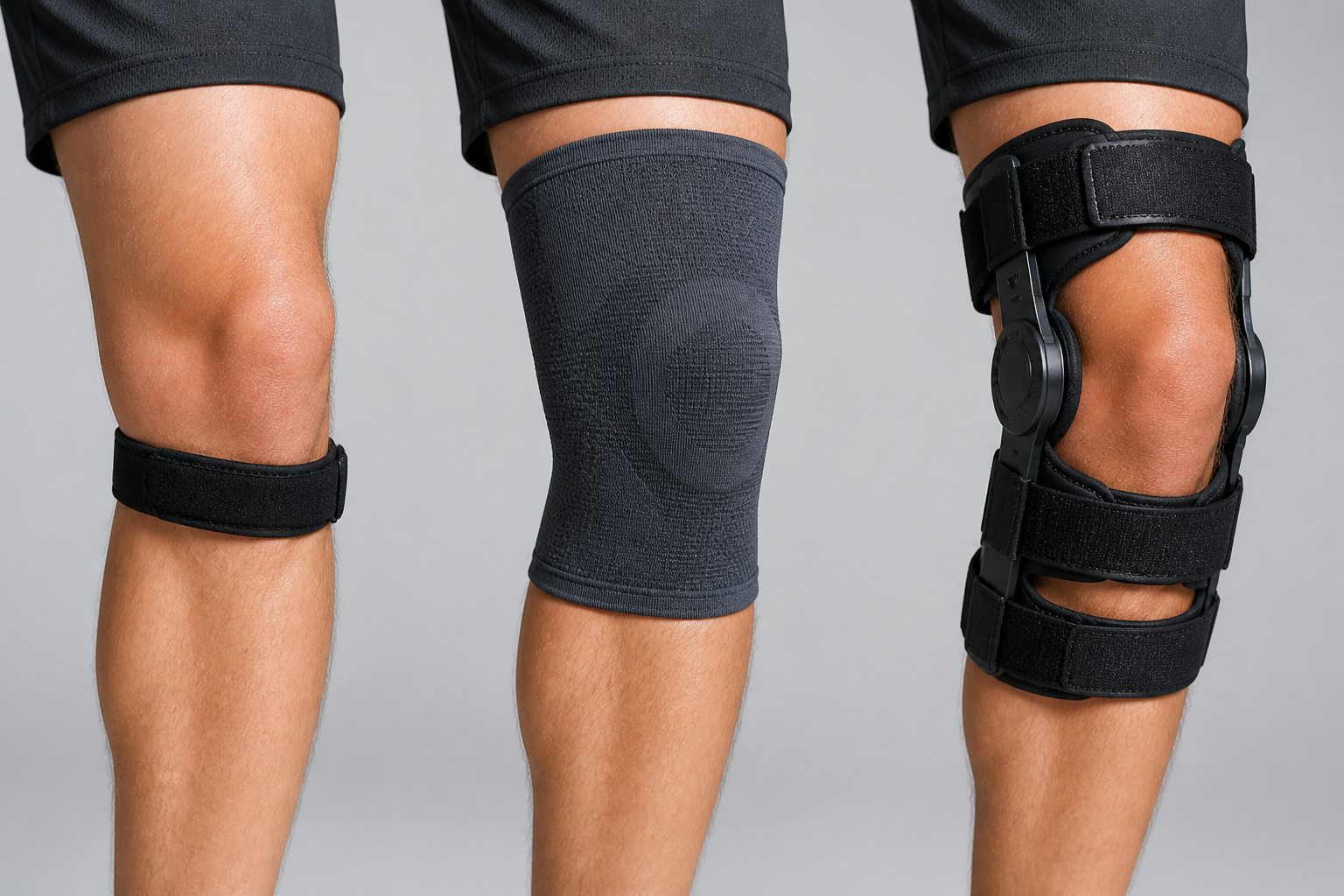
| Product | Where it acts | Common reason people try it | Important limit |
|---|---|---|---|
| Patellar strap | Narrow pressure below kneecap | Load-related patellar tendon pain | Does not stabilize the whole knee |
| Compression sleeve | Wider fabric coverage | Compression, warmth, supported feel | Does not reproduce focused tendon pressure |
| Structured brace | Joint with straps, stays, or hinges | A specific stability or protection need | Selection may require clinical guidance |
If you want broad compression rather than focused tendon pressure, read the compression sleeve sizing guide. If instability or a recent injury is the issue, equipment should follow an assessment rather than a search for the strongest brace.
A Better Way to Test the Strap
- Choose one task. Use a controlled movement that reliably produces mild, familiar symptoms, not an all-out match or maximal jump test.
- Record the starting response. Note discomfort, confidence, and movement quality without the strap.
- Fit the strap carefully. Use the placement and circulation checks above.
- Repeat the same dose. Keep speed, range, surface, and repetitions as similar as practical.
- Check the immediate response. Keep the strap only if the change is clearly useful and no new symptom appears.
- Check later and next morning. A comfortable session followed by increased tendon pain still counts as an excessive load.
Avoid changing shoes, exercise volume, strap pressure, medication, and warm-up at the same time. One-variable testing makes the result easier to interpret. If benefit disappears unless the strap is tightened aggressively, it is not a good trade.
How Long to Wear It
There is no universal wear schedule. A sensible experiment is limited to the activity for which it provides a clear benefit, followed by removal and a skin check. Wearing it from breakfast to bedtime makes it harder to learn whether it helps and increases exposure to friction and pressure.
Do not sleep in a patellar strap unless an appropriately qualified clinician has given product-specific instructions. Sensation and position change during sleep, and the strap is intended as an active-use aid. People with reduced sensation, known circulation problems, fragile skin, or significant swelling should get individual advice before using compression around the upper shin.
What to Look for When Choosing a Patellar Band
A higher price or thicker pad does not guarantee a better response. The useful product is one that can be centered on your tendon, remains flat during the target activity, and can be adjusted without creating excessive pressure. Measure according to the manufacturer's size chart rather than assuming one-size straps fit every upper shin.
- Pad shape: It should contact the tendon without pressing into the edges of the kneecap.
- Adjustment range: The fastener should secure within its designed range, not at the last few millimeters of hook-and-loop material.
- Width: A wider band distributes pressure differently from a narrow cord-like strap. Comfort matters more than a dramatic pressure point.
- Skin-facing material: Smooth seams and a washable surface matter during running and jumping.
- Stability: The strap should not rotate or migrate toward the knee crease.
- Return policy: A fair trial matters because not every tendon pain pattern responds.
Double straps and magnetic claims do not solve a poor match. Focus on fit, repeatable activity response, and the underlying load plan. If you need substantial side-to-side stability, a narrow patellar band is not a smaller version of a hinged brace.
Running, Jumping, and Gym Use
Sport changes the test but not the rules. For running, begin with a short familiar surface rather than a long hilly route. For court or field sport, test controlled jogging and submaximal direction changes before full competition. For the gym, compare the same squat or step pattern at the same depth and load.
The strap may reduce pain enough to improve movement confidence, but it can also hide that the session dose is too high. Track total jumps, running minutes, hard accelerations, and next-morning tendon response. A comfortable warm-up does not automatically approve the rest of the workout.
If the band repeatedly slips during sweat-heavy sessions, check size and placement rather than tightening until the lower leg throbs. Remove it after activity, inspect the skin, and let both the strap and skin dry before another session.
The Strap Does Not Replace Tendon Loading
Patellar tendinopathy usually reflects a mismatch between tendon capacity and repeated demand. Reducing every load indefinitely can also reduce capacity. Rehabilitation commonly manages the painful activities, then develops isometric, isotonic, energy-storage, and sport-specific tolerance in stages. The order and dose depend on symptom irritability and goals.
A Spanish squat is one possible exercise, not a mandatory cure. Our Spanish squat technique guide explains setup and when another exercise is more appropriate. A strap can be used during a selected exercise if it improves comfort, but it should not be the only reason a progression suddenly becomes much harder or faster.
Pain monitoring should include the delayed response. Record how the tendon feels later that day, on the first stairs the next morning, and during the next planned session. Stable function across those checkpoints is more useful than chasing a completely pain-free minute while wearing the band.
Common Patellar Strap Mistakes
- Placing it across the kneecap. The strap is designed to sit below the patella.
- Placing it too low. Pressure on the tibial tubercle is different from pressure across the patellar tendon.
- Assuming tighter is better. Excess pressure can create skin, nerve, or circulation symptoms.
- Using it for every front knee pain. Patellofemoral, meniscus, arthritis, and referred patterns do not become tendon problems because a strap is available.
- Testing it during a maximal session. A controlled repeated task gives cleaner information.
- Ignoring next-day pain. Immediate relief does not erase the total training load.
- Skipping rehabilitation. Short-term comfort is not a substitute for building capacity.
- Wearing it over damaged skin. Friction and sweat can worsen irritation.
When to Get Medical Help
Seek urgent assessment after a sudden pop if you cannot actively straighten the knee, the kneecap appears unusually high, swelling is rapid, the knee is deformed or locked, or you cannot bear weight. Remove the strap for numbness, tingling, a cold or discolored foot, increasing lower-leg swelling, or severe skin pain. Arrange assessment when tendon-area pain persists, worsens, interrupts ordinary activity, or repeatedly returns despite sensible load changes.
The Bottom Line
A patellar tendon strap is a narrow, optional activity aid. Place it across the tendon just below the kneecap, tighten it only enough to remain stable, and compare one familiar movement before and after fitting it. Keep it only when the benefit is clear and the skin, sensation, and circulation remain normal. For patellar tendinopathy, the strap may reduce short-term pain, but progressive loading and a well-matched diagnosis do the longer-term work. A loud pop, loss of straightening, marked swelling, locking, or instability calls for assessment rather than a tighter band.
For repeated jumping and court-specific load decisions, read jumper's knee in basketball. It keeps strap comfort separate from progressive tendon rehabilitation and readiness to play.
Frequently Asked Questions
Where should a patellar tendon strap be placed?
Place the padded part across the patellar tendon just below the bottom edge of the kneecap. It should not cover the kneecap, sit on the bony bump lower down the shin, or wrap behind the knee crease. Product shapes vary, so combine this landmark with the manufacturer's instructions.
How tight should a patellar strap be?
It should be snug enough to remain in position during the target activity without digging into the skin. Loosen or remove it if there is numbness, tingling, throbbing, skin color change, increased swelling, or a deep pressure mark. More pressure does not mean more benefit.
Does a patellar tendon strap help jumper's knee?
It can reduce pain during activity for some people with patellar tendinopathy, but the effect is not universal and does not prove that the tendon is healing. Use it as an optional symptom-management tool alongside an appropriate progressive loading plan, not as the treatment by itself.
Can I wear a patellar strap while running or playing sport?
You can test it during one familiar, controlled activity if the knee has been appropriately assessed and there are no warning signs. Compare the same movement with and without the strap, then check the knee later that day and the next morning. Do not use it to push through escalating pain.
Is a patellar strap useful for Osgood-Schlatter pain?
Some people try an infrapatellar strap for symptoms near the tibial tubercle, but Osgood-Schlatter disease is not the same as adult patellar tendinopathy. A growing athlete with persistent pain, swelling, limping, or reduced sport participation should be assessed and follow age-appropriate load guidance.
Should I wear a patellar tendon strap all day or while sleeping?
Usually no. A strap is generally tested for a specific waking activity, then removed so the skin and circulation can be checked. Do not sleep in it unless a qualified clinician who knows your condition and the exact product has instructed you to do so.
What is the difference between a patellar strap, knee sleeve, and brace?
A patellar strap applies a narrow band of pressure below the kneecap. A compression sleeve covers a wider area and mainly provides warmth, compression, and a supported feel. A hinged or stabilizing brace is more substantial and may be prescribed for a specific instability or injury. They are not interchangeable treatments.