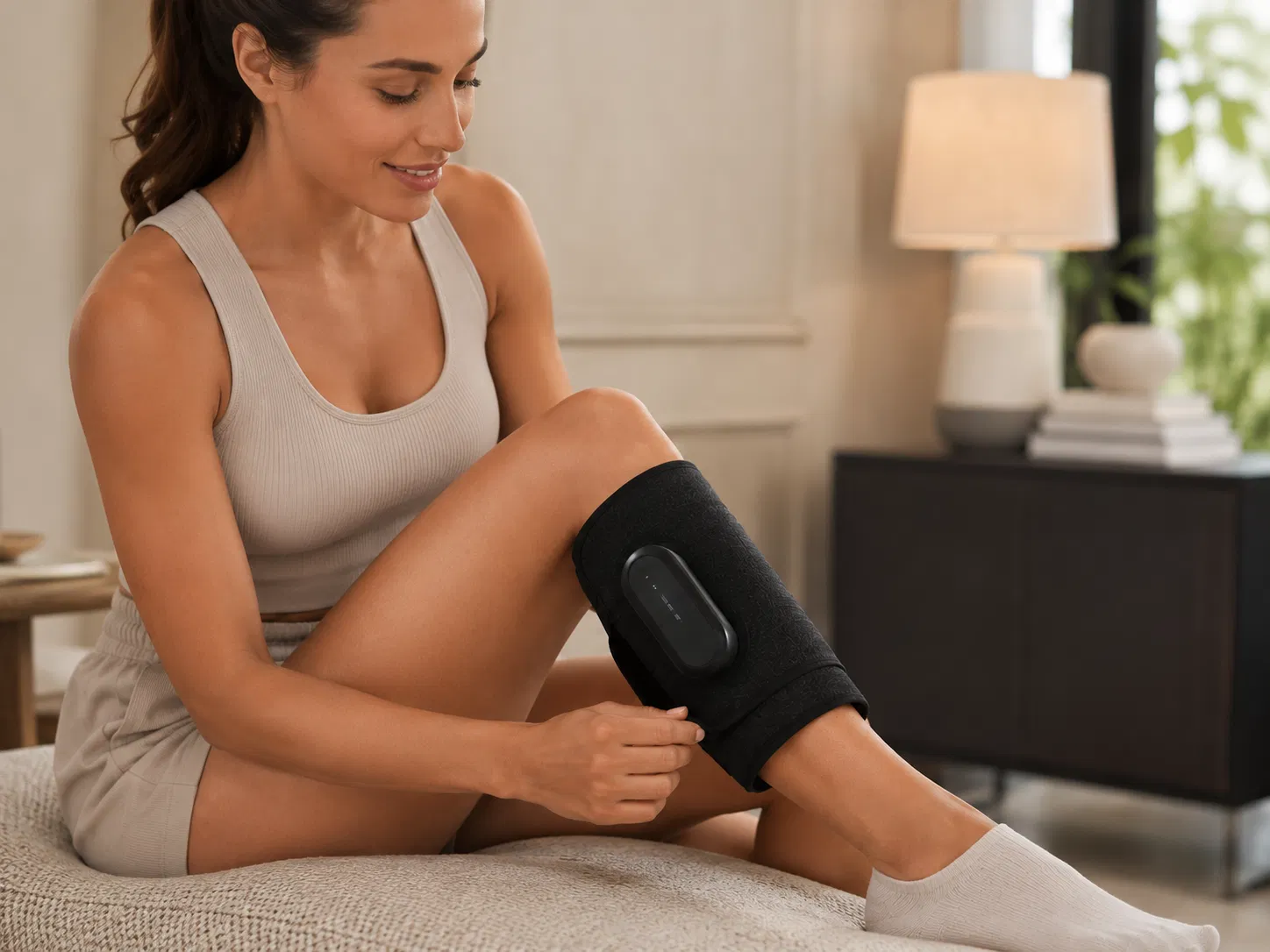
Different symptoms and device types need different considerations. Read knee pain after flights for travel-related patterns and do knee massagers work for devices that act directly around the knee.
How Air Compression Boots and Calf Massagers Work
Inflatable chambers apply external pressure, then release it. Multi-chamber devices may inflate in a sequence from the foot or ankle upward. This can temporarily compress soft tissue and veins during the session. A consumer recovery boot is related in principle to clinical intermittent pneumatic compression, but the purpose, fit, pressure program, medical oversight, and evidence cannot be assumed to be equivalent.

What Research Says About Recovery
A 2024 systematic review and meta-analysis included 17 studies and 319 participants. It reported effects ranging from trivial to small for several performance measures and trivial to moderate changes in perceived pain or soreness, with variable findings across markers. A 2025 review found moderate-certainty evidence that intermittent pneumatic compression did not reduce muscle soreness at 24 hours compared with control. These findings support a cautious conclusion: the device may feel useful to some people, but it should not be sold as a dependable way to restore performance or accelerate healing.
| Claim | Reasonable conclusion | Do not conclude |
|---|---|---|
| Legs feel less heavy or sore | Some users and studies report a short-term perceived benefit | That damaged tissue healed faster |
| Exercise performance recovers | Results are small, mixed, and outcome-dependent | That boots reliably improve the next workout |
| Pressure changes fluid movement | External compression has a real mechanical effect during use | That unexplained swelling is safe to self-treat |
| A session is relaxing | Comfort and routine value are legitimate personal outcomes | That relaxation proves a medical benefit |

Air Compression Boots vs Calf Wraps, Socks, and Walking
| Option | What it does | Practical role | Main limit |
|---|---|---|---|
| Full recovery boots | Inflate across foot, calf, and thigh zones | At-rest recovery routine | Cost, size, fit, and uncertain added benefit |
| Calf air massager | Inflates around a smaller lower-leg area | Portable comfort session | Does not reproduce full-leg systems |
| Compression socks | Provide static graded pressure when fitted correctly | Wearable option for selected uses | Sizing and medical suitability matter |
| Walking and calf movement | Activates the body's muscle pump | First-line movement when safe and possible | May not be possible after surgery or with acute symptoms |

What About Air Compression Boots After Flying?
Travel searches often lead directly from heavy legs to a massager. That jump is unsafe when swelling is new, one-sided, warm, red, or tender. Prolonged immobility is one risk factor for deep vein thrombosis. Chest pain or breathlessness requires emergency care, and possible clot symptoms need urgent medical advice rather than compression, heat, or massage.
For ordinary travel without warning signs, position changes and walking when safe remain basic tools. A healthcare professional can advise whether compression socks or a pneumatic device makes sense for a person's medical history.
Does Adding Heat Make a Leg Massager Better?
Some leg massagers combine air compression with heat. Warmth can change comfort, but it does not turn weak recovery evidence into strong evidence. Avoid heat on a newly injured, swollen, red, unusually hot, or numb area. People with reduced sensation or circulation problems may not detect excessive temperature reliably.
How to Compare Consumer Devices
- Coverage: know whether the product treats the foot, calf, thigh, or only one small zone.
- Chambers and cycle: confirm whether zones inflate sequentially or together.
- Fit range: use actual circumference measurements rather than a vague one-size claim.
- Controls: pressure and heat should be independently adjustable and easy to stop.
- Instructions: contraindications and cleaning guidance should be available before purchase.
- Return policy: fit and pressure tolerance cannot be judged from a specification sheet.
Pressure and Session Length
Do not copy a professional athlete's pressure, a clinical protocol, or an online “best” number. Research protocols vary, and consumer devices may not measure pressure in comparable ways. Use the manual, begin at the lowest comfortable setting, and stop if the session causes pain, numbness, pins and needles, skin-color change, dizziness, or worsening symptoms. More pressure and longer sessions do not automatically create more benefit.
When Compression Is the Wrong Tool
Do not use a consumer air compression device to investigate or treat suspected deep vein thrombosis, sudden one-sided swelling, a hot red leg, acute skin infection, an open wound beneath the sleeve, severe peripheral arterial disease, or significant loss of sensation. Heart failure and other causes of fluid retention require individualized medical advice. Recent surgery, pregnancy, anticoagulant use, or a history of clots also deserves a clinician's guidance.
The Bottom Line
Air compression leg massagers do something real: they apply rhythmic external pressure. The leap from that fact to guaranteed circulation, swelling, or recovery benefits is where marketing outruns evidence. Treat boots and wraps as optional comfort tools, judge them by a repeatable personal outcome, keep expectations modest, and never use them to delay assessment of unexplained one-sided swelling or vascular warning signs.
Frequently Asked Questions
Do air compression leg massagers really work?
They create measurable external pressure and may temporarily change fluid movement or how the legs feel. Sports-recovery studies suggest small or inconsistent benefits for perceived soreness and little dependable improvement in objective performance. They are not a treatment for unexplained swelling or vascular disease.
Do compression boots improve workout recovery?
Some people report less soreness or heaviness, but systematic reviews find mixed results and limited certainty. A 2025 review found moderate-certainty evidence that intermittent pneumatic compression did not reduce muscle soreness at 24 hours compared with control. Recovery boots should be considered optional comfort equipment.
Can I use an air compression massager for leg swelling?
Not until the cause of new or one-sided swelling is clear. Clinical pneumatic compression is prescribed for specific medical situations, but a consumer device should not be used to self-treat possible deep vein thrombosis, infection, arterial disease, heart-related fluid retention, or unexplained swelling.
Are air compression boots the same as compression socks?
No. Boots or wraps inflate and deflate during a session, while compression socks provide graded static pressure while worn. Each has different fit, pressure, evidence, and safety considerations.
Is a leg massager with heat better?
Heat may feel relaxing, but it does not prove better circulation or recovery. Avoid heat on a newly injured, hot, red, swollen, numb, or poorly perfused leg, and check medical advice when sensation or circulation is impaired.
What pressure should I use on compression boots?
Use the device manual and any clinician instruction rather than copying an athlete's pressure number. Start with the lowest comfortable setting. Stop for pain, numbness, tingling, color change, dizziness, or worsening swelling.
Who should not use air compression leg massagers?
People with suspected deep vein thrombosis, sudden one-sided swelling, severe peripheral arterial disease, acute infection, open wounds under the sleeve, significant loss of sensation, or heart-failure-related fluid concerns need medical guidance before use.