There is a special unfairness to knee pain at night. You have carried your knees through the whole day, and the moment you finally lie down to rest, they start broadcasting. Maybe it is a deep ache along the inner knee when you lie on your side. Maybe your knee refuses to find any position that feels neutral. Maybe you fall asleep fine and wake at 3 a.m. with a stiff, complaining joint. Whatever the flavor, the result is the same: worse sleep, and because poor sleep raises pain sensitivity the next day, a knee that feels even louder tomorrow night. It is a genuine cycle, and it is worth breaking deliberately.
The good news is that sleeping comfortably with knee pain is largely a mechanical problem, and mechanical problems have mechanical solutions: the right position, a pillow in the right place, and a short evening routine that hands your knees over to the night in a calmer state. This guide covers all three, in enough detail that you can set up your bed correctly tonight.
Why Knees Hurt More at Night
Understanding the "why" makes the fixes make sense. Four things change when you lie down. First, movement stops. During the day, every step circulates synovial fluid, the joint's natural lubricant, through the knee. At rest, that circulation slows dramatically, tissues cool, and the joint stiffens. This is the same mechanism behind the rusty-gate feeling we cover in our guide on morning knee stiffness, just starting at 11 p.m. instead of 7 a.m.
Second, the day's inflammation catches up. If you overloaded the knee earlier, whether through a workout, yardwork, or simply an unusually long day on your feet, the low-grade inflammatory response tends to peak hours later, often right around bedtime. This delayed pattern is so common that we wrote a whole guide about knee pain that appears after exercise but not during it. Third, distraction disappears. During the day your brain filters out a remarkable amount of low-level discomfort because it is busy. In a dark, quiet room, the filter drops and signals that were background noise become the main event. Fourth, position pressure. Lying still for hours concentrates pressure on whichever knee surfaces are loaded, and lets fluid pool unevenly around tissues.
None of these four factors means your knee is getting worse at night. But together they explain why the same knee that let you grocery shop all afternoon suddenly demands negotiation at bedtime, and each factor points to a fix.
The Best Sleeping Positions for Knee Pain, Ranked

1. Side Sleeping With a Pillow Between the Knees (Best for Most People)
Side sleeping is how most adults sleep, and with one addition it becomes the most knee-friendly position available. The problem with plain side sleeping is geometry: your top leg has nowhere to rest, so it drops forward and down. That drop rotates the top hip, twists the thigh inward, and loads the inner surfaces of both knees, the top knee through the twist and the bottom knee through direct pressure of stacked joints.
A firm pillow between the knees fixes the geometry. The top leg gets a shelf, the hips stay level, and the knee joints stay stacked in a neutral line with the spine. The relief is often immediate and surprising.

The details that make it work: use a firm pillow, because a soft one compresses flat within an hour and you lose the support without waking enough to notice why. Length matters more than thickness; a pillow that spans from mid-thigh to mid-calf supports the whole leg instead of creating a single pressure point at the knees. If your bottom knee is the painful one, add a slight bend to both knees, around 20 to 30 degrees, which reduces direct pressure on the bottom joint. And if the bony inner sides of your knees still touch and irritate each other through the night, the pillow is too thin.
2. Back Sleeping With a Small Lift Under the Knees
Back sleeping distributes body weight more evenly than any other position and puts no direct pressure on either knee, which makes it excellent for most knee complaints. Its one flaw: lying flat pulls the knees into full extension all night, and for many irritated knees, especially stiff ones and those with arthritis, hours of forced full straightening feels grinding by morning.
The fix is a small lift: a thin pillow or a rolled towel under both knees, enough to create a gentle 10 to 20 degree bend. The knee joint rests in its most relaxed mid-range instead of being held at its end range.

One warning: keep the lift small. A thick pillow that holds your knees deeply bent all night can leave them stiffer, not looser, and over months a habit of sleeping with strongly bent knees can make full straightening feel harder. A rolled bath towel is honestly the perfect size for most people.
3. Side Sleeping Without a Pillow (Workable, Not Great)
If you sleep on your side without support, you can reduce the damage by bending both knees equally in a loose fetal position and letting the top leg rest as parallel to the bottom leg as possible. It is better than nothing, but the pillow upgrade costs a few dollars and fixes the root geometry. If you routinely wake with inner-knee soreness or notice knee tightness on waking, this is the first change to make.
4. Stomach Sleeping (The One to Retire)
Stomach sleeping rotates the hips, hyperextends the lower back, and presses the kneecaps into the mattress for hours. If you have knee pain, it is the position most likely to feed it. Retraining a lifelong stomach-sleeping habit is genuinely hard, so use the body-pillow trick: hug a full-length pillow and place it under one side of your torso and hip, which gives you most of the pressed-into-the-bed feeling stomach sleepers crave while keeping you rotated toward a side position with your knees in a manageable line.
Quick Reference: Position and Pillow Cheat Sheet
| You sleep... | Pillow goes... | Pillow type | Knee angle |
|---|---|---|---|
| On your side | Between the knees, mid-thigh to mid-calf | Firm, holds shape | Slight bend, 20-30? |
| On your back | Under the knees | Thin pillow or rolled towel | Gentle bend, 10-20? |
| On your stomach | Full-length body pillow under torso and hip | Body pillow | Transition toward side sleeping |
| Switching all night | Between knees, and keep it there as you turn | Firm, lightweight | Whatever stays neutral |
The Evening Wind-Down That Calms Knees Before Bed
Position solves the mechanical half of night knee pain. The other half is the state your knees are in when you lie down. A knee that goes to bed warm, loose, and relaxed behaves very differently at 3 a.m. than one that goes to bed cold and stiff after three motionless hours on the couch. A realistic 30-minute wind-down looks like this.
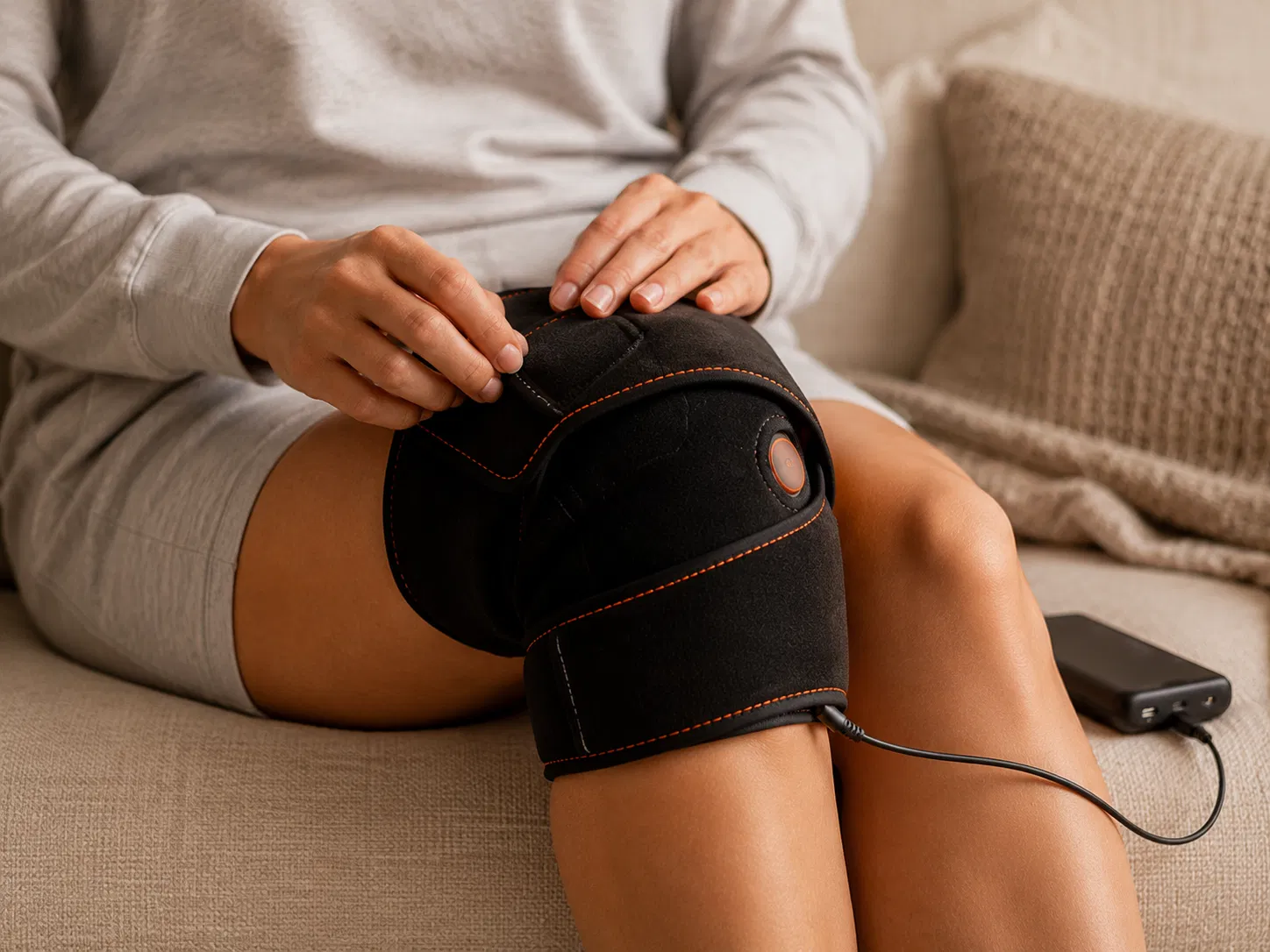
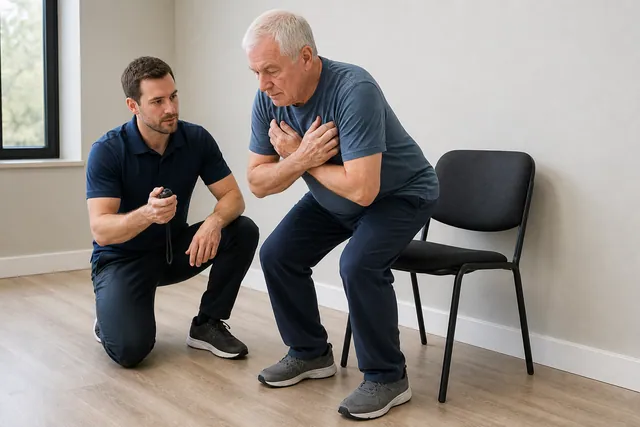
Start with two to three minutes of gentle motion: an easy walk around the house, ten slow sit-to-stands from a chair, or simply pumping the knees through their comfortable range while seated. The goal is circulating fluid, not exercising. Follow with 15 to 20 minutes of gentle warmth around the knee. Warmth increases local blood flow, relaxes the muscles that cross the joint, and reduces the stiffness signal your knee sends when you settle into bed. Evening is precisely when warmth beats cold for most non-swollen, achy knees; the full decision logic is in our heat vs. ice guide. One safety rule: warmth sessions end before sleep does. Do not sleep with an actively heating device on.
Finish with 60 seconds of light stretching: a gentle standing quad stretch and a seated hamstring stretch, held softly rather than aggressively. Then set up your pillow before you are sleepy enough to skip it. People who keep this routine for two weeks consistently report both easier sleep onset and calmer mornings, which compounds, because better sleep lowers next-day pain sensitivity. If your mornings are still the hardest part, pair this with the routines in our guide to knee pain when getting up after sitting.
Sleep and Pain: the Cycle Worth Knowing About
There is one more reason to take night knee comfort seriously, and it is bigger than the knee itself. Sleep and pain regulate each other in both directions. Poor sleep measurably lowers your pain threshold the next day: research on sleep restriction consistently shows that people rate identical stimuli as more painful after short or fragmented nights, because the brain systems that normally dampen pain signals run on sleep. At the same time, deep sleep is when the body does its most efficient tissue maintenance and inflammation regulation. So a bad knee night does not just cost you rest; it hands you a more sensitive knee tomorrow, which makes the next night harder, and the spiral feeds itself.
The encouraging flip side is that the cycle runs in reverse just as reliably. Two or three consecutive nights of better sleep, achieved through nothing fancier than correct positioning and a consistent wind-down, measurably calm the whole system. This is why people who fix their sleep setup often report that their daytime knee comfort improved too, even though nothing about their daytime routine changed. You are not imagining it; you upgraded the machinery that processes the pain signal. Treat the pillow placement and the evening routine in this guide not as comfort tricks but as part of your knee care itself, on equal footing with strengthening and sensible activity habits.
Small Bedroom Upgrades That Help More Than Expected
A few environmental details punch above their weight. Mattress firmness matters at the extremes: a very soft mattress lets your hips sink and twists the knee line in side sleeping, while a very firm one concentrates pressure on the bottom knee. Medium-firm suits most knee-pain sleepers, and a mattress topper is a cheaper experiment than a new mattress. Keep the room warm enough that your legs are not cold; cold tissue stiffens, and knees respond to that within the first hour of the night. If you wake to use the bathroom, take ten seconds to march gently in place before walking; those first cold-start steps on a stiff knee are when nighttime knees complain loudest. And if you use a knee sleeve during the day, take it off at night; joints benefit from unrestricted circulation during sleep, and compression sleeves are daytime tools.
Special Situations: Arthritis, Flare-Ups, and Active Days
The position rules above cover most knees, but three situations deserve their own notes. Knees with osteoarthritis tend to be the most position-sensitive of all, because both prolonged full straightening and prolonged deep bending aggravate them; the sweet spot is that gentle 10 to 20 degree bend held by a small support, in either the side or back position. Arthritis knees also respond most strongly to the evening warmth session, since warmth directly targets the stiffness that defines the condition. On flare-up nights, when the knee is unusually irritated after an overloaded day, temporarily elevate the whole lower leg on a flat pillow so the knee sits slightly above heart level, which helps the day's accumulated fluid drain rather than settle; you can read more about that mechanism in our guide to knee swelling after exercise.
And for active people, the night after a hard workout, long hike, or unusually big walking day is exactly when delayed knee ache shows up at bedtime. The two highest-value moves on those days are a proper wind-down warmth session and going to bed slightly earlier, because the first half of the night carries the deepest, most restorative sleep, and recovery hormones do their best joint work there.
The 3 a.m. Wake-Up Protocol
Waking at night with an aching knee has its own two-minute playbook, and having one prevents the frustrated tossing that turns a five-minute wake-up into an hour. First, reset the position: your pillow has usually migrated, so put it back where it belongs and restack your legs deliberately. Second, pump gently: while lying down, slowly bend and straighten the knee ten to fifteen times through a small, comfortable range. This recirculates synovial fluid and quiets the stiffness signal far faster than lying still and hoping. Third, if the ache persists, get up briefly and walk one slow lap of the room; thirty seconds of gentle loading resets most nighttime knee grumbling. Fourth, back in bed, take three slow breaths with a long exhale, because the goal now is switching your nervous system back toward sleep rather than continuing to monitor the knee. What you should not do is start stretching aggressively, scroll your phone while waiting for the ache to pass, or take up residence on the couch in a worse position. If the same knee wakes you at the same hour night after night for weeks despite good positioning, that pattern itself is worth mentioning to a professional.
Do Knee Pillows and Wedges Earn Their Price?
The dedicated knee pillow industry would like you to believe an ordinary pillow cannot do this job. The honest version: for side sleepers, contoured hourglass-shaped knee pillows do hold position better than a squishy spare pillow, because the shape locks between the legs and travels with you when you turn, and firm memory foam does not flatten by 2 a.m. If you turn frequently, a strap-free contoured pillow or a full body pillow is the practical choice; dedicated straps sound clever and feel like a tourniquet by morning. For back sleepers, skip the marketing entirely, because a rolled bath towel under the knees performs identically to a purpose-built wedge for a fraction of the cost. Whatever you choose, apply the same two-to-three-week test you would apply to any comfort tool: if your mornings are not calmer after three weeks of consistent use, the pillow is not the missing piece, and it is time to look at the daytime factors feeding your nights, starting with your daily knee care routine.
When Night Knee Pain Deserves a Doctor
Position and routine changes handle mechanical night pain, which is the majority. But some patterns are your cue to get assessed instead: pain that wakes you from sleep repeatedly regardless of position, a knee that is visibly swollen, warm, or red, constant pain that does not change at all when you move or reposition, fever or night sweats alongside the knee pain, or new night pain following an injury. These patterns can involve inflammation or conditions that need diagnosis, not pillows. Everything else, the achy, position-sensitive, worse-after-busy-days variety, responds remarkably well to the setup in this guide, usually within the first week or two of doing it consistently.
Tonight, then: pillow in the right place for your position, 15 minutes of warmth in your wind-down, gentle motion before lights out. Small mechanical changes, repeated nightly, are how loud knees learn to sleep through the night again.
Frequently Asked Questions
What is the best sleeping position for knee pain?
Side sleeping with a firm pillow between the knees is the most reliably comfortable position for most knee issues. It keeps the knees, hips, and spine stacked in a neutral line. Back sleeping with a small pillow or rolled towel under the knees is a close second. Stomach sleeping is the least knee-friendly position.
Why does my knee hurt more at night than during the day?
Several factors stack up at night: joints cool and stiffen without movement, daytime distractions disappear so your brain gives pain signals more attention, inflammation from the day's activity peaks in the evening, and staying in one position lets fluid settle unevenly around the joint. Your knee is not necessarily worse at night; you are just finally listening to it in unfavorable conditions.
Should the pillow go between or under my knees?
It depends on your sleeping position. Side sleepers put a firm pillow between the knees, ideally extending from mid-thigh to mid-calf. Back sleepers put a thin pillow or rolled towel under the knees to keep them slightly bent. Using both rules for the wrong position cancels the benefit.
Is it OK to sleep with a heated knee wrap on?
Sleeping with an actively heating device on is not recommended; prolonged unattended heat against skin is a burn risk. The smart pattern is a 15 to 20 minute warmth session as part of your wind-down before sleep, then remove the device when you turn out the lights. The relaxation effect carries into the night.
When should I see a doctor about knee pain at night?
Night pain that wakes you repeatedly, pain that is constant regardless of position, a knee that is swollen, hot, or red, night sweats or fever alongside the pain, or pain following a recent injury all deserve a professional evaluation rather than only position changes.