You're walking to the kitchen, climbing a flight of stairs, or simply standing up from your desk. Suddenly, your knee sends a sharp, unexpected signal. No fall, no twist, no obvious reason. Just sudden knee pain that seems to appear from nowhere.
Sudden pain can affect active and less active adults, and it may begin with or without an obvious injury. Location is useful to describe the symptom, but the immediate decision depends more on swelling, heat, redness, movement, stability, fever, and whether the leg supports your weight.
Safety Check: How Urgent Is Sudden Knee Pain?
| What you notice | Why it matters | Next step |
|---|---|---|
| Knee or leg looks deformed after trauma | A fracture or dislocation must be considered | Emergency assessment; do not try to force it back into position |
| Cannot bear weight, cannot move the knee, true locking, or repeated giving way | Function is significantly impaired and a substantial injury or mechanical block may be present | Urgent assessment |
| Rapid or severe swelling, especially after a twist, pop, fall, or impact | Bleeding or significant internal injury may need evaluation | Prompt medical assessment |
| Hot, red, swollen knee with fever, chills, or feeling unwell | Joint infection is one urgent possibility | Urgent same-day care; do not wait for home treatment to work |
| One calf or whole leg becomes swollen, painful, warm, or discolored | A deep vein thrombosis must be considered | Urgent medical advice |
| Mild pain, normal shape, no major swelling, and safe weight-bearing | A short period of protection and monitoring may be reasonable | Reduce the provoking activity and arrange care if it is not improving or keeps returning |
Chest pain, sudden shortness of breath, coughing blood, fainting, or severe illness is an emergency, particularly when it follows one-sided leg swelling or pain. Call emergency services rather than driving yourself.
What Does "Sudden Knee Pain" Actually Mean?
Before diving into causes, it's important to distinguish between fast-onset (sudden) knee pain and gradual-onset knee pain. They're fundamentally different experiences:
- Sudden onset: Pain appears within seconds or minutes, often during or immediately after a specific movement or position change. You can usually pinpoint exactly when it started.
- Gradual onset: Pain builds over days, weeks, or months. There is no single moment; it is a slow progression that becomes more noticeable over time.
This guide focuses exclusively on the sudden-onset category. If your discomfort has been building gradually, our guide on what causes knee pain covers that pattern in depth. For pain that appears and disappears in unpredictable cycles, see our intermittent knee pain guide.
Fast-Onset vs Gradual: Why It Matters
The speed at which knee pain develops often provides important clues about the underlying mechanism. Sudden pain frequently suggests a mechanical event (catch, pinch, slip) within the joint, while gradual pain typically points to cumulative tissue stress or inflammatory processes. Knowing which type you're experiencing helps you respond appropriately.
For a hot swollen knee, the gout versus pseudogout comparison explains crystal-related possibilities and why infection must still be considered. If fluid testing is recommended, the knee aspiration guide explains preparation and aftercare questions.
Possible Causes Without an Obvious Injury
No remembered injury does not mean nothing important happened. A small twist may go unnoticed, and some inflammatory or medical conditions begin abruptly. The groups below explain why an examination and the associated signs matter more than matching one sentence to your pain.
Flare of a Load-Sensitive Knee Problem
Osteoarthritis, patellofemoral pain, tendon irritation, or another existing problem can become noticeable after a change in walking, stairs, kneeling, training, or time spent in one position. The pain may feel sudden even though the tissue response developed over hours or days. A flare is more plausible when a familiar activity reproduces the symptom and there is no major trauma, fever, deformity, or rapid swelling. It still should not be assumed when the presentation is new or severe.
Meniscal or Loose-Body Symptoms
A meniscal problem or a loose piece within the joint can sometimes cause joint-line pain, catching, or a true mechanical block. The phrase locked knee should mean that the knee physically cannot fully straighten or bend, not simply that movement hurts. A truly locked knee needs prompt assessment. Many people have meniscal changes on scans without symptoms, so imaging findings must be interpreted alongside the history and examination.
Crystal Arthritis
Gout and calcium pyrophosphate deposition can cause a rapid attack of severe joint pain, warmth, and swelling. These conditions cannot be reliably separated from infection by appearance alone. A first episode of a hot, red, swollen knee deserves urgent medical assessment, particularly with fever or feeling unwell. Do not apply heat to that presentation.
Joint Infection
Septic arthritis is uncommon but time-sensitive. Risk can be higher with recent joint surgery or injection, a weakened immune system, some chronic illnesses, or an infection elsewhere, but it can occur without an obvious risk factor. A hot, swollen, very painful knee with fever, chills, or general illness requires urgent same-day care. The absence of a high fever does not make a severely hot swollen joint safe to ignore.
Pain Referred From Outside the Knee
Symptoms from the hip, lower back, nerves, muscles, or blood vessels can be felt around the knee. Numbness, tingling, weakness, calf swelling, or pain extending well above or below the joint broadens the assessment. This is especially important for pain behind the knee, where a clinician may need to distinguish a local tendon or cyst problem from a whole-leg vascular symptom.
Sudden Knee Pain by Location
Where your sudden pain appears provides valuable clues about what might be happening inside the joint. Different zones of the knee are associated with different structures and mechanisms.

Sudden Pain in Front of the Knee
Front-of-knee pain may involve the patella (kneecap), the patellar or quadriceps tendon, a bursa, or the joint itself. Useful clues include a direct impact, a sudden increase in jumping or running, pain with loaded knee bending, and visible swelling. These clues overlap and do not confirm one structure.
- After a direct blow: Check for rapid swelling, deformity, and whether the knee safely supports weight.
- After a forceful jump or contraction: Inability to actively straighten the knee needs prompt assessment.
- During stairs or squats: A kneecap-related load pattern is possible, but locking, instability, or swelling changes the decision.
If you frequently experience front knee sensations, our guide on front knee tightness after activity explores this pattern in depth.
Sudden Pain Behind the Knee
Sudden pain behind the knee may involve posterior structures, including the hamstring tendons, gastrocnemius muscle, a Baker's cyst, or the knee joint itself. Whole-leg symptoms require a broader assessment. Possible patterns include:
- Baker's cyst: A fluid-filled swelling can cause fullness or pain behind the knee and may be associated with another knee condition.
- Muscle or tendon problem: The hamstring or calf may hurt after a stretch, sprint, or sudden contraction.
- Whole-leg warning pattern: New calf or leg swelling, warmth, color change, chest pain, or breathlessness needs urgent evaluation for a possible blood clot.
For more detailed coverage, see our guide on back-of-knee pain causes.
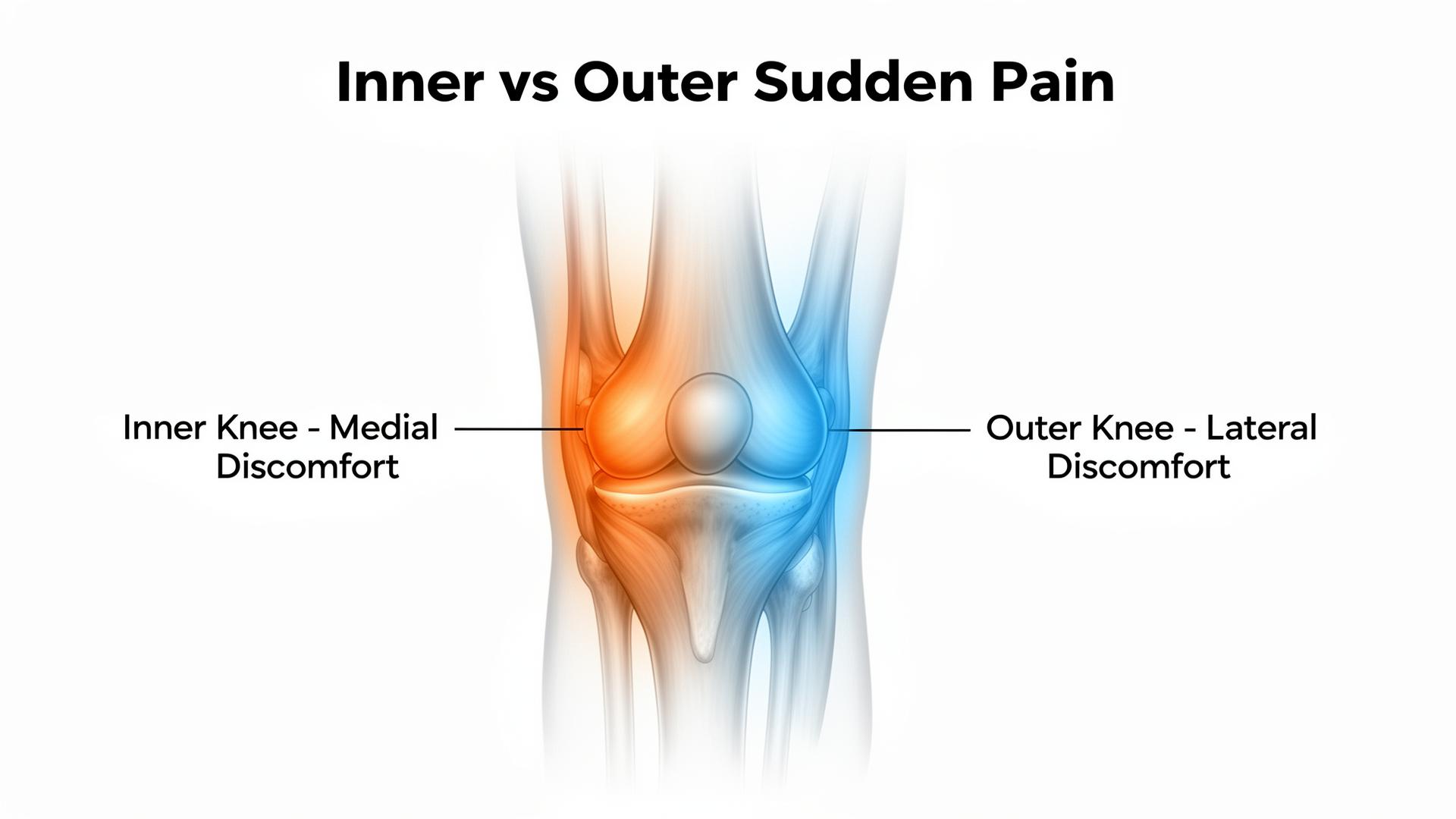
Sudden Inner Knee Pain
Sudden inner knee pain (medial side) is frequently associated with:
- Medial meniscus catch: The inner meniscus is less mobile than the outer one, making it more prone to catching during twisting movements
- MCL micro-stress: The medial collateral ligament can produce sudden twinges during lateral movements
- Pes anserine area: Tendons and a bursa on the inner shin below the knee can become sensitive, although this cannot be confirmed from location alone.
Sudden Outer Knee Pain
Outer (lateral) sudden knee pain commonly involves:
- IT band snapping: The iliotibial band can snap over the lateral femoral condyle during knee bending and straightening
- Lateral meniscus irritation: The outer meniscus can catch during pivoting movements
- LCL stress: The lateral collateral ligament can produce sudden twinges during inward-directed forces
Explore our IT band syndrome guide for detailed coverage of outer knee discomfort patterns.
Sudden Knee Pain by Sensation
Beyond location, the quality of your sudden knee pain can provide additional clues about the underlying mechanism.
Sharp Sudden Pain
Sharp sudden knee pain can occur with a twist, tendon injury, kneecap-related pain, meniscal irritation, a loose body, or an inflammatory condition. Sharp does not automatically mean that something is trapped or torn. The trigger and functional changes are more useful: did you hear a pop, did swelling appear quickly, can you straighten the knee, and can you walk safely?
Sudden Stabbing Pain
Sudden stabbing knee pain describes intensity and focus, but it does not identify the cause. A recurrent pinpoint symptom deserves assessment when it limits activity, and a first severe episode deserves faster care when the knee is swollen, hot, red, locked, or unable to support weight. For more on describing this pattern, read our guide on sharp and stabbing knee pain.
Sudden Locking Sensation
A truly locked knee cannot fully straighten or bend because movement is physically blocked, not simply because it hurts. A meniscal problem or loose body is one possibility, but an examination is needed. New true locking should prompt urgent assessment, especially after injury or with swelling.
Sudden Tightness or "Catch"
A brief tightness or catch can settle quickly, but it should not be labeled harmless from sensation alone. Note whether it is painful, whether it recurs in the same position, and whether the knee fully straightens afterward. Repeated catching with swelling, loss of movement, or instability deserves evaluation.
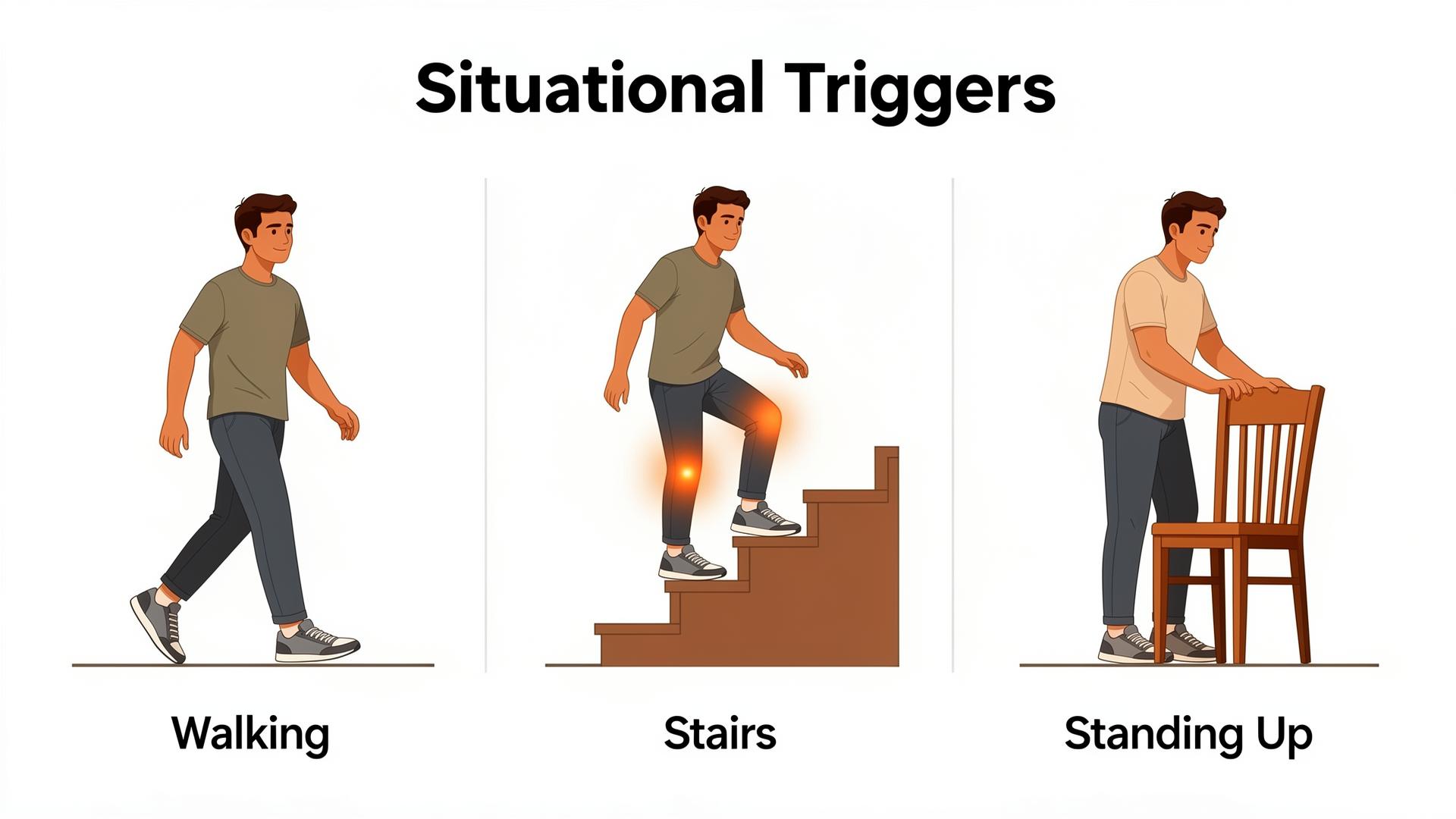
Situational Triggers: When Sudden Pain Strikes
Many people notice their sudden knee pain follows specific activity patterns. Understanding your triggers can help you anticipate and manage episodes.
Sudden Pain While Walking
Sudden knee pain walking is particularly common because walking involves repetitive loading across all knee structures. Pain that strikes mid-walk often relates to:
- Meniscal catch during the rotation phase of gait
- IT band tension reaching a threshold after sustained walking
- Footwear-related tracking changes on different surfaces
- Cumulative muscle fatigue transferring load to the joint
If walking-related knee pain is a pattern for you, our guide on knee pain after long walks covers detailed strategies.
Sudden Pain While Standing Up
The transition from sitting to standing requires the quadriceps to extend the knee while the joint accepts load. Pain on the first repetition can occur with a load-sensitive kneecap or arthritic knee, stiffness after sitting, tendon pain, or another condition. Useful clues include:
- Whether the pain eases after a few gentle movements or increases with repetition
- Whether the chair is unusually low and the knee is deeply bent
- Whether swelling, locking, instability, or a recent injury is present
Learn more in our dedicated knee pain getting up after sitting guide.
Sudden Pain on Stairs
Sudden knee pain on stairs occurs while the knee is bending under load. Descending also asks the supporting leg to control the body's lowering. A front-of-knee load pattern is possible, but a twist, joint-line pain, tendon symptoms, or another cause can look similar. Use the rail, stop if the knee feels unstable, and see our knee pain going down stairs guide for safer task modifications.
Sudden Pain After Inactivity
Pain or stiffness on the first movements after sitting can occur with osteoarthritis and other load-sensitive knee conditions. If it eases with gentle motion and there are no warning signs, note how long it takes to settle and whether the pattern is changing. A knee that is physically locked, badly swollen, hot, or unable to bear weight is not a routine first-step pattern. This is explored further in our knee stiffness after resting guide.
When Sudden Knee Pain Is Normal vs. When to Pay Attention
Not all sudden knee pain has the same urgency. No checklist can rule out a serious condition, but function and associated symptoms help determine whether brief monitoring is reasonable or prompt care is safer.
May Be Reasonable to Monitor Briefly
✓ Quick Tips
- •Mild discomfort that settles and does not return during ordinary movement
- •First-movement stiffness after sitting or sleeping that eases with gentle movement
- •Occasional clicking or popping without pain
- •Symptoms after unusual activity that trend back toward baseline
- •Normal knee shape, no major swelling, and safe weight-bearing
- •No fever, redness, heat, locking, or instability
Deserves Professional Attention
✓ Quick Tips
- •Rapid visible swelling within hours of pain onset
- •Inability to bear weight or walk normally
- •Knee feels unstable, gives way, or locks repeatedly
- •A hot, red, or markedly swollen joint
- •Pain that wakes you from sleep consistently
- •Sudden pain accompanied by fever or general illness
- •Episodes increasing in frequency, duration, or intensity
- •Pain that is not improving, keeps returning, or increasingly limits activity
Recurrence Still Matters
A single mild episode that fully settles may not require treatment, but recurrence changes the picture. If the same pain returns in the same location, starts with progressively less activity, or is joined by swelling, catching, weakness, or reduced movement, arrange an assessment even when each episode is brief.
At-Home Comfort Steps for Sudden Knee Pain
These steps are only for a knee with no deformity, major swelling, fever, true locking, instability, or inability to bear weight. Warning signs take priority over home care.
Step 1: Pause and Breathe
Stop the activity that triggered the pain. Find a comfortable seated or supported position. Take a few slow breaths. Sudden pain can trigger muscle guarding and tension, so give your body a moment to settle while you check function and warning signs.
Step 2: Protect, Do Not Provoke
Avoid the exact twist, squat depth, stair pattern, or impact that triggered the pain. Do not repeatedly test a locked or unstable knee. If the knee is newly painful or swollen and skin sensation is normal, a wrapped cold pack can be used for up to 20 minutes at a time. Never place ice directly on the skin. Avoid heat on a hot, red, or acutely swollen knee. The knee injury ice-or-heat guide explains how swelling, bruising, stiffness, and skin safety change that short-term choice.
Step 3: Gentle Range-of-Motion
If the knee is not locked and movement feels safe, try a few gentle bends and straightens within a comfortable range. Do not force the end range or try to release a catch yourself. Stop if pain escalates, the knee gives way, or movement becomes more restricted.
Step 4: Monitor the Pattern
Note the onset, trigger, exact location, swelling, movement, weight-bearing ability, and any fever or whole-leg symptoms. Recheck function rather than repeatedly provoking the pain. If the trend is not clearly improving, or if the episode returns, a clinician can determine whether examination or imaging is appropriate.
Building Resilience Against Sudden Pain Episodes
While you can't completely prevent sudden knee pain, certain daily habits can reduce the frequency and intensity of episodes:
✓ Quick Tips
- •Stay consistently active rather than alternating between inactivity and intense activity
- •Warm up your knees with gentle movements before demanding activities
- •Strengthen the muscles around your knee, especially quadriceps and hamstrings
- •Progress walking, stairs, running, or strength work gradually
- •Choose supportive footwear that matches your daily activities
- •Take regular movement breaks during prolonged sitting
- •Incorporate gentle stretching into your morning and evening routines
- •Maintain a healthy weight to reduce joint loading forces
For a structured approach to daily knee maintenance, explore our guides on how to strengthen knees and building a daily knee care routine.
Frequently Asked Questions
Why does sudden knee pain happen without injury?
Possible causes include a flare of an existing joint problem, gout or another crystal arthritis, infection, a meniscal or loose-body problem, tendon or bursa irritation, and pain referred from elsewhere. The presence of heat, redness, swelling, fever, locking, or inability to bear weight is more important than trying to identify the cause from one symptom.
What causes sudden sharp knee pain?
A sharp quality can occur with an injury, meniscal irritation, a loose body, tendon pain, kneecap-related pain, or other conditions. Pain quality alone cannot distinguish mechanical from inflammatory causes. Note the trigger, exact location, swelling, movement loss, and whether the knee supports your weight.
Why does my knee suddenly hurt when walking?
Stop and check whether the knee can safely support you. A twist, unstable surface, tendon or kneecap irritation, or a meniscal problem may be involved, but the cause cannot be confirmed from walking pain alone. Seek prompt care if the knee gives way, locks, rapidly swells, or you cannot bear weight.
What does sudden pain behind the knee mean?
Pain behind the knee can come from muscles or tendons, a Baker's cyst, the joint, or structures elsewhere in the leg. New calf or whole-leg swelling, warmth, discoloration, chest pain, or breathlessness changes the urgency because a blood clot must be considered.
Why do I get sudden inner knee pain?
The medial meniscus, medial collateral ligament, tendons, and joint surfaces can all produce inner-knee pain. A recent twist, joint-line tenderness, swelling, locking, and instability are useful clinical clues, but location alone does not identify the structure.
When is sudden knee pain serious?
Seek urgent care if the knee is badly swollen or deformed, you cannot move it or bear weight, it locks or gives way, or a hot red knee occurs with fever or feeling unwell. Significant trauma, rapid swelling, or a suspected dislocation also needs prompt assessment.
How long should sudden knee pain last?
There is no safe universal time limit because urgency depends on the associated signs. Severe pain, deformity, rapid swelling, fever, locking, instability, or inability to bear weight should not wait several days. Milder symptoms that are not improving, keep returning, or limit daily activity should also be assessed.
What are the best at-home steps for sudden knee discomfort?
Stop the provoking activity, get to a safe supported position, and check for warning signs. Avoid forcing, twisting, or repeatedly testing the knee. A wrapped cold pack can be used briefly for a newly painful or swollen knee if skin sensation is normal. Do not apply heat to a hot, red, or acutely swollen knee.