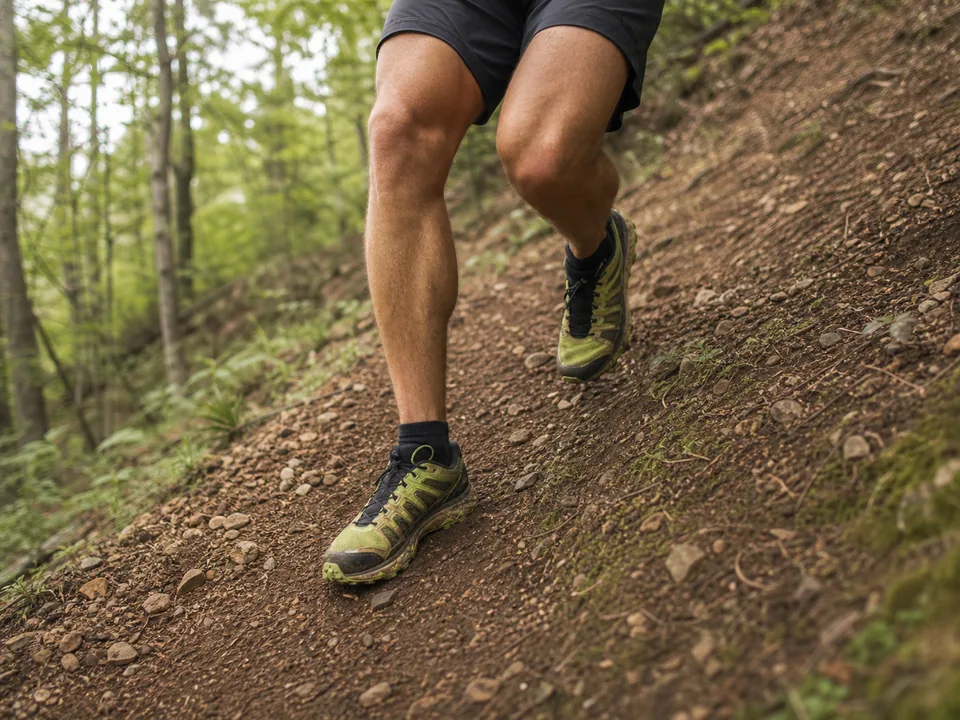
"I only ran six miles" can be a misleading summary of a trail session. Six miles on a wide, firm path and six miles across roots, loose stone, tight turns, and repeated elevation changes are different exposures. A GPS file may show the same distance and average pace while the legs handle very different footing, step patterns, stabilization demands, and fatigue.
This article focuses on what makes trail running knee pain different. The broader running knee pain guide covers general running injuries and symptoms. Here, the central questions are more specific: Which surface, camber, turn, elevation change, or fatigue point made this route different? Which terrain should return first? If the problem is limited to a smooth slope rather than technical trail features, the downhill running knee pain guide explains braking, stride, cadence, and descent-specific progression in more detail. Pain location helps organize the trail questions, but it cannot confirm a diagnosis.
What Makes Trail Running Different?
World Athletics describes trail running as endurance running on varied natural terrain that can include dirt, forest paths, single track, sand, snow, mountains, plains, and deserts. Significant climbing and descending are common. This variability is the attraction of the sport, but it also means that distance is only one part of the workload.
A trail runner continually adjusts step width, foot placement, stride length, speed, and body position. A root may shorten one step. Loose gravel may require a controlled slide. A cambered section can load the two legs differently. None of these features is automatically harmful. They require a capacity for repeated adaptation that has to be trained.
Prospective trail-running research supports taking knee symptoms seriously without presenting the sport as dangerous. In one 30-week cohort of 152 trail runners, the knee was the leading anatomical site among recorded running-related injuries. Previous injury was an important risk factor. The study does not prove that trails caused every knee problem, and its findings should not be converted into a personal risk percentage.
How Technical Terrain Changes the Knee's Job

A smooth, open slope and a rocky switchback can share the same grade while asking for different movement. On predictable ground, the runner can settle into a rhythm. Roots, loose gravel, ruts, wet rock, and narrow single track interrupt that rhythm. Each feature may change where the foot lands, how wide the next step needs to be, and how quickly the body must reorganize over the planted leg.
Off-camber ground adds another layer because the two feet meet different angles. Tight turns and step-downs may load one side repeatedly, especially on a route that always circles in the same direction. Low speed does not automatically mean low demand. A runner moving cautiously through difficult terrain may spend longer under tension and make more corrective movements than someone covering a simple trail quickly.
Laboratory models show that gradient can redistribute cumulative load across the patellofemoral joint, tibia, and Achilles tendon, but those controlled studies cannot reproduce every trail surface or predict an individual injury. Use elevation as one clue within the whole route. Total technical time, surface stability, visibility, turns, accumulated fatigue, and previous exposure help explain why the same hill may feel manageable on one trail and provocative on another.
Why pain may appear after the trail run
Symptoms do not have to appear at the moment of the hardest feature. Attention to footing and a constantly changing environment can make a mild problem less noticeable during the run. Pain may become clearer after cooling down, during stairs later that day, or when standing the next morning. Use the guide to knee pain after exercise but not during when the delayed response is the main puzzle.
Map the Pain Before Changing Everything
Search terms such as "runner's knee" are broad. They often refer to patellofemoral pain, but runners also use the phrase for almost any knee symptom. A more useful description includes the location, timing, slope, surface, and whether the knee swells. The runner's knee pain location guide provides a wider map.
| Location | Trail pattern to note | Possible category | Clues that need assessment |
|---|---|---|---|
| Around or behind the kneecap | Worse after steep elevation, repeated step-downs, stairs, or sitting | Patellofemoral load-sensitive pattern | Large swelling, trauma, loss of motion, worsening daily pain |
| Outside of the knee | Appears at a repeatable distance, on camber, or on one-sided footing | IT band or another lateral structure | Twist, swelling, instability, joint-line locking |
| Inside of the knee | Camber, awkward step, deep bend, or distinct pivot | Medial tendon, ligament, meniscus, or joint irritation | Rapid swelling, catching, true locking, giving way |
| Below the kneecap | Steep running, jumping obstacles, forceful push-off | Patellar tendon or upper shin region | A pop, sudden weakness, inability to straighten the knee |
| Back of the knee | Long stride, deep flexion, uphill push, or fullness after running | Muscle, tendon, joint, or fluid-related pattern | Calf swelling, redness, major loss of motion, breathing symptoms |
Front knee pain after steep or sustained trail sections
Patellofemoral pain is commonly felt around or behind the kneecap and can be aggravated by running, squatting, and stairs. The American Academy of Orthopaedic Surgeons also lists changes in activity, surface, and equipment as relevant contributors. A route with unfamiliar elevation, repeated rock step-downs, or much longer technical time can fit that history, but only an assessment can distinguish patellofemoral pain from tendon, cartilage, fat-pad, or other anterior-knee sources. Our pain behind the kneecap guide explains the overlap.
Outer knee pain on repeated camber or narrow single track
Iliotibial band syndrome is a common lateral-knee diagnosis in runners. Clinicians ask about mileage, route profile, and elevation changes when evaluating this pattern. A long cambered traverse, narrow track, or route that repeatedly turns the same way may be worth recording, but outer pain can also arise from other structures and should not be labeled from one online test. Use the IT band pain location diagram to describe the area, then seek assessment when pain is persistent or mechanical symptoms appear.
Back or inner knee pain after a technical trail
Back-of-knee pain may involve muscle, tendon, joint, or fluid-related causes, and inner pain can come from several different tissues. A clear awkward step, new swelling, and restricted motion matter more than blaming the trail in general. New calf swelling, warmth, or redness is not a routine recovery problem. Review back-of-knee patterns when the location is posterior.
Audit Trail Load, Not Just Weekly Mileage

Running research suggests that sudden changes in load may be associated with injury, but the evidence does not support one universal percentage rule for every runner. A systematic review found limited evidence and different definitions across the available studies. The practical lesson is to compare the current week with what your body has recently handled, not to treat a fixed formula as protection.
A useful trail log records more than miles or kilometers:
- Distance and total time: how long the legs were working, including hiking.
- Elevation gain and loss: record total change, the steepest sections, and how much was continuous.
- Technicality: smooth dirt, loose gravel, roots, rocks, mud, snow, and off-camber ground create different demands.
- Terrain-adjusted pace: the same speed can be easy on wide dirt and aggressive on narrow, broken ground.
- Consecutive days: a familiar route may feel different after a hard run, strength session, or poor recovery.
- Footwear and surface changes: record them without assuming they are the cause.
- Symptom response: during the run, later that day, and the following morning.
Look for the first variable that changed before pain began. A road runner who moves to trails may keep the same mileage but add far more elevation, camber, and technical time. An experienced trail runner may tolerate the route but add speed, a race, poor visibility, or back-to-back long runs. Reducing the newest stressor often preserves more fitness than stopping all running without a plan.
What to Do During a Run When the Knee Starts Hurting
Use movement quality as the first checkpoint. If pain makes you limp, stiffen the leg, avoid one side, or lose confident footing, stop running. Walking a safer route back may be reasonable if you can bear weight normally, but remote terrain changes the risk calculation. A small problem can become a larger safety issue when balance and concentration decline far from help.
On mild symptoms without swelling or instability, shorten the route and choose the simplest safe exit. Avoid repeatedly testing the same rock garden, cambered traverse, or steep segment to see whether the pain is still present. Do not make a sudden, extreme change to foot strike or technique in the middle of a painful run. Any adjustment should be small, practiced, and judged over time.
A pop, forceful twist, rapid swelling, locked knee, repeated giving way, or inability to bear weight requires a different response. Stop, arrange safe transport, and seek medical assessment. Trail runners should carry communication and emergency supplies appropriate for the route because an injury that is manageable near home may be serious when access is difficult.
How to Settle a Mild Load-Related Flare
Reduce the specific exposure that provokes symptoms. That may mean choosing a shorter familiar route, removing loose or off-camber sections, reducing continuous elevation change, or replacing one trail session with comfortable cycling or pool work. The goal is not to prove toughness. It is to keep an amount of activity that does not produce worsening pain, swelling, or altered gait.
Cold may feel useful for a newly swollen or unusually warm knee, while warmth may suit stiffness without swelling. Neither is required for every runner, and neither builds trail capacity. The heat or ice decision guide explains the distinction. A simple post-workout knee recovery routine may help ordinary soreness, but it is not a substitute for assessing trauma or recurring swelling.
Check the knee again the following morning. Normal walking, ordinary stairs, range of motion, and swelling are more useful than whether the area felt briefly better after massage or a device. Symptoms that keep returning at the same route feature or elapsed time deserve a more structured review.
Strength and Control for Technical Trails
Trail preparation should include more than heavy lifting and more than balance practice alone. The sport asks the quadriceps to control knee flexion, the hip and trunk to organize the leg, the calf and foot to adapt to the surface, and the nervous system to make rapid corrections. A review of trail-running rehabilitation emphasizes coordinated movement across this chain.
Build controlled knee capacity
A squat or sit-to-stand, supported split squat, and slow step-down can train controlled knee flexion. Begin with a height, depth, and resistance that do not cause sharp or escalating pain. The lowering phase should remain smooth rather than becoming a drop. Progress one feature at a time.
Train the hip, calf, and foot
Hip-hinge work, bridges, side steps, calf raises, and supported single-leg balance can complement knee-focused exercises. These movements do not "fix alignment" in every runner. They build options for controlling the body when the trail changes. The guides to calf and ankle motion and flat feet and overpronation cover those links without treating foot shape as a diagnosis.
Add trail-specific balance and reaction
After basic strength is comfortable, introduce planned reaches, step-overs, and direction changes on a safe surface. Technical terrain should not be the first balance exercise after an injury. A rail, wall, or stable support allows a runner to practice control before adding unpredictability. Hops and faster drills belong later and may require professional guidance.
A Gradual Return to Trail Running
Return should be based on function and the diagnosis, not a generic number of rest days. A bone stress injury, ligament injury, or meniscus problem follows a different plan from mild patellofemoral or IT band symptoms. The steps below are a framework for a mild, improving pattern after serious causes have been excluded.
Step 1: Comfortable daily movement
Walking is normal, stairs are manageable, the knee has close to its usual range, and meaningful swelling is absent. A runner who still limps should not use a trail as a rehabilitation test.
Step 2: Flat run-walk or easy running
Start on a predictable surface at a conversational effort. The purpose is to reintroduce running rhythm without simultaneously adding elevation and technical footing. Keep the first exposure short enough that the later-day and next-morning responses are easy to interpret.
Step 3: A smooth, familiar trail
Choose a wide, predictable trail with stable footing and easy access back. Keep the route flat or gently rolling and do not chase the previous pace. This step tests the change from road or treadmill to trail without adding the most difficult surface, elevation, and duration at the same time.
Step 4: Add elevation separately
Add modest climbing and loss on stable ground before combining elevation with roots, loose stone, or sharp turns. Hiking a section is a valid intermediate step. If symptoms appear mainly on a smooth descent, move to the focused downhill guide rather than turning this trail progression into a technique experiment.
Step 5: Technicality, duration, and speed
Add roots, rocks, camber, mud, narrow track, and more difficult turns only after a predictable trail is tolerated. Increase technical time before adding race speed, or add speed before a much longer route, but do not stack both immediately. Consecutive trail days and back-to-back long runs belong near the end of the progression.
Our knee pain when hiking guide is the better resource when walking routes, pack weight, or trekking poles are the main concern. This trail-running article remains focused on running exposure, foot placement, route design, and return to run.
Footing, Line Choice, and Trail Shoes
Look several steps ahead rather than reacting only to the ground under the current foot. Choose a line that offers secure contact and enough room to adjust. Slow before a technical feature, not after balance has already been lost. Wet rock, leaves, mud, ruts, and loose gravel may justify hiking even when the grade itself looks easy.
Do not force identical steps across changing terrain. Step width, stride length, and direction naturally vary around obstacles and camber. A route becomes harder when fatigue reduces the ability to make those small corrections. When foot placement becomes noisy, uncertain, or consistently one-sided, shortening the session is more useful than trying to hold a perfect form cue.
Trail shoes should fit securely and provide traction appropriate to the surface, but cushioning and heel-to-toe drop do not diagnose or cure knee pain. Make footwear changes gradually and test them on a short familiar route. For broader shoe questions, use the running shoes and knee pain guide.
When to Get Medical Help
Arrange an assessment when trail running pain repeatedly returns, begins earlier on each run, limits ordinary walking or stairs, or produces recurring swelling. Seek prompt care after a fall or twist if you cannot bear weight, the knee is deformed or physically locked, swelling is rapid, or the knee repeatedly gives way. A hot red swollen joint with fever, new calf swelling, a cold or discolored foot, chest pain, or breathing difficulty needs urgent medical guidance.
The Bottom Line
Trail running knee pain cannot be understood from mileage alone. Terrain type, total elevation, continuous technical time, footing, camber, route difficulty, speed, fatigue, and consecutive training days all change what the knee must handle. A familiar distance on a harder route is still a new load.
Map the location, identify the surface, turn, camber, elevation segment, or fatigue point where symptoms begin, and check the response after the run and the following morning. Mild load-sensitive pain may improve when the provoking route feature is reduced, strength and control are rebuilt, and terrain returns separately from speed and distance. Swelling, locking, instability, trauma, or altered gait requires a different path. The goal is not to avoid trails. It is to earn back the specific capacity that makes technical running safe and confident.
Runners whose symptoms are tied specifically to the descent can use the focused guide to downhill braking, cadence, stride, and return progression, while this trail guide remains the broader resource for terrain, route difficulty, footwear, and elevation planning.
Frequently Asked Questions
Why do my knees hurt after trail running?
Trail running combines distance with elevation loss, uneven footing, frequent changes in stride, and repeated stabilization. A new route may therefore create a larger knee demand even when its mileage looks familiar. Pain can also reflect a specific condition or injury, so note the exact location, whether it began on a descent or after the run, and whether swelling, locking, or instability is present.
Why does my knee hurt on technical trail sections?
Technical trail sections require repeated changes in foot placement, step width, direction, and body position. Loose ground, roots, rocks, camber, elevation change, and fatigue can combine into a larger demand than the same distance on a predictable surface. If pain appears only on a smooth descent, the focused downhill running guide is a better match for questions about braking, stride, and cadence.
Is trail running harder on the knees than road running?
Not in one universal way. Trails change slope, footing, step length, and direction, while roads provide a more repetitive surface. Descents may increase front-knee demand, but varied terrain can distribute work differently across tissues. Injury risk depends on previous injury, training exposure, route difficulty, strength, fatigue, and recovery, not only whether the surface is road or trail.
What causes outer knee pain on uneven or off-camber trails?
Outer knee pain in runners is often associated with an iliotibial band pain pattern, but the lateral meniscus, ligaments, tendons, and joint can also produce symptoms in that area. A repeatable distance, prolonged camber, narrow single track, recent route change, or awkward step is useful context, not proof of a diagnosis. A distinct twist, swelling, locking, or giving way should be assessed.
How do I return to trail running after knee pain?
First regain comfortable walking, stairs, and ordinary knee motion without meaningful swelling. Reintroduce flat running or run-walk intervals, then a familiar smooth trail, modest elevation, and finally uneven or off-camber footing. Add route duration, technicality, speed, and consecutive trail days separately. If a stage changes your gait or causes a clear next-morning flare, step back and seek assessment if the pattern persists.