Search data shows strong interest in turmeric for joint pain, turmeric supplements, turmeric benefits, turmeric and ginger, and the misspelled but common query “tumeric for knee pain.” Those searches often land on pages that treat every yellow capsule as the same product. That is the first problem to solve. The active compounds studied in most knee trials are curcuminoids, especially curcumin, and the amount absorbed depends heavily on how the product is made.
Turmeric sits within the wider supplement picture described in our evidence guide to knee pain supplements. It has a more credible symptom signal than many proprietary joint blends, yet it still belongs beside, not instead of, exercise, strength, weight management, and diagnosis. If your main question is whether your symptoms reflect joint wear, start with the knee arthritis guide before trying to treat an uncertain problem with a herb.
Turmeric, Curcumin, and Curcuminoids Are Not the Same Thing
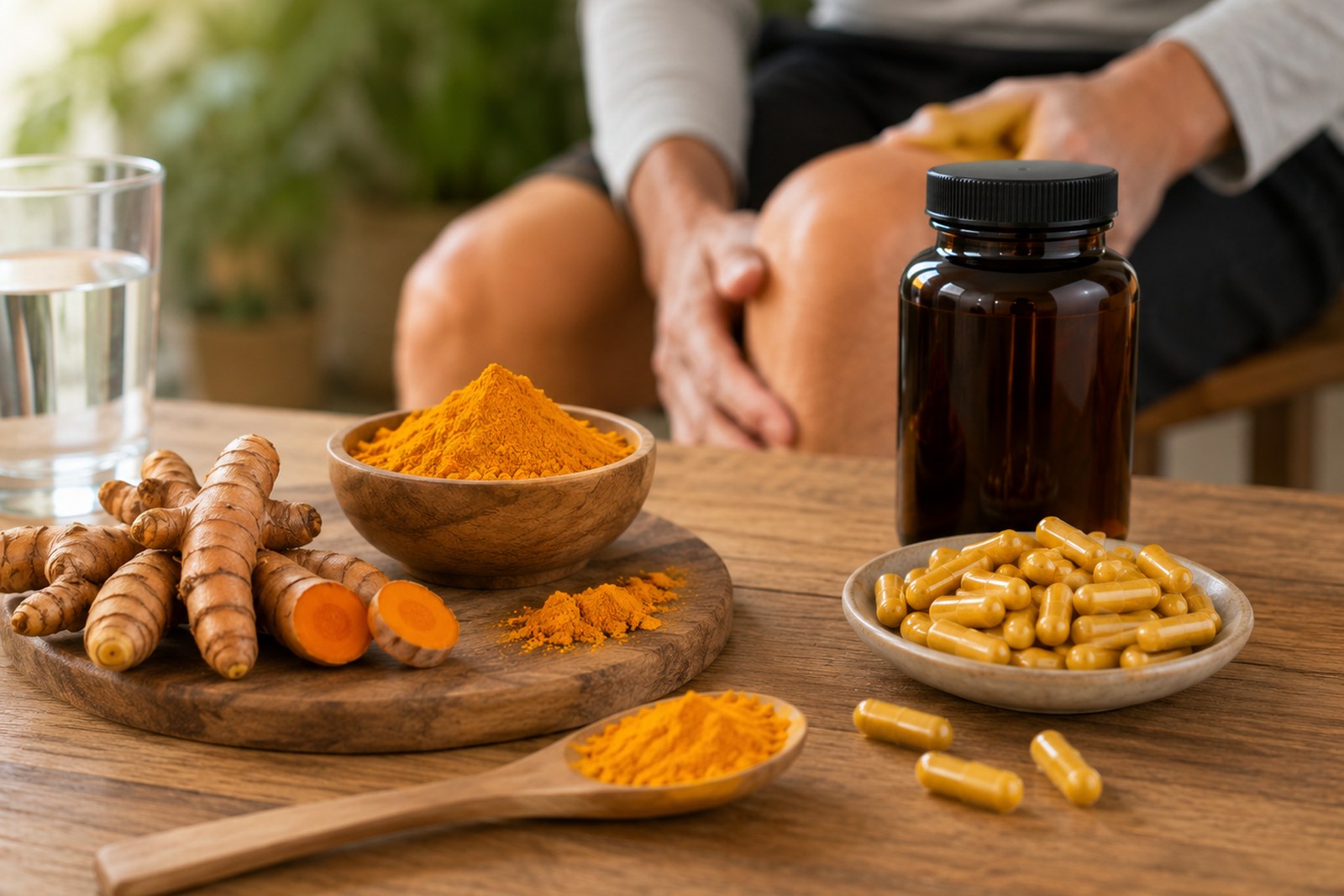
Turmeric is the ground rhizome of Curcuma longa. It contains starches, oils, fiber, and a small percentage of curcuminoids. Curcumin is the best-known curcuminoid, but commercial extracts may contain curcumin, demethoxycurcumin, bisdemethoxycurcumin, or a standardized total curcuminoid percentage. Labels may use “turmeric,” “turmeric extract,” and “curcumin” loosely, even though the dose delivered can differ by an order of magnitude.
Culinary turmeric is valuable as food and may contribute to a healthy dietary pattern, but it is not equivalent to the concentrated extracts used in most randomized trials. Plain curcumin is also absorbed poorly. It dissolves badly in water, is rapidly metabolized, and does not remain in the bloodstream for long. Manufacturers therefore use piperine from black pepper, phospholipid complexes, nanoparticles, micelles, oils, or other systems to increase exposure.
Increased absorption changes both potential benefit and potential risk. A highly bioavailable 250 mg product cannot be assumed weaker than a conventional 1,000 mg product. This is why articles that announce one universal dose of turmeric are unreliable. The formulation is part of the dose.
Turmeric Powder vs. Curcumin Extract vs. Enhanced Formulas
| Form | What the label usually means | Absorption | How it relates to research | Main caution |
|---|---|---|---|---|
| Culinary turmeric powder | Whole ground spice with a low natural curcuminoid percentage | Low and variable | Not directly interchangeable with concentrated trial extracts | Large spoonfuls can upset digestion without matching a studied dose |
| Standardized turmeric extract | Extract standardized to a stated percentage of curcuminoids | Usually limited unless paired with a delivery system | Many older knee osteoarthritis trials used this category | The extract amount and actual curcuminoid amount may be different |
| Curcumin with piperine | Curcuminoids plus black-pepper extract to reduce metabolism | Higher than plain curcumin | Some products have clinical data; the exact ratio matters | Piperine may change how medicines are processed |
| Phospholipid, micellar, or nanoparticle curcumin | A branded or specialized delivery system | Often substantially enhanced | Evidence applies most directly to the studied formulation | Higher absorption can make dose comparisons misleading |
| Turmeric and ginger blend | Multiple herbs, sometimes with boswellia or glucosamine | Depends on every ingredient | Cannot borrow evidence from single-ingredient curcumin automatically | Interactions and side effects are harder to trace |
What the Knee Osteoarthritis Research Shows
Several systematic reviews have found that turmeric or curcumin extracts improve pain and physical function compared with placebo in adults with knee osteoarthritis. A 2021 meta-analysis of ten randomized trials involving 783 participants found better pain relief and function with Curcuma longa extracts than placebo. Another review of sixteen trials and 1,810 adults found reductions in pain and improvements in function, while emphasizing high heterogeneity and moderate risk of bias.
More recent evidence remains encouraging but cautious. A 2025 network meta-analysis included seventeen randomized trials and found that several turmeric preparation categories reduced WOMAC pain compared with placebo. The authors judged the certainty of evidence low and noted that bioavailability-enhanced preparations reached a clinically important threshold in one analysis. That result supports taking the category seriously, but it does not identify one universally best supplement.
Short studies comparing curcumin products with nonsteroidal anti-inflammatory drugs have sometimes reported similar symptom scores and fewer gastrointestinal events. These comparisons are frequently overinterpreted. A small, short trial showing no statistical difference does not prove that a supplement is pharmacologically equal to ibuprofen, naproxen, or diclofenac across doses, conditions, and patients. It also does not establish cardiovascular, kidney, or long-term safety superiority.
Importantly, trials generally measure pain scales and function questionnaires. They do not show that turmeric rebuilds cartilage. Imaging and biochemical outcomes have not consistently demonstrated structural change. The realistic promise is possible symptom reduction, not reversal of osteoarthritis.
How Much Turmeric or Curcumin Is Used in Studies?
Searchers often ask “how much turmeric for knee pain,” but the honest answer must begin with the formulation. Trials have used a wide range: conventional curcuminoid extracts totaling several hundred milligrams to around 1,500 mg per day, highly bioavailable preparations at lower nominal doses, and branded turmeric matrices that cannot be reproduced by weighing kitchen spice.
Read the Supplement Facts panel in two steps. First, identify the total extract amount. Second, identify how much is standardized curcuminoids. A capsule may contain 1,000 mg of turmeric root but only a small curcuminoid amount. Another may contain 500 mg of an extract standardized to 95 percent curcuminoids. A third may deliver 250 mg in a phospholipid complex with substantially greater exposure. Those are not equivalent products.
Do not increase the dose simply because a product feels slow. Most useful trials last at least four weeks, and many run eight to sixteen weeks. More supplement may create more digestive upset or interaction risk without improving the outcome. If the exact product has human trial data, use the studied label dose rather than translating from an unrelated extract.
How Long Should a Fair Turmeric Trial Last?
Give a tolerated product six to eight weeks before making an early judgment and no more than eight to twelve weeks before demanding a meaningful answer. Record a baseline first. Useful measures include morning stiffness in minutes, discomfort on the same staircase, distance before pain begins, or a consistent sit-to-stand test.
Test turmeric alone rather than starting collagen, glucosamine, a brace, and a new exercise plan in the same week. The deep guide to glucosamine and chondroitin uses the same one-variable principle. If you also want to compare collagen, review the differences in collagen peptides and type II collagen and test the products sequentially.
Normal symptom fluctuation can easily look like a supplement effect. Knees often feel better during a lower-load week and worse after travel, poor sleep, or an abrupt activity increase. Keeping a stable daily knee care routine makes the comparison more honest.
Turmeric With Black Pepper: Better Absorption, More Questions
Piperine can raise curcumin exposure by slowing metabolism and increasing intestinal absorption. That is why “turmeric with black pepper” appears on so many labels. The marketing implication is that piperine is always necessary and always beneficial. Neither statement is true.
Many modern preparations use non-piperine delivery systems. More importantly, piperine can affect drug-metabolizing enzymes and transporters. The clinical significance varies by medication and dose, but a person taking medicines with a narrow therapeutic range should not assume a black-pepper extract is harmless because it comes from food. Ask a pharmacist to check the exact product.
Adding ordinary pepper to a turmeric-containing meal is different from taking a concentrated piperine extract. Food use is generally much lower exposure. Do not create a homemade high-dose mixture to imitate a commercial absorption system.
Safety, Side Effects, and Rare Liver Injury
Common side effects include nausea, reflux, abdominal discomfort, diarrhea, or headache. Turmeric may stimulate the gallbladder and is not a casual choice for someone with gallstones, bile-duct obstruction, or significant biliary disease. Concentrated supplements may also influence platelet function and bleeding risk, which matters before surgery and when combined with anticoagulants or antiplatelet medicines.
Turmeric and curcumin have also been linked to a small but real number of clinically apparent liver injuries. LiverTox notes that cases have increased as highly bioavailable products became more common. The absolute risk appears low, but it is not zero. Stop the product and seek medical evaluation for yellow skin or eyes, dark urine, pale stool, severe fatigue, persistent nausea, right-upper-abdominal pain, or widespread itching.
A natural label does not guarantee purity. Supplement manufacturers do not have to prove effectiveness before sale in the same way medicine manufacturers do, and contamination or inaccurate dosing can occur. Choose a company with batch testing and avoid products that promise rapid cartilage regeneration.
Turmeric Interactions Worth Checking
| Situation | Why caution is sensible | Practical step |
|---|---|---|
| Warfarin, apixaban, rivaroxaban, clopidogrel, or regular aspirin | Possible additive effects on bleeding or drug exposure | Ask the prescriber or pharmacist before starting |
| Upcoming surgery or dental procedure | Bleeding and anesthesia-related supplement concerns | Tell the surgical team early; follow their stop-date advice |
| Gallstones or bile-duct disease | Turmeric may aggravate biliary symptoms | Do not self-treat without medical advice |
| Previous liver disease or supplement-related hepatitis | Rare turmeric-associated liver injury has been reported | Discuss alternatives and monitoring with a clinician |
| Diabetes medication | Possible additive glucose-lowering effects in some people | Monitor as directed and review symptoms of low blood sugar |
| Multiple supplements in one blend | Interactions and adverse effects become difficult to identify | Prefer a single-ingredient trial |
How to Choose a Turmeric Supplement
A useful label identifies the botanical, extract amount, curcuminoid standardization, delivery system, piperine amount if present, daily serving, and other active ingredients. It should be possible to calculate what you take each day. A blend that lists turmeric, ginger, boswellia, pepper, collagen, and glucosamine under one combined milligram number cannot be evaluated.
Look for independent quality testing and lot traceability. Ignore star ratings as evidence of clinical effectiveness; reviews are influenced by taste, packaging, expectations, and natural symptom variation. Be especially cautious with “doctor-formulated” claims that do not identify the doctor or the human evidence for the exact product.
Price comparisons should use cost per researched daily serving, not cost per capsule. A cheap product that requires six capsules may cost more than a concentrated formula. Conversely, an expensive enhanced product is not automatically better; it should have credible human evidence that justifies its formulation.
Where Turmeric Fits in a Real Knee Plan
Turmeric may reduce symptoms enough to make movement easier. That is valuable only if the improved comfort supports the interventions that protect function. The strongest long-term work usually comes from progressive strengthening, described in how to strengthen knees, and tolerable aerobic activity. When walking repeatedly provokes symptoms, compare options in walking versus cycling versus swimming rather than stopping all cardio.
The pain pattern also matters. Front-of-knee symptoms with stairs may reflect patellofemoral loading; the guide to pain behind the kneecap explains that mechanism, while knee pain going down stairs focuses on the high-load lowering phase. Pain that appears only after training may be better addressed through workload and recovery, as covered in knee pain after exercise.
Heat and cold can still be used according to the symptom pattern. The heat versus ice decision guide separates stiffness from recent swelling, and the home remedies for knee pain guide shows which low-risk habits are worth keeping. Turmeric does not make either strategy unnecessary, and it should not be used to push through sharp pain, locking, or instability.
Which Knee Pain Patterns Are Most Likely to Match the Evidence?
Nearly all of the useful clinical evidence concerns adults with knee osteoarthritis, not every condition that produces knee pain. That boundary matters. Curcumin trials do not establish benefit for a torn ligament, an acutely injured meniscus, a bacterial joint infection, a stress fracture, a fresh tendon injury, or a blood clot. A supplement cannot compensate for a diagnosis that needs protection, rehabilitation, antibiotics, anticoagulation, or surgery.
A reasonable research-matched candidate has a stable osteoarthritis pattern: recurring load-related pain, stiffness after rest, reduced comfort on stairs, and symptoms that fluctuate without a new traumatic event. Even here, turmeric is an adjunct. If a knee repeatedly locks, gives way, becomes dramatically swollen, or cannot bear weight, symptom suppression should not be the first goal. Those features change the diagnostic priority.
Inflammatory arthritis creates another distinction. Rheumatoid arthritis may respond symptomatically to many anti-inflammatory strategies, but turmeric has not been shown to replace disease-modifying antirheumatic drugs. A person with prolonged morning stiffness, symmetrical hand or foot swelling, fatigue, or an established autoimmune diagnosis should use the comparison of knee osteoarthritis versus rheumatoid arthritis and discuss supplements with the treating rheumatology team.
The same caution applies when pain is generated mainly by movement mechanics. If a low saddle is compressing the kneecap thousands of times during a ride, the useful intervention is found in the cycling knee pain and bike-fit guide, not in increasing curcumin. Supplements can change symptom perception; they cannot correct a repeated setup error.
A Practical Eight-Week Curcumin Test
- Choose one product: Prefer a single, clearly standardized formulation with a traceable daily dose.
- Check safety: Review medication, gallbladder, liver, surgery, pregnancy, and allergy issues.
- Record baseline: Measure morning stiffness, one staircase, and one repeatable walking task for seven days.
- Use consistently: Follow the label or clinician-recommended dose without adding extra piperine or another joint supplement.
- Review at four weeks: Continue only if tolerated; do not expect structural change.
- Decide at eight to twelve weeks: Keep it only if the improvement is noticeable, repeatable, and worth the cost.
A successful trial can end with either answer. A clear improvement supports continued use with periodic reassessment. No improvement supports stopping. Indefinite use without a measurable result is not evidence-based persistence; it is subscription inertia.
The Bottom Line
Turmeric and curcumin extracts have enough randomized evidence to be considered a reasonable optional trial for knee osteoarthritis symptoms. The average benefit is modest, the studies are short, and formulations differ too much for a universal dose. A standardized extract is not the same as kitchen spice, and an enhanced-absorption formula is not directly comparable with plain curcumin by milligrams alone.
Choose a transparent product, check interactions, track one or two real activities, and demand a meaningful result within eight to twelve weeks. Stop for signs of liver injury, unusual bleeding, or significant side effects. Most importantly, use any symptom improvement to support movement, strength, and daily function rather than treating a capsule as a replacement for the parts of knee care with the strongest evidence.
Frequently Asked Questions
Does turmeric actually help knee pain?
Randomized trials and several meta-analyses suggest that standardized turmeric or curcumin extracts can modestly reduce pain and improve function in some people with knee osteoarthritis. The certainty is limited by short studies, different formulations, and substantial variation between trials. Turmeric is best treated as an optional symptom tool, not as a cure or cartilage-rebuilding treatment.
How much turmeric should I take for knee pain?
There is no single dose because products contain different amounts of curcuminoids and use different absorption technologies. Trials often use several hundred milligrams to roughly 1,500 milligrams of curcuminoids or standardized extract per day, usually divided, but copying a dose without matching the exact formulation can be misleading. Follow the tested product instructions and review the dose with a pharmacist if you take medication.
Is turmeric powder the same as curcumin capsules?
No. Culinary turmeric contains only a fraction of curcuminoids and is poorly absorbed. A standardized curcumin extract concentrates those compounds, while enhanced formulations may add piperine, phospholipids, micelles, or other delivery systems. A teaspoon of spice cannot be converted reliably into the dose used in a supplement trial.
How long does turmeric take to work for knee pain?
Most knee osteoarthritis studies last four to sixteen weeks. A fair personal trial usually needs at least six to eight weeks of consistent use, provided the product is tolerated. Track the same activity, such as stairs or a fixed walk, and stop if no meaningful improvement appears by eight to twelve weeks.
Should turmeric be taken with black pepper?
Piperine from black pepper can increase curcumin absorption, but that is not automatically better for everyone. It may also affect drug metabolism and increase exposure to some medicines. Many products use other absorption systems. Choose a formulation with human evidence rather than adding large amounts of black pepper on your own.
Can turmeric replace ibuprofen or diclofenac?
Some short trials found symptom improvements similar to nonsteroidal anti-inflammatory drugs, but they were not designed to prove that turmeric is an equal substitute for every patient. Do not stop prescribed or recommended medication without speaking to a clinician, especially when inflammation, swelling, or another diagnosis has not been assessed.
Who should not take turmeric supplements?
People using anticoagulants or antiplatelet medicines, those with gallbladder or bile-duct disease, people preparing for surgery, pregnant people, and anyone with previous supplement-related liver injury should get individual advice first. Stop and seek care for jaundice, dark urine, severe itching, persistent nausea, unusual bleeding, or a rash.
Is turmeric and ginger better than turmeric alone?
The combination is popular, but evidence for a specific turmeric-and-ginger blend is much less consistent than evidence for standardized curcumin preparations. Ginger can also affect bleeding risk and digestion. A multi-ingredient product makes it harder to identify the effective ingredient or the cause of side effects.